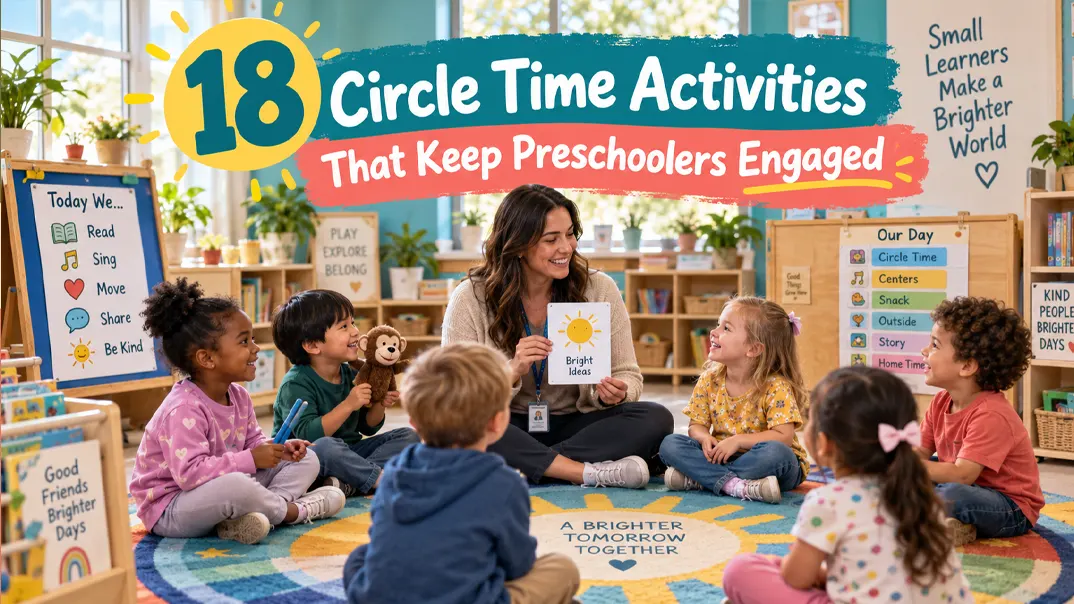
Good circle time activities give every child a way to participate without requiring the whole group to sit and listen for too long. The most useful routines alternate talking, looking, handling materials and moving. This guide gives you 18 practical preschool activities, explains what each one supports, and shows how to prepare the space so group time is easier to manage.
What Should Circle Time Accomplish?
Circle time should have one clear purpose: help the group connect, communicate, investigate an idea or practice a shared routine. It is not the best format for every lesson. If an activity needs every child to manipulate materials, answer several questions or receive individual feedback, move it to a small group or learning center instead.
NAEYC’s guidance on developmentally appropriate teaching recommends limiting large-group periods to suit the children’s attention and balancing attentive activities with active movement. Participation also needs flexibility for individual children. This means the quality of a circle is more important than reaching a fixed duration.
Choose activities by the result you want, not by how many songs or calendar cards fit into the schedule. A simple planning mix is:
| Purpose | Good activity types | Useful materials |
|---|---|---|
| Build belonging | Greetings, name games, shared routines | Name cards, class photos, greeting choices |
| Develop language | Story retelling, rhyming, picture discussion | Books, puppets, story props, picture cards |
| Explore math and science | Counting, patterns, sorting, daily observation | Loose parts, shape cards, natural objects |
| Practice self-regulation | Feelings check-ins, stop-and-go games, breathing | Emotion cards, scarves, rhythm instruments |
18 Circle Time Activities for Preschool
1. Personalized Hello Song
Sing the same short greeting tune while replacing one word with each child’s name. Invite the child to choose a wave, clap, tap or gesture for the group to copy. The repeated structure helps children anticipate their turn while the individual choice prevents the routine from feeling mechanical.
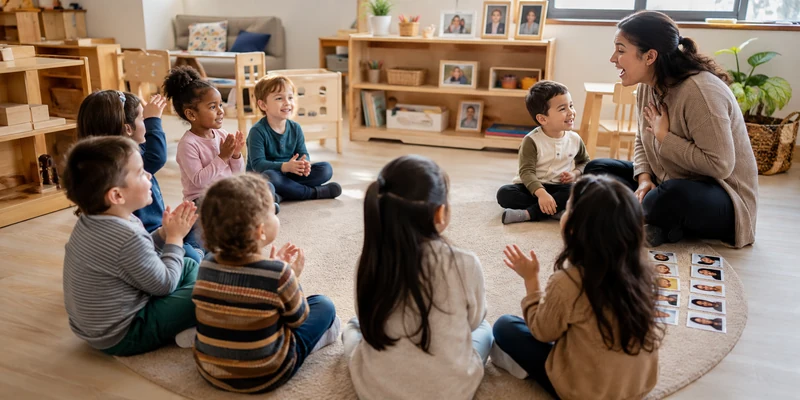
Display photo or name cards in the order you will use them so children can see that everyone will be included. A child who does not want to perform can hold up a greeting card or ask the teacher to choose. This keeps participation available without making public performance compulsory.
2. Name-and-Movement Greeting
One child says their name and demonstrates a simple movement, such as touching shoulders or making two gentle jumps. The group repeats the name and movement. Limit the choices to movements that fit safely inside each child’s marked space, especially when the group is large.
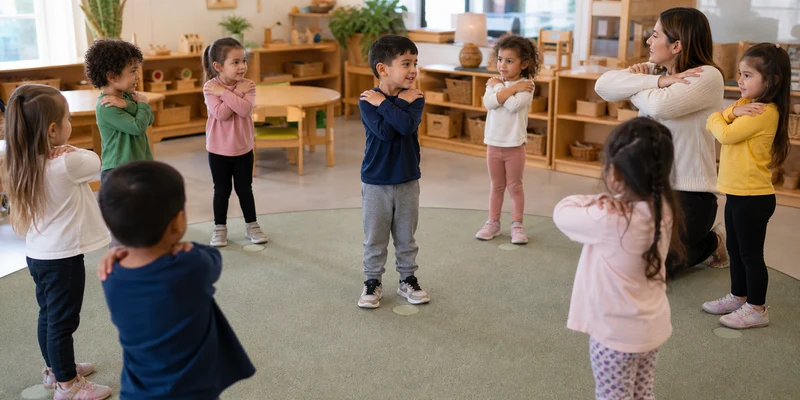
You do not need to include every child in one round. Select four or five leaders today and continue tomorrow. That keeps the activity short while giving children a real turn rather than rushing through names.
3. Roll-and-Greet Ball Game
Sit with enough open floor between children to roll a soft ball. The sender names another child, makes eye contact if comfortable, and rolls the ball across the circle. The receiver greets the sender before choosing the next person.
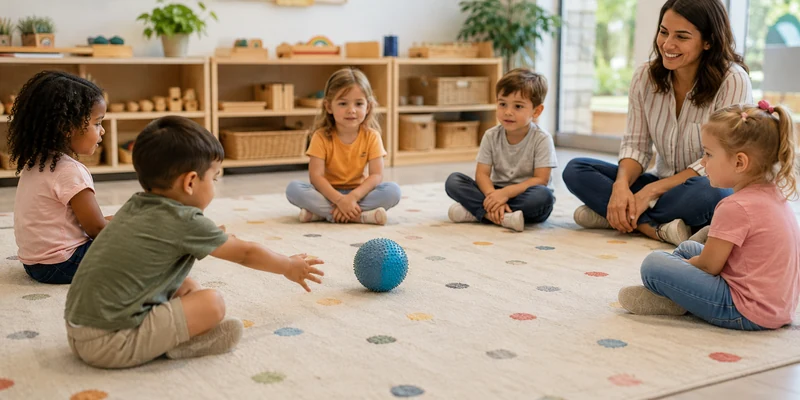
This routine practices names, turn-taking and controlled movement. For children who need communication support, offer photo cards to select the next receiver. Use a slow-rolling textured ball if tracking or catching is difficult.
4. Mystery Bag Guessing
Place one familiar classroom object in an opaque fabric bag. Let a child feel the object without looking and describe one property: hard, soft, round, long or bumpy. The group can ask questions or make one guess before the object is revealed.
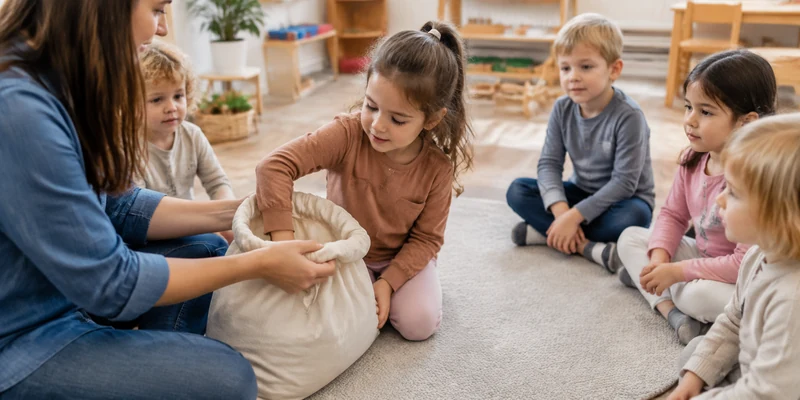
Select objects connected to the day’s investigation so the activity introduces useful vocabulary. Avoid tiny pieces in a whole-group setting, and inspect the bag before every use. Children who prefer not to reach inside can listen to clues and choose from two picture options.
5. Story Prop Retelling
After reading a familiar picture book, place three to five large story props in the center. Invite children to put the props in sequence and explain what happened first, next and last. Use only the events needed to understand the story rather than recreating every page.
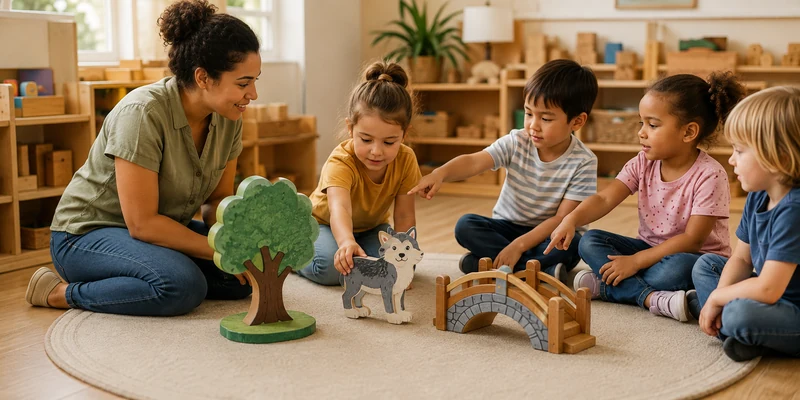
Give children different ways to respond: move a prop, point to the next picture, repeat a key phrase or add a sound effect. Store each book’s props together in a labeled pouch so teachers can prepare the activity quickly.
6. Puppet Problem-Solving
Use two puppets to act out a short classroom problem, such as both characters wanting the same block. Stop before the solution and ask children what the puppets could say or do. Try one or two suggestions and compare the results.
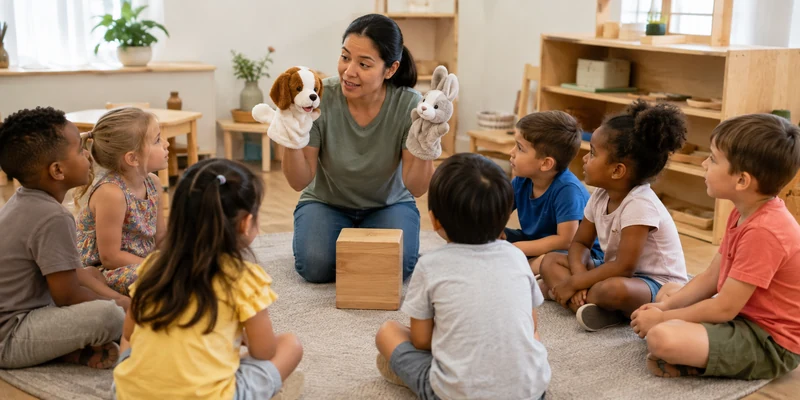
Keep the scenario neutral and fictional rather than recreating a recent conflict between named children. The puppet creates useful distance, allowing the group to examine choices without embarrassing anyone.
7. Picture Talk
Show one large, uncluttered photograph related to the current topic. Begin with an observation prompt: “What do you notice?” Follow with “What makes you think that?” Record two or three ideas on a board using simple words or sketches.
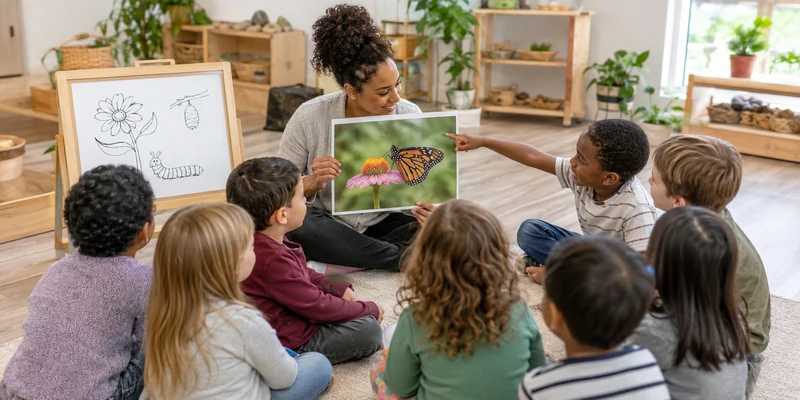
A real photograph often supports more precise language than a busy poster. Give children a quiet observation period before requesting answers, and let them point to details if they are not ready to speak in front of the group.
8. Rhyming Basket
Prepare a small basket with pairs of familiar objects or picture cards whose names rhyme, such as cat and hat. Reveal one item, say its name clearly, and ask children to listen for its partner. Place each matched pair together where everyone can see it.
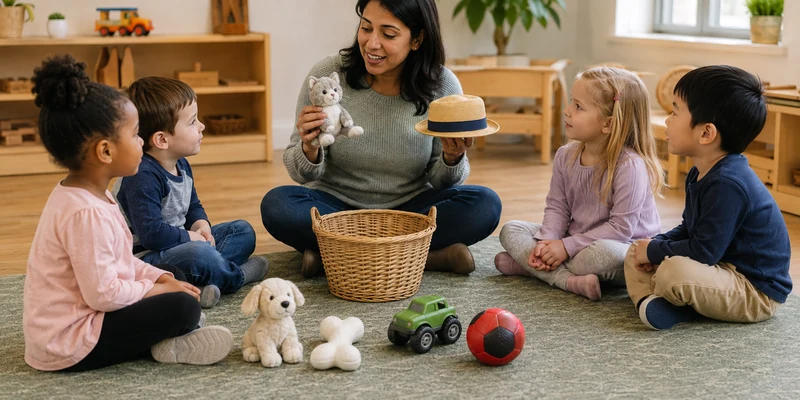
Start with two possible matches rather than spreading many cards across the floor. For dual-language learners, preview the object names with pictures and gestures; the task should test sound awareness, not whether a child already knows every English noun.
9. Beginning-Sound Hunt
Choose one sound that appears in several familiar classroom objects. Show a sound card, model the sound, and invite children to scan the circle area for an object whose name starts the same way. Bring only one or two examples into the center.
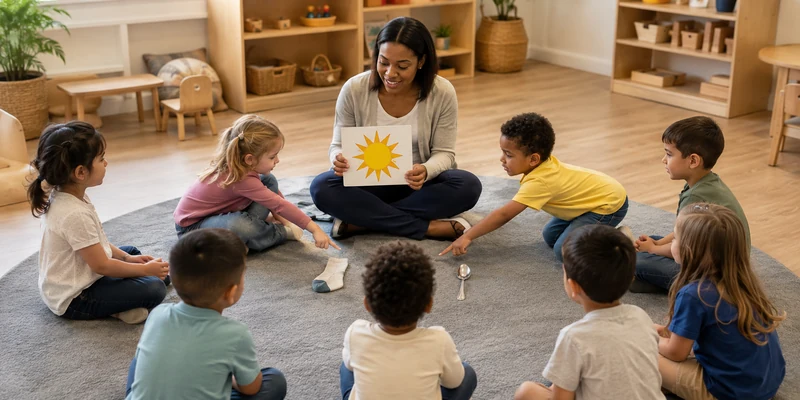
Keep the search within visible boundaries so children do not scatter around the room. If the sound is difficult, contrast two picture cards and say both words slowly. Treat children’s approximations as information for future small-group practice.
10. Count-and-Pass
Give the first child a basket containing a small set of large counters. The child takes one, passes the basket and says the next number with the group. At the end, place the objects in a line and count again to check whether the spoken sequence matches the quantity.
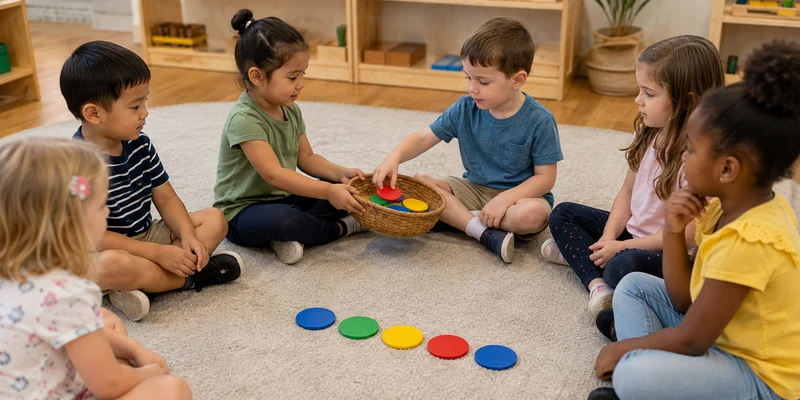
Match the number of objects to what your group can count meaningfully. For a larger class, run the activity with half the circle while the other half keeps the beat, then switch roles another day. Use pieces too large to present a choking hazard for the children in your program.
11. Copy-and-Extend a Pattern
Make a short sound-and-motion pattern, such as clap, clap, tap. Children copy it once, and then the group predicts what comes next. Invite a child to create a new two-part pattern when the group is ready.
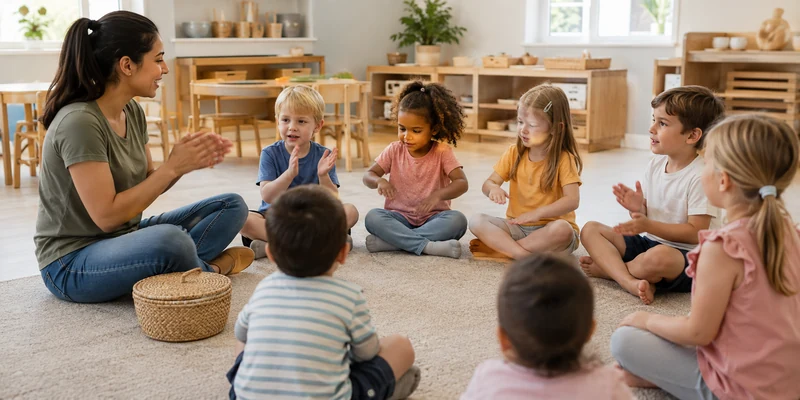
Begin with body percussion because it requires no distribution or cleanup. Add rhythm sticks or shakers only after children know how to stop, start and place instruments on the floor. Harvard’s executive-function activities guide notes that songs and movement games can challenge attention, working memory and self-control.
12. Shape Clue Game
Hold a large shape card behind a board and reveal one section at a time. Children describe the visible edges, corners or curves and revise their guesses as more appears. After revealing it, look for one object in the room with a related shape.
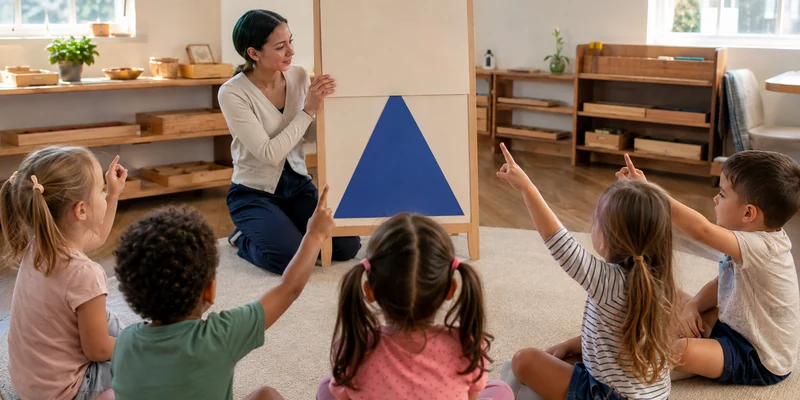
The value comes from explaining observations, not naming the shape as quickly as possible. Accept words, gestures and tracing motions in the air. Avoid showing too many shapes in one session.
13. Daily Weather Evidence
Ask one child to look through a nearby window or bring a simple observation from outdoors. Instead of only selecting a weather icon, ask for evidence: moving branches, puddles, bright light, dark clouds or clothing people are wearing.
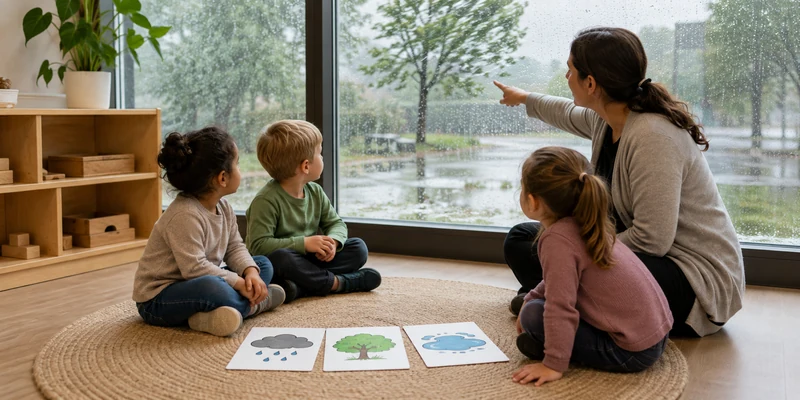
Record only one useful observation and compare it with a previous day when appropriate. A calendar or weather board earns its place when children use it to think and communicate; reciting every label daily can turn it into a passive routine.
14. Feelings Check-In With Choices
Display a small set of clear emotion cards. Children may point to a card, hold up a matching face, show a gesture or pass. The teacher acknowledges the response without asking the child to explain personal details in front of the group.
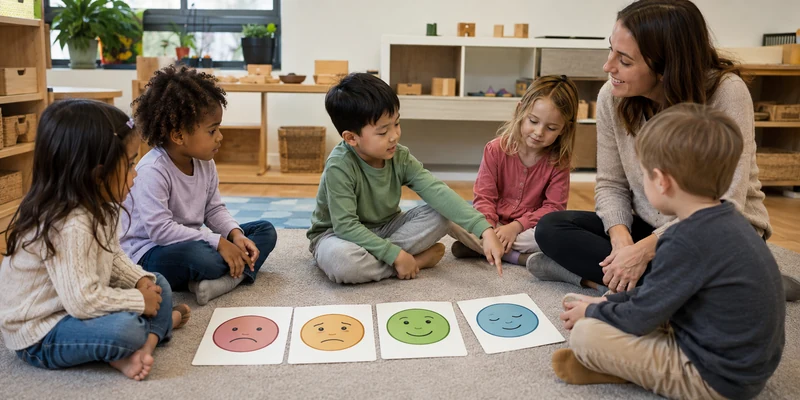
Use the information to adjust the day, not to label a child. If several children indicate high energy, follow with movement. If a child signals distress, arrange a private check-in after the circle rather than turning the group activity into counseling.
15. Kindness Scenario Cards
Show a simple illustrated situation: a child drops materials, someone is waiting for a turn, or a new classmate is standing nearby. Ask, “What could a friend do?” Choose one response to demonstrate with two volunteers or puppets.
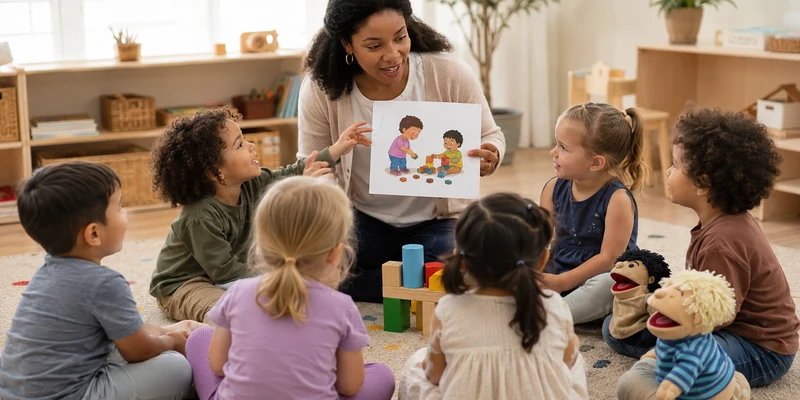
Use situations children can act on during the school day. Avoid questions with one scripted “good” answer; compare several safe, respectful options. Return to the idea later when you notice it happening naturally.
16. Freeze Dance With Visual Cues
Play a short section of music while children move in their own spaces. When the music stops, hold up a pose card for everyone to copy. Restart with a new movement quality such as slow, small or stretching tall.
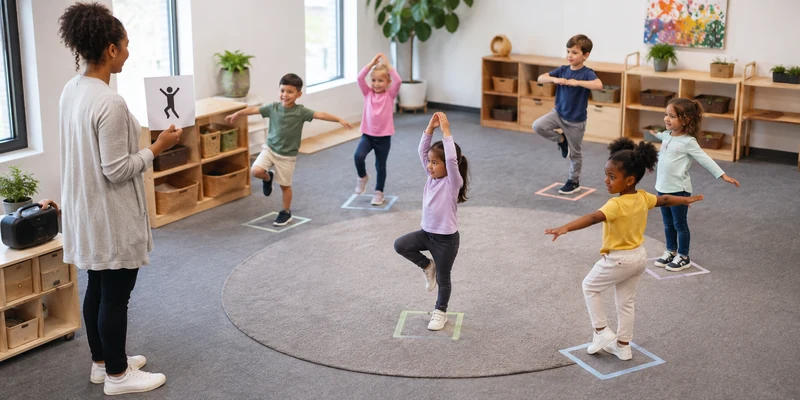
Mark enough space between children and remove baskets, chairs or loose materials before starting. A child who does not want to dance can control the music with an adult or choose the next pose card. Head Start’s music guidance also emphasizes planning music activities intentionally and using them responsively with children.
17. Animal Movement Guessing
Show one child an animal card and let them demonstrate a controlled movement or sound while the group guesses. Choose animals whose actions can be performed safely in place: stretching like a cat, standing like a flamingo or opening arms like a bird.
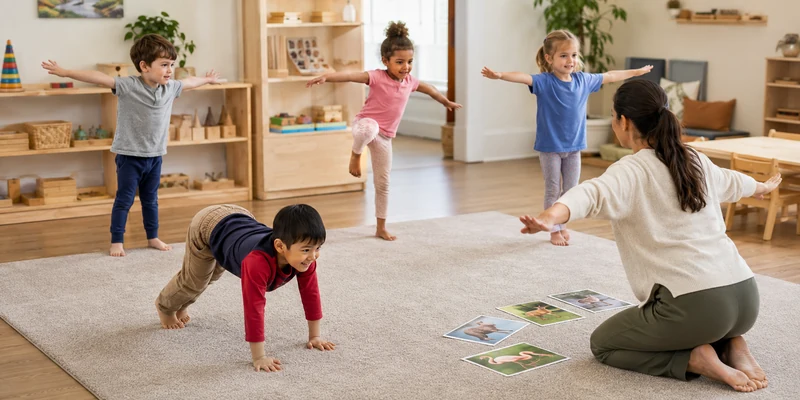
Connect the game to a book, habitat investigation or new vocabulary. If children become overexcited, reduce the group response to a hand gesture and move the full-body version outdoors.
18. Breathing and Goodbye Routine
End with one predictable action: smell an imaginary flower and slowly blow out a candle, trace one finger up and down the other hand, or raise and lower a scarf with the breath. Then state exactly where children will go next.
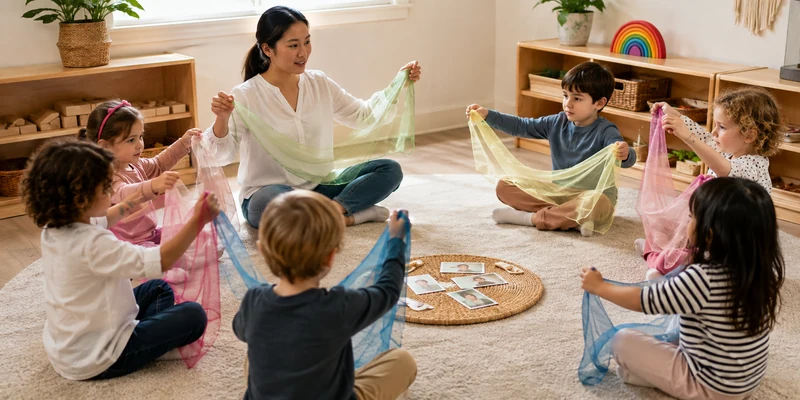
The transition cue matters as much as the breathing. Release children by a visible grouping system, such as name cards or rug rows, rather than asking everyone to move at once. Keep the routine calm and brief; children should not be required to close their eyes.
How to Build a Circle Time Routine That Stays Engaging
A workable routine changes mode before children have to struggle to stay involved. You can begin with connection, add one focused idea, include active participation and end with a clear transition. For example:
- Hello song with two greeting choices
- One picture, story prop or observation linked to the day’s topic
- A pattern, counting or language game
- A brief movement response
- A goodbye cue that sends children to the next area in small groups
You do not need all five parts every day. Watch the group and stop while participation is still productive. If a discussion becomes rich for four children but the rest disengage, continue it later as a small group. NAEYC’s discussion of circle time and small groups explains why smaller groups can create better opportunities for differentiated learning and open-ended conversation.
Set Up the Circle Area for Real Classroom Use
The circle area should give children a visible boundary without blocking normal classroom circulation. A rug can define the group zone, but doors, main walking routes and access to learning centers must remain clear. Position the teacher where all children can see props without facing distracting traffic behind the teacher.
Store the day’s book, cards, puppet and instrument basket within the teacher’s reach. Keep extra materials in nearby classroom storage cabinets instead of surrounding the rug with several open bins. Distributing materials one at a time prevents waiting and reduces the temptation to handle items before instructions begin.
Not every child needs the same sitting position. A marked carpet space, floor cushion, stable chair or supported position at the edge of the group may all allow meaningful participation. Review these flexible seating choices when the classroom needs alternatives to one fixed posture.
If you are arranging the entire room, plan circle time together with quiet, active and material-based areas rather than treating the rug as an isolated feature. This guide to setting up classroom learning centers explains how zoning, storage and furniture placement work together.
What to Change When Circle Time Is Not Working
Children Leave the Group
First shorten the waiting and listening portions. Put every prop in order before the group arrives, let children respond through actions or objects, and remove repeated routines that no longer require thinking. A child who observes from a nearby defined place may still be participating.
The Group Is Too Large for Materials
Do not pass one small object through a large circle while everyone waits. Demonstrate it to the whole group, then place duplicates in a small-group activity or center. Whole-group time is useful for a shared introduction; hands-on investigation often works better afterward.
The Same Children Answer Every Question
Replace rapid verbal questions with response modes that include everyone: point to one of two pictures, copy a movement, hold up a matching card or briefly tell a partner. Wait before calling on speakers, and do not turn every response into a right-or-wrong test.
Children Have Different Language or Sensory Needs
Use photographs, objects, gestures and predictable repeated phrases alongside spoken language. Offer a position at the edge of the circle, lower-volume instruments and a way to pass. Developmentally appropriate participation can look different from child to child.
FAQs
How long should preschool circle time last?
There is no useful universal target. Keep it short enough for the age, needs and current engagement of your group. End or change the format when most children are no longer participating productively rather than extending the session to meet a planned number of minutes.
Should every child be required to sit in the circle?
Children need clear, safe boundaries, but meaningful participation does not require one posture. Some may sit on the rug, use a stable chair, stand at the edge or observe before joining. Follow your program’s supervision policies and any individual support plans.
Does calendar time need to happen every day?
No. Use a calendar when it connects to something children can understand and act on, such as anticipating a class event or comparing days. Repeating long date routines without a meaningful purpose can replace more active language, movement or inquiry.
How often should circle time activities change?
Keep predictable opening and closing cues, then rotate the central activity according to children’s interests and curriculum goals. Familiar games can become more challenging by changing the pictures, movement rule or story material instead of introducing a completely new routine each day.
What materials are worth buying for circle time?
Start with versatile materials: a clear group rug, a small mobile storage unit, durable picture cards, puppets, large counters, scarves and a limited set of rhythm instruments. Choose quantities and product specifications based on group size, child age, cleaning needs and local requirements.
Plan Group Time Around Participation
The best activity is the one that gives your current group a clear reason to look, speak, think or move together. Keep the purpose narrow, prepare materials before children arrive, and move deeper discussion or hands-on work into smaller groups when needed.
If you are planning a preschool or daycare classroom, West Shore can help coordinate the circle area with learning zones, child-sized furniture and storage. Send your room dimensions, floor plan, child capacity and daily-use requirements for classroom design and layout support before you finalize a furniture order.