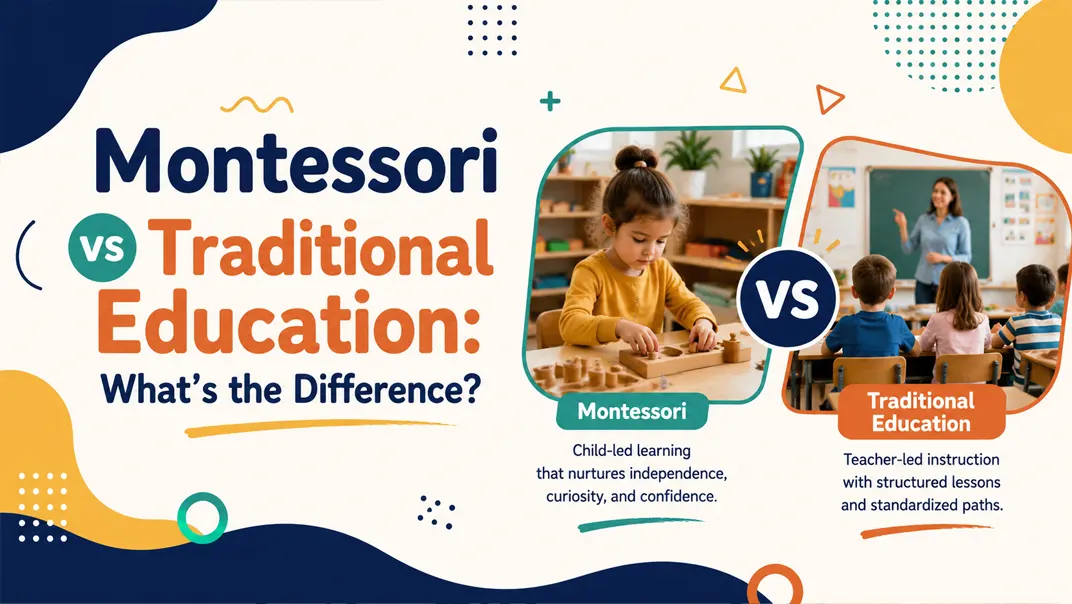
Choosing between Montessori vs traditional preschool is not always a simple decision. For parents, it often means choosing the type of environment where their child will spend many hours each day. For preschool owners or daycare operators, it can also affect classroom design, furniture selection, daily routines, and even the way the school presents itself to families.
When comparing Montessori education with traditional preschool, one should not consider merely the theoretical level; rather, it is also essential to examine the actual classroom experience—including how children engage in activities, the methods teachers use to provide guidance, the layout and arrangement of the classroom, and the types of furniture that facilitate daily learning.
That is why comparing Montessori and traditional preschool should not only focus on theory. It should also look at the real classroom experience, including how children move, how teachers guide them, how the room is arranged, and what type of furniture supports daily learning.
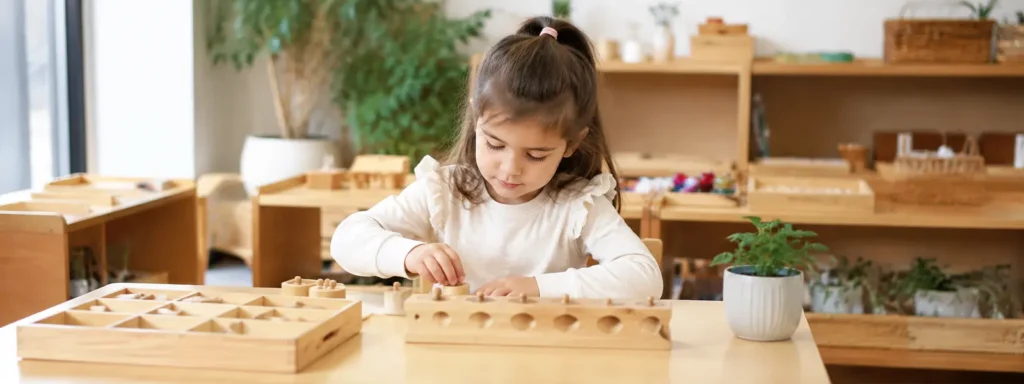
What Is Montessori Education?
Montessori education is a child-centered learning approach that encourages independence, hands-on exploration, and self-paced development. Instead of relying mainly on teacher-led lessons, Montessori classrooms are designed to let children learn through carefully prepared activities and materials.
Key Features of Montessori Education
| Feature | What It Means |
|---|---|
| Child-led learning | Children choose activities based on interest and readiness. |
| Prepared environment | The classroom is carefully arranged to support independence. |
| Hands-on materials | Children learn by touching, moving, sorting, building, and practicing. |
| Self-paced progress | Children can spend more time on activities they need or enjoy. |
| Teacher as guide | The teacher observes, supports, and introduces materials when needed. |
| Mixed-age grouping | Younger and older children often learn in the same classroom. |
| Independent work habits | Children practice choosing, focusing, completing, and cleaning up tasks. |
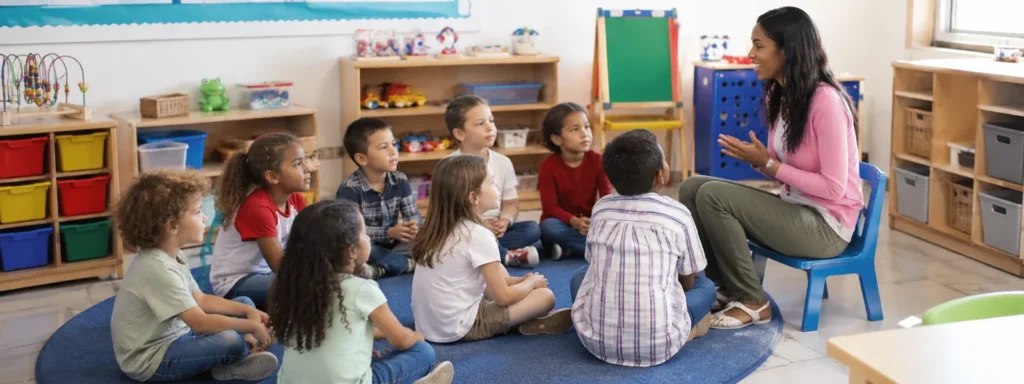
What Is Traditional Preschool?
Traditional preschool is usually a more teacher-led early learning model. Children often follow a planned daily schedule, and the teacher organizes group activities, classroom routines, lessons, playtime, art, music, story time, and outdoor activities.
Key Features of Traditional Preschool
| Feature | What It Means |
|---|---|
| Teacher-led instruction | The teacher plans and guides most learning activities. |
| Structured schedule | Children follow a daily routine with planned time blocks. |
| Group learning | Many activities happen as a whole class or in small groups. |
| Same-age classrooms | Children are usually grouped by age level. |
| Themed activities | Lessons may follow weekly or monthly themes. |
| Shared materials | Toys and learning resources are often used by groups. |
| Strong routine building | Children practice transitions, listening, and classroom rules. |
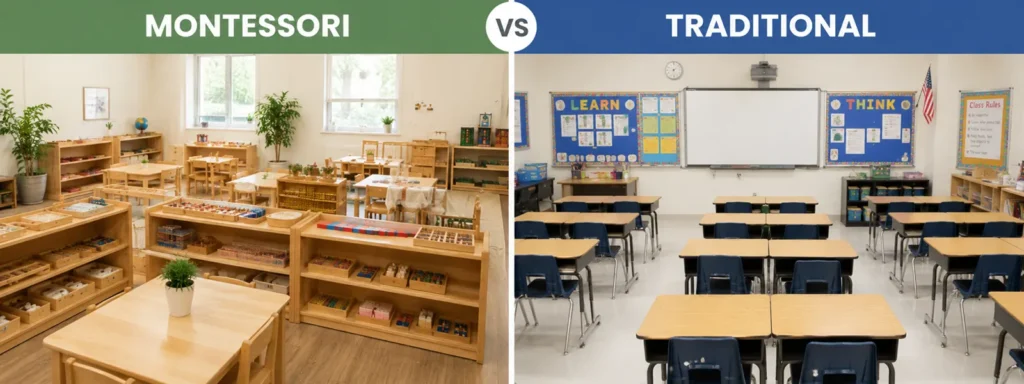
Montessori vs Traditional: Key Differences
Although both Montessori and traditional education aim to help children learn and grow, the two approaches are very different in terms of teaching style, classroom environment, furniture design, and how children interact with learning materials.
Below is a closer look at the key differences between Montessori and traditional classrooms.
1. Teaching Style
Montessori:
In a Montessori classroom, children are encouraged to choose their own activities from a carefully prepared environment. The teacher introduces materials, observes progress, and gives support when needed, but children usually have more control over what they work on and how long they stay with an activity.
This helps children build:
- Independence
- Focus
- Decision-making skills
- Self-discipline
- Confidence in completing tasks
For example, a child may choose a practical life activity, work with counting materials, or use a floor mat for hands-on learning. They are expected to complete the activity, return the material, and keep the classroom organized.
Traditional:
In a traditional preschool, the teacher usually plans the activities and leads the class through the daily schedule. Children may join circle time, group art projects, music, storytelling, worksheets, outdoor play, and themed learning activities.
This approach helps children:
- Follow instructions
- Join group routines
- Build listening skills
- Practice cooperation
- Prepare for more structured school settings
For some children, this kind of routine feels safe and predictable. For teachers, it can also make classroom management more direct and organized.
2. Classroom Environment
A Montessori classroom is carefully prepared so children can move, choose, work, and clean up independently. The space is usually calm and orderly. Materials are displayed on low open shelves, and each item has a clear place.
A traditional preschool classroom is often built around different activity centers and group learning areas. The space may be more colorful and visually rich, with displays, posters, children’s artwork, learning charts, and themed decorations.
3. Differences in Furniture Selection
Montessori Classroom Furniture
Montessori furniture is usually low, simple, child-sized, and easy for children to use independently.
The goal is to help children do things by themselves. They should be able to reach materials, carry chairs, sit comfortably, choose work, and return items without waiting for an adult.
- Low open shelves
- Child-sized wooden tables
- Child-sized chairs
- Floor mats
- Practical life shelves
- Material display shelves
- Low storage units
- Natural wood furniture
Traditional Preschool Furniture
Traditional preschool furniture is often more flexible and activity-based. Since many activities happen in groups, the classroom usually needs tables, chairs, storage, and play-area furniture that can support different daily tasks.
- Group activity tables
- Stackable preschool chairs
- Cubbies
- Art tables
- Toy storage cabinets
- Reading corner furniture
- Dramatic play furniture
- Block storage units
- Teacher storage cabinets
Montessori furniture supports independence. Traditional preschool furniture supports group activity and classroom management.
This difference is very important for school owners. A Montessori classroom may need fewer visual elements but more thoughtful shelf planning. A traditional classroom may need more activity-based furniture, stronger storage, and more flexible table arrangements.
4. Learning Materials
Montessori materials are usually designed with a specific learning purpose. Many materials focus on one skill at a time, such as sorting, counting, matching, pouring, grading, sequencing, or fine motor control.
- Practical life materials
- Sensorial materials
- Math materials
- Language materials
- Geography materials
- Science materials
- Puzzle maps
- Pink tower
- Number rods
- Moveable alphabet
Traditional preschool classrooms often use a broader range of materials. These may include toys, books, art supplies, blocks, puzzles, dramatic play items, sensory bins, worksheets, music tools, and classroom games.
- Weekly themes
- Group lessons
- Art projects
- Social play
- Seasonal activities
- Story-based learning
- Early literacy and math practice
If a school plans to build a Montessori classroom, material display is very important. The shelf is part of the learning system.
If a school plans to build a traditional preschool classroom, storage and flexibility become more important. Teachers need easy access to many different resources.
5. Curriculum and Daily Schedule
In Montessori classrooms, management often comes from the prepared environment and clear expectations. Children know where materials belong, how to choose work, and how to return items.
In traditional classrooms, management often comes from teacher direction, schedule control, group transitions, and classroom rules.
Both methods need good planning.
A Montessori classroom can become messy if materials are not well organized.
6. Teacher Role: Guide vs Instructor
In a Montessori classroom, the teacher observes children carefully and introduces materials when each child is ready. The teacher does not always stand at the front of the room or lead the whole class at once. The teacher’s job is to prepare the environment, guide children, and support independence.
In a traditional preschool, the teacher usually leads the class more directly. The teacher plans lessons, gives instructions, organizes activities, manages transitions, and guides group learning.
Montessori classroom management depends heavily on the prepared environment and children’s routines. Traditional classroom management depends more on teacher direction and daily schedules.
Both can work well, but they require different classroom setups. Montessori needs a classroom where children can move and work independently. Traditional preschool needs a classroom that supports group transitions, teacher visibility, and flexible activities.
7. Social Development Differences
Montessori:
Montessori classrooms often include mixed-age groups. Younger children learn by watching older children. Older children build confidence by helping younger classmates.
Children also learn to respect other people’s work, wait for materials, solve small problems, and take care of the classroom environment.
Traditional:
Traditional preschool gives children many chances to interact through group activities. Children sing together, listen to stories together, play games, build together, and join teacher-led activities. This helps children learn cooperation, communication, and group participation.
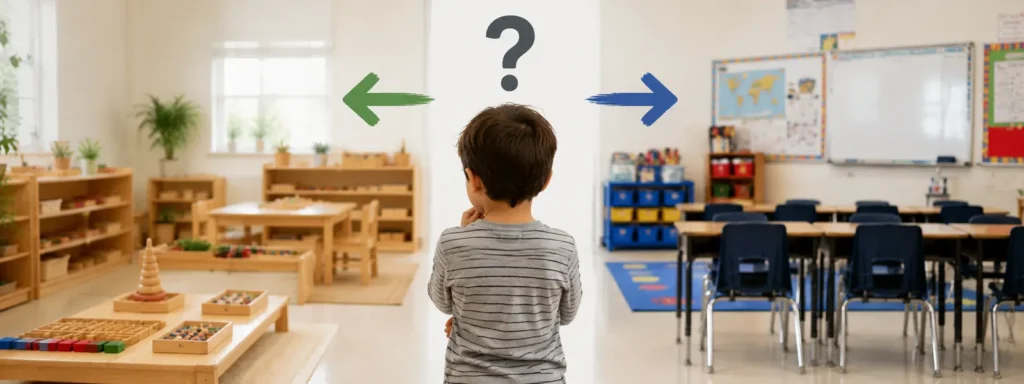
Which Is Better for Children?
There is no single answer to whether Montessori or traditional preschool is better for children. Both approaches can support early childhood development, but they work better for different children, families, and learning needs.
The better choice depends on the child’s personality, daily habits, social needs, and how they respond to structure.
Montessori May Be Better for Children Who:
- Enjoys working independently
- Likes hands-on activities
- Can focus on one task for a period of time
- Feels comfortable exploring quietly
- Shows curiosity about materials and objects
- Likes to do things by themselves
- Benefits from a calm classroom environment
Traditional Preschool May Be Better for Children Who:
- Enjoys group activities
- Likes songs, stories, games, and circle time
- Needs more teacher guidance
- Feels comfortable with clear routines
- Enjoys playing with classmates of the same age
- Benefits from structured transitions
- Likes themed activities and group projects
Montessori is not automatically better for every child. Traditional preschool is not automatically outdated. A child can grow well in either environment when the classroom is safe, organized, caring, and developmentally appropriate.
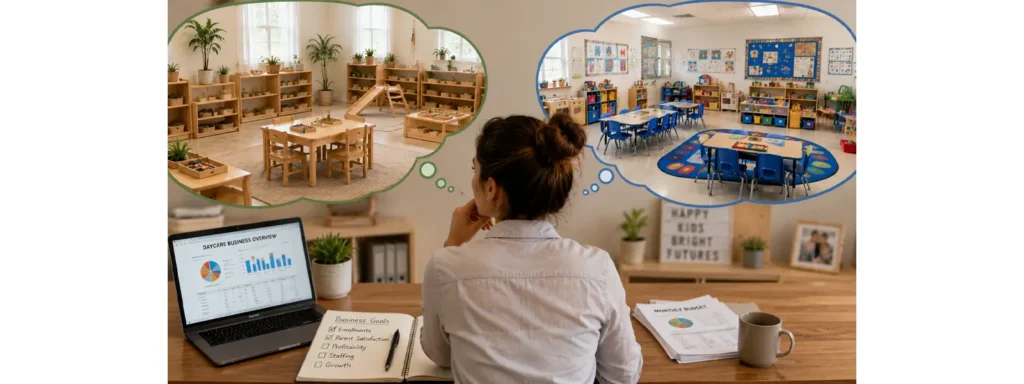
Which Model Is Better for a Preschool or Daycare Business?
For preschool owners and daycare operators, the choice between Montessori and traditional preschool is also a business decision. It affects your brand positioning, classroom design, tuition level, teacher training, daily operation, and furniture investment.
Business Comparison
| Factor | Montessori Model | Traditional Preschool Model |
|---|---|---|
| Brand Positioning | More premium and specialized | More familiar and flexible |
| Parent Perception | Calm, independent, high-quality | Structured, social, easy to understand |
| Setup Cost | Usually higher | More flexible |
| Teacher Training | More specialized | Easier to adapt |
| Furniture Needs | More specific | More varied |
| Classroom Layout | Carefully prepared environment | Activity-zone based |
| Best For | Premium positioning and Montessori demand | Broad family needs and flexible operation |
For Many Schools, a Mixed Approach Works Best
Many modern preschools do not choose one method completely. They may keep a traditional daily schedule while adding Montessori-inspired elements.
This can be a practical choice for schools that want a more premium classroom image without fully changing their curriculum.
FAQs
1. Montessori better than traditional preschool?
Not always. Montessori may be better for children who enjoy independence, hands-on work, and quiet concentration. Traditional preschool may be better for children who enjoy group activities, teacher guidance, and predictable routines. The better choice depends on the child’s personality and learning needs.
2. What is the biggest difference between Montessori and traditional preschool?
The biggest difference is how learning is guided. Montessori is more child-led, while traditional preschool is more teacher-led. This difference also affects classroom layout, furniture, learning materials, daily routine, and classroom management.
3. Is Montessori good for every child?
Montessori can benefit many children, but it may not be the best fit for every child. Some children enjoy independent work, while others need more group interaction and direct teacher support. Parents should consider the child’s temperament, social needs, and learning style.
4. Is traditional preschool outdated?
No. A traditional preschool can still be warm, creative, and developmentally appropriate. Many traditional classrooms provide strong social interaction, clear routines, group learning, and rich activity experiences.
5. Can a traditional preschool become Montessori-inspired?
Yes. A traditional preschool can add Montessori-inspired elements without becoming a full Montessori school. Low shelves, child-sized furniture, practical life activities, natural materials, and calmer classroom zones can all improve the learning environment.
6. Is Montessori more expensive to set up?
Usually, yes. Montessori classrooms often require specific learning materials, low open shelves, natural furniture, and careful classroom planning. However, schools can also start with a Montessori-inspired setup and upgrade gradually.
7. Can daycare centers use Montessori furniture?
Yes. Many daycare centers use Montessori-style furniture even if they do not follow a full Montessori curriculum. Low shelves, child-sized tables, accessible storage, and natural wood furniture can improve independence and classroom organization.
Conclusion
Montessori vs traditional preschool are not simply two labels. They represent two different ways of thinking about how children learn, how teachers guide the classroom, and how the environment supports daily development.
Montessori and traditional preschool are both valuable early learning models. The better choice depends on the child, the family’s expectations, the school’s teaching goals, and the real classroom environment.
Whether you are building a full Montessori classroom, designing a traditional preschool, or upgrading your current space with Montessori-inspired elements, the goal should always be the same: to create a safe, functional, beautiful, and child-friendly environment where children can learn with confidence.
West Shore Groups supports preschool and daycare projects with classroom furniture selection, layout planning, customization, and complete classroom solutions. If you are planning a new preschool classroom or upgrading an existing space, we can help you create an environment that fits your teaching approach, budget, and long-term operation needs.