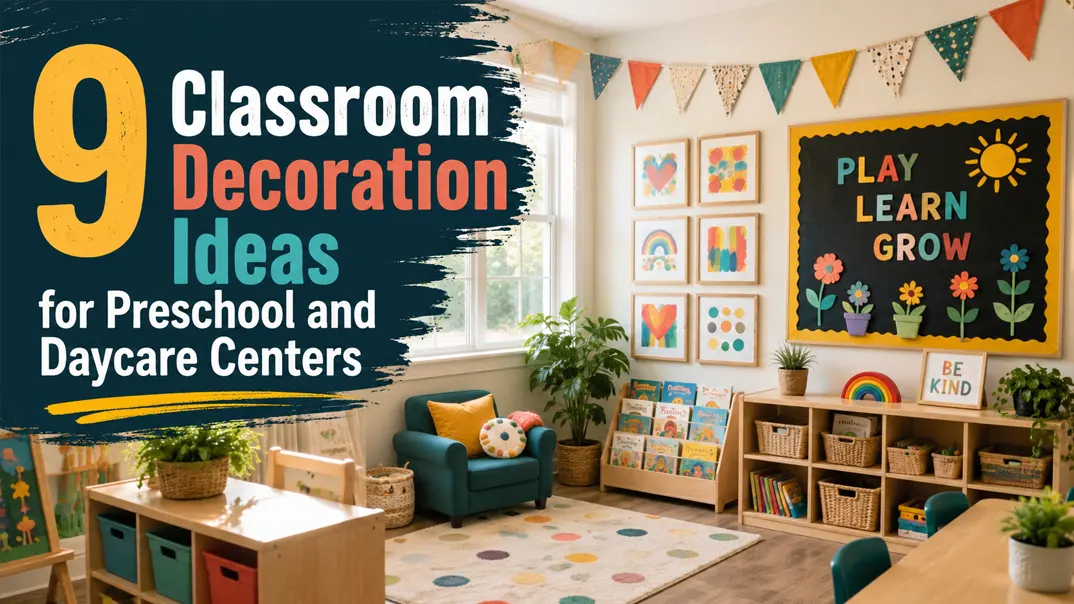
When you’re faced with a new classroom or one that hasn’t been renovated in a long time, you may be unsure how to decorate it. You can consider your goals and needs. The core of classroom decoration ideas should be to make the environment a “third teacher”.
We’ve compiled nine classroom decoration ideas. These ideas did not emerge out of thin air; they’re all based on our real-world communication with many kindergarten principals and our experience implementing projects.
1. Entrance Features
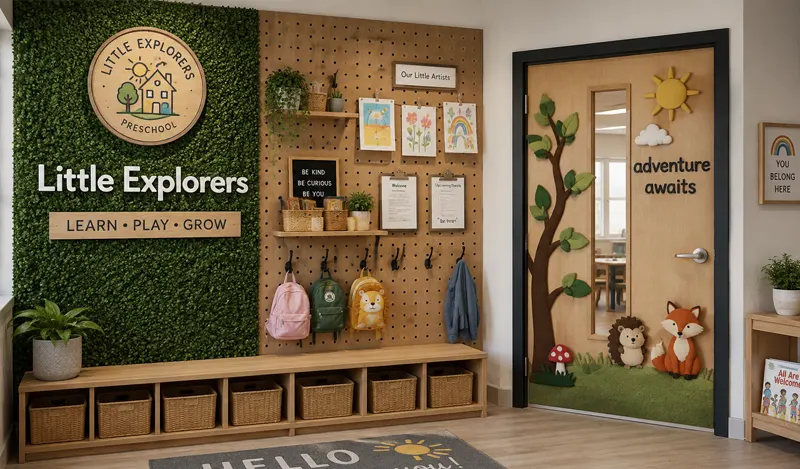
The entrance is the first point of contact for children and parents; you can utilize the doors and wall surfaces to create a welcoming atmosphere.
Consider using a pegboard or a faux boxwood wall—combined with your logo and the school’s name—to create a functional entrance that highlights your brand identity. This wall serves not only as a first impression for visitors but also as a versatile display area; using hooks and storage baskets on a pegboard allows you to showcase children’s artwork, school notices, or seasonal decorations.
Move beyond simple stickers for classroom doors. Opt for 3D felt elements or magnetic accents; these allow you to change themes monthly without damaging the surface, ensuring a fresh, welcoming feel every season.
If your preschool has a specific theme, choose wall and door decorations that align with it, allowing the entrance to “tell a story” right from the start.
2. Make the Most of Your Classroom Walls
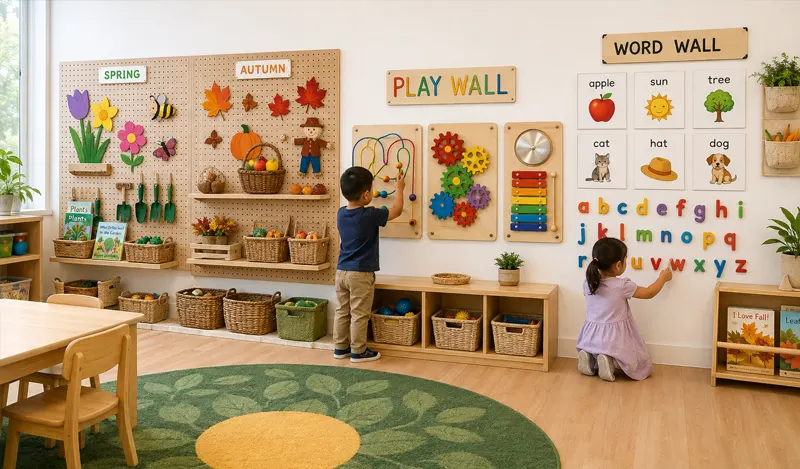
There are numerous creative ways to decorate classroom walls, and you can tailor the design to the specific type of classroom. Consider installing pegboards paired with interchangeable hooks, storage baskets, and display shelves; this allows you to refresh the wall content according to the season or theme without needing a full redecoration. For instance, you might display flower- and insect-themed activity panels in the spring, then switch to leaf- and harvest-themed decorations in the autumn. These walls serve as both decorative elements and interactive teaching tools.
You can also install wall-mounted games—such as bead mazes, spinning gears, or musical panels—to create an interactive play wall that transforms a plain surface into something lively and engaging. These panels should be mounted at children’s eye level (approximately 80–100 cm); the modular design allows for flexible arrangements based on the available wall space.
Some educators also transform their walls from static display areas into active teaching tools. By utilizing magnetic surfaces or hook-and-loop fasteners, you can create “word walls” that encourage hands-on vocabulary learning and enrich the overall educational experience.
3. Using Color to Create Distinct Learning Environments
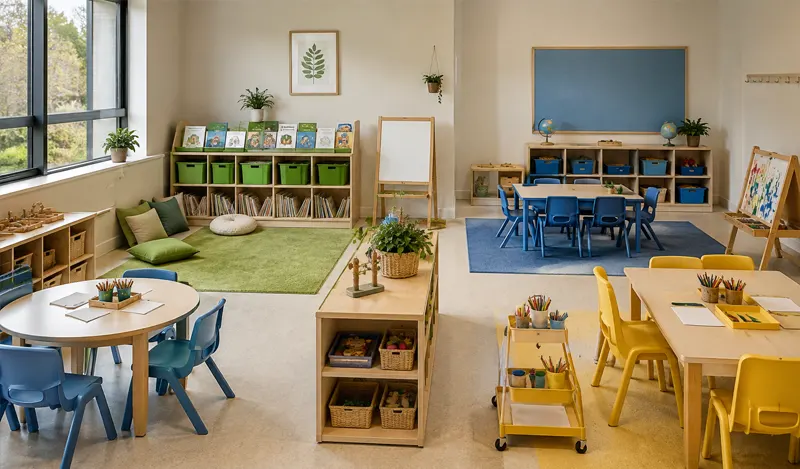
The color of the classroom will also determine your decor style. You can assign a primary color scheme to each classroom or functional area, as colors can evoke different moods in different spaces. There is no need to paint every wall; instead, you can incorporate color through furniture and fixtures such as desks, chairs, storage units, and rugs. For instance, a green rug paired with matching shelf labels can define the color scheme of a reading area.
It is recommended to limit each classroom to two or three colors: use a neutral tone as the base and select a single accent color for each learning zone to avoid visual clutter.
4. Introducing the “Nature Classroom” Theme
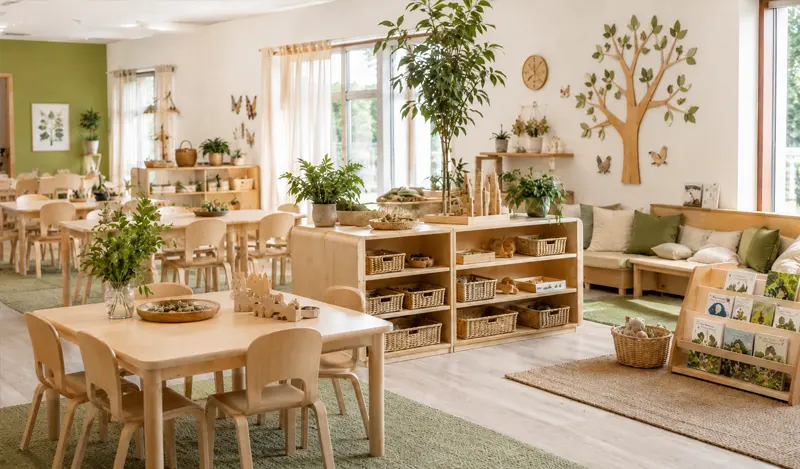
Integrating nature is a core pillar of the Reggio Emilia approach. If you operate a Reggio-inspired preschool or a center that embraces a nature-focused style, this décor concept is a must-adopt.
Your classroom should feature a cohesive look using light birch-wood textures for furniture and décor, complemented by natural wood tones, soft greens, and white to create a warm, natural environment—acting as the “third teacher.” Enhance the space’s character by incorporating motifs of leaves, flowers, trees, and simple animal figures.
Specific décor elements include birch-finished storage units, tables, chairs, and bookshelves, paired with greenery, woven baskets, curtains and cushions made of cotton or linen, and natural wood ornaments. All furniture edges must be rounded to ensure safety.
5. Classroom Decoration Ideas — Don’t Waste Your Ceiling
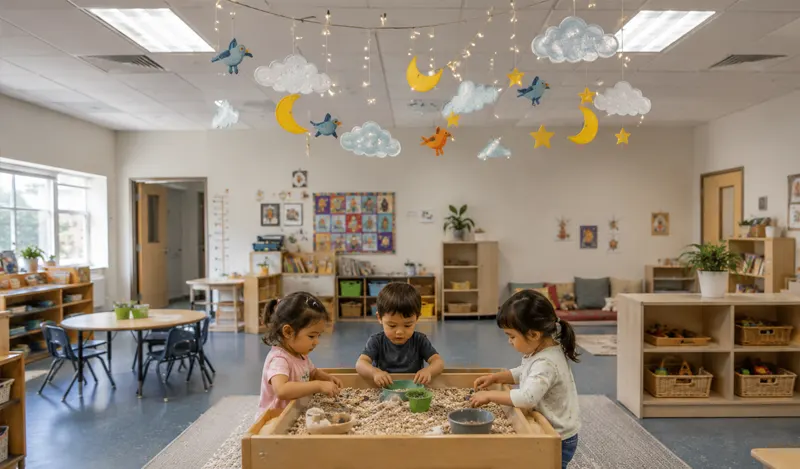
Don’t overlook your vertical space. The ceiling is often ignored when planning classroom décor, yet a simple overhead decoration can completely transform the atmosphere of a learning area.
You can also tie the ceiling décor into your classroom theme; for a sky-themed classroom, for instance, you might hang clouds, birds, stars, or moons. Children can even get involved in creating these items and have their work displayed overhead.
It is best to avoid covering the entire ceiling and to limit the number of elements; otherwise, the classroom can look cluttered. Instead, focus decorations on specific learning areas—such as hanging a small school of fish-shaped ornaments above a water table—to visually connect the activity below with the display above.
All hanging items should be lightweight and securely fastened, and kept well away from light fixtures, air vents, and safety equipment.
6. Add a Creative Touch to Your Reading Nook
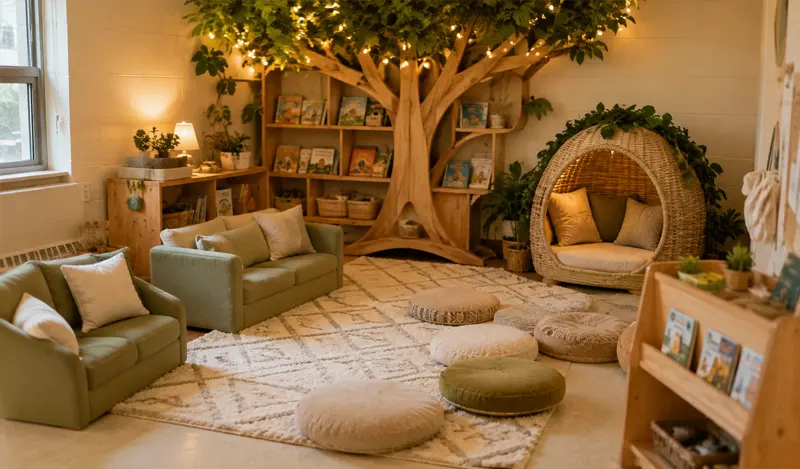
Tree-shaped bookshelves and dome are currently popular choices for reading nooks. When paired with soft, bohemian-style cushions, rugs, and gentle lighting, a tree-shaped bookshelf creates a fairytale atmosphere—like reading under a tree—while dome-style seating offers a cozy, enclosed space that feels both snug and spacious.
If space is limited, you can create a similarly comfortable reading nook by combining a low bookshelf with two small sofas for children.
7. Maximizing Natural Light
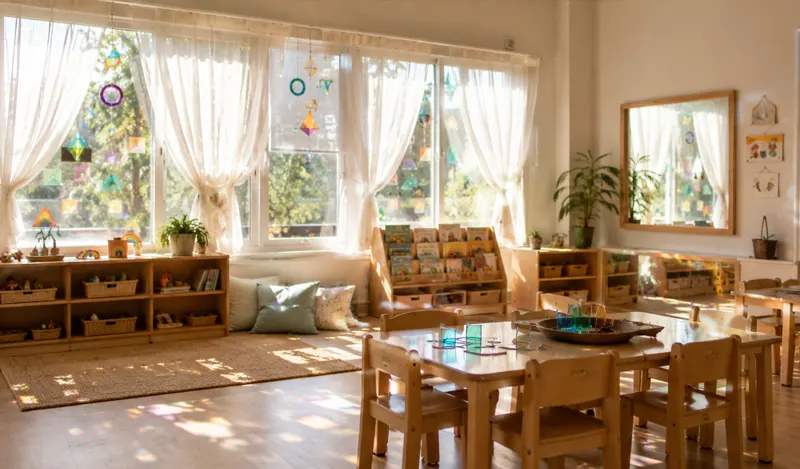
Natural light is the most cost-effective form of “decoration.” Sunlight and shadows create shifting visual effects throughout the day. Opt for sheer cotton or linen curtains to allow soft, diffused natural light to enter the classroom.
Decorate window areas with transparent panels, window decals, and translucent hanging ornaments that cast colorful reflections when sunlight streams in. Strategically place safety mirrors to reflect and distribute natural light, brightening the entire classroom.
Our goal is to use light as a decorative element rather than blocking it out.
8. Choose a Classroom Theme That Ties the Entire Space Together
If you are unsure how to coordinate various decorating ideas, a classroom theme provides a clear starting point. You can select a theme first and then plan the rest of the décor around it; the theme will guide your choices regarding colors, wall displays, and furniture details.
For example, an ocean-themed classroom might feature blue and aqua accents, with wave patterns and illustrations of marine life adorning the walls and ceiling.
Common preschool classroom themes include:
- Jungle and wildlife
- Natural wood/nature-inspired
- Outer space
- Ocean/underwater
- Farm and community
However, since classroom themes often need to be changed, consider the flexibility of your décor choices. Opt for elements that are easy to swap out rather than permanent designs that are difficult to alter later. For instance, painting the walls to match a specific theme can be time-consuming and costly to change when you want to switch to a new one.
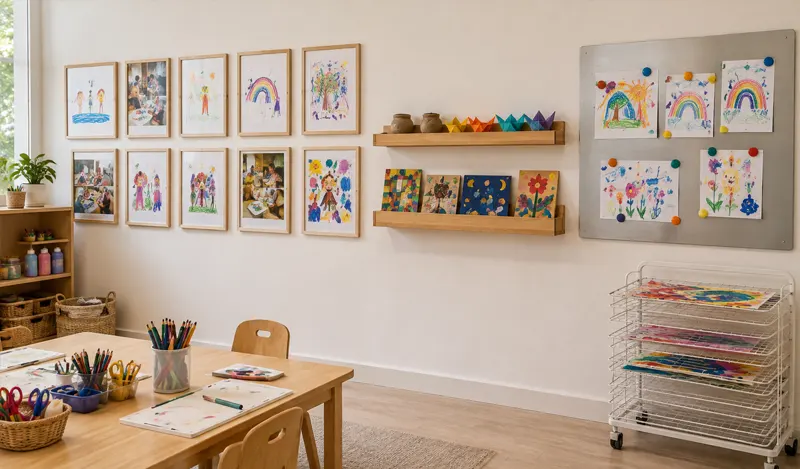
9. Creating an Art Gallery for Children
Children’s artwork is one of the most meaningful forms of classroom decoration. You can create a dedicated art gallery in the classroom to showcase children’s drawings, crafts, and photos. Ideally, the displays should be mounted at the children’s eye level (approximately 90–110 cm) to allow them to admire their own work, thereby boosting their self-confidence and enthusiasm for creativity. It is recommended to rotate the displayed items monthly to keep the space fresh and engaging. Additionally, placing a drying rack near the art area makes it convenient to dry and store the children’s creations.
There are several options for displaying artwork:
- Wall-mounted frames: Choose wooden or metal frames to mount on the wall. A4 or A3 sizes are recommended for displaying activity photos and drawings. You can choose to install between 6 and 12 frames, depending on the available wall space.
- Display shelves: If you opt for shelving, consider installing wooden or metal shelves to display children’s crafts (such as pottery, origami, or collages). Recommended shelf dimensions are 15–20 cm in width and 10–15 cm in depth.
- Magnetic walls: You can install a metal sheet or apply magnetic paint to the wall, allowing children to attach their artwork directly using magnets.
FAQs
1. Is a natural lighting solution still suitable for classrooms with few windows or poor natural light?
Yes, it is. For classrooms with insufficient natural light, we can compensate in the following ways: use light-colored, light-transmitting curtains to maximize existing light; install shatterproof safety mirrors in strategic locations on the walls to reflect and diffuse light; and use light color schemes (such as cream, white, or pale green) for walls and furniture, leveraging the reflective properties of light-colored surfaces to enhance overall brightness.
2. How much classroom decoration is too much?
If children have difficulty focusing on one display, finding materials, or knowing where to look, the classroom may be visually overloaded. Leave some wall space empty and give important displays enough room to stand out.
3. Can the classroom theme be changed later? If so, is it expensive?
Yes, and the cost of changing it is low. The thematic atmosphere is primarily created through soft furnishings—such as rugs, wall decals, curtains, cushions, and decorative items—which are inexpensive to replace.
4. What can be done if natural light is too intense, causing glare or overheating?
You can opt for a double-layer curtain design featuring light-filtering curtains paired with blackout curtains. During the day, use the light-filtering layer to let in soft natural light, and draw the blackout curtains during nap times or periods of intense sunlight.
5. Should all classrooms in a daycare center look the same?
No. They can share the same furniture style, materials, and overall color scheme while still showcasing unique personalities. This approach maintains a consistent style across the center without making every classroom look identical.
6. Which materials are best suited for long-term classroom decoration?
Choose materials that can withstand frequent handling and cleaning. Washable surfaces, reusable signage, interchangeable display inserts, sturdy frames, and durable panels are generally more practical than decorations designed for short-term use.
7. What factors should you consider before decorating a new daycare classroom?
First, determine the placement of furniture, learning zones, storage areas, traffic flow, windows, and key wall spaces. Once the room’s basic layout is clear, it becomes easier to decide where decorations will truly enhance the space.
8. Must classroom decorations always be educational?
No. Some decorations can help children feel comfortable and at ease, fostering a sense of connection to the classroom. A well-designed environment typically combines useful visual information, the children’s own artwork, and decorative elements that add warmth and personality to the room.
Conclusion
Every wall, door, and corner offers an opportunity for classroom décor and can serve as an educational tool.
When planning your classroom décor, remember that the furniture forms the core of the design, with other decorative elements serving to complement it. If you are looking for a custom décor solution, West Shore Groups can tailor designs to your specific educational philosophy and space, providing recommendations perfectly suited to your classroom.