If you are comparing preschool vs pre-K, start with the practical answer: the names overlap, but programs often serve different points on the path to kindergarten. Preschool may cover several years before kindergarten, while pre-K usually describes the program a child attends in the year or two immediately before kindergarten. Your state, school district, or child-care provider may use the labels differently, so compare the actual classroom, schedule, eligibility date, and learning goals—not the name on the brochure.
In practice, pre-K usually means a center-based program for children in the three-to-five age range that puts extra emphasis on the move into kindergarten. It may run during the school year, for part of the day, or as a full-day program with extended care. Names and eligibility rules change by location; a current overview of prekindergarten options shows why you need to check the local definition before comparing two programs. The classroom goals and daily experience still matter more than the label.
What Is Preschool?
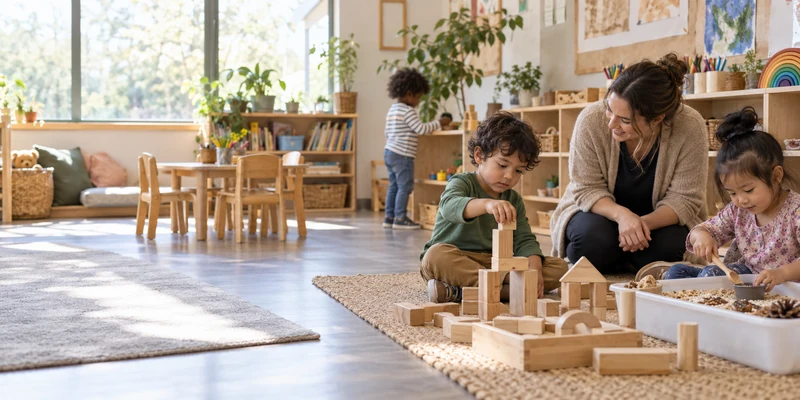
Preschool is an early learning program for children who are not yet in kindergarten. Many programs enroll children around ages three and four, and some accept younger children or continue through the year before kindergarten. A preschool classroom usually balances play, routines, movement, language, art, early math, and social-emotional learning.
You should expect a preschool day to include long stretches of hands-on exploration. Children may build with blocks, act out a story, sort natural objects, paint, sing, solve a simple problem with a friend, and practice putting materials away. The teacher uses those moments to extend vocabulary, model cooperation, and observe each child’s development.
Preschool is a good fit when your child needs a first group-care experience, more practice separating from you, or a place to develop communication and self-help skills before a more structured school year. A strong program still teaches intentionally; it simply uses young children’s need to move and play as the route into learning.
What Is Pre-K?
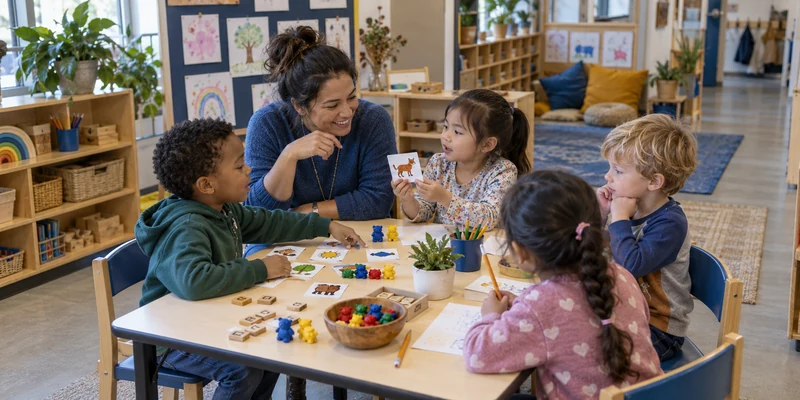
Pre-K, short for pre-kindergarten, generally serves children who will enter kindergarten next. Programs commonly enroll four-year-olds, although eligibility dates vary by state and provider. The goal is to strengthen the skills children will use in kindergarten: listening in a group, explaining ideas, managing personal belongings, following a multi-step routine, recognizing patterns, using early literacy and math concepts, and solving social problems with less adult help.
Pre-K should still feel like early childhood education. You should see dramatic play, construction, outdoor time, sensory materials, books, and creative work alongside small-group lessons. The difference is the level of challenge and the way teachers connect activities to kindergarten expectations. A teacher may invite children to dictate a story, compare quantities while cooking, or plan how to build a bridge instead of handing out worksheets for long periods.
Some pre-K programs are offered by public schools, while others are run by private schools, child-care centers, nonprofits, or community organizations. Funding, hours, transportation, meals, and eligibility are local decisions. Check your state’s rules before you assume that a pre-K place is free, full-day, or available to every four-year-old.
Preschool vs Pre-K: The Main Differences
The table below shows common patterns, not universal rules. Ask each provider how it defines the terms and what children do during a normal day.
| Point of comparison | Preschool | Pre-K |
|---|---|---|
| Typical age | Often 3–4, with some programs beginning earlier or serving older preschoolers | Often 4–5, usually the year before kindergarten |
| Main purpose | Build comfort in a group, communication, independence, and broad early learning foundations | Connect those foundations to kindergarten routines, learning behaviors, and early academic concepts |
| Daily rhythm | More open-ended choice, movement, sensory play, and short teacher-led gatherings | Still play-based, with longer small-group work, more predictable routines, and increasing independence |
| Schedule | Part-day or full-day care; many private centers offer year-round options | Often school-year and part-day, but private and community programs may offer full-day or extended care |
| Readiness focus | Separating from caregivers, joining play, communicating needs, and managing simple routines | Listening, self-regulation, early literacy and math, self-help, and participating in kindergarten-style routines |
| Eligibility and cost | Set by the provider | Set by the state, district, school, or provider; public options may have income or age requirements |
Are Preschool and Pre-K the Same?
Sometimes. A child-care center may call its three-year-old classroom preschool and its four-year-old classroom pre-K. Another center may use “preschool” for every group before kindergarten. A public school may reserve “pre-K” for a state-funded program with specific birth-date rules. The label alone cannot tell you the quality, curriculum, hours, or teacher qualifications.
When you compare programs, ask to see a written daily schedule and examples of children’s work. Find out how the teacher supports language, early math, self-help, peer conflict, and outdoor movement. You will learn more from those answers than from whether the sign says preschool or pre-K.
Which Program Should You Choose?
Use your child’s current needs and your family’s schedule as the starting point.
Choose a preschool classroom when your child needs to:
- practice separating from you in a predictable, caring setting;
- learn to join play, take turns, and ask for help;
- build independence with toileting, handwashing, meals, dressing, and cleanup;
- explore language, movement, art, music, sensory materials, and early math through play; or
- attend a flexible full-day program that fits your work schedule.
Choose a pre-K classroom when your child is ready to:
- stay with a small-group conversation or activity for longer periods;
- follow two- or three-step directions with less adult prompting;
- talk about stories, sounds, quantities, patterns, and observations;
- manage personal items and classroom materials more independently; and
- practice the social and learning routines expected in the kindergarten you are considering.
These are readiness indicators, not a test. A child who is four does not need to read independently to benefit from pre-K. If your child is still developing speech, self-regulation, motor skills, or confidence in groups, a responsive program should adjust the environment and the level of support rather than rush the child through a checklist. The five developmental areas in this school-readiness framework are a useful lens for that conversation, but your child’s teacher should apply them through observation and play—not a pass-or-fail test.
What to Look for When You Visit a Program
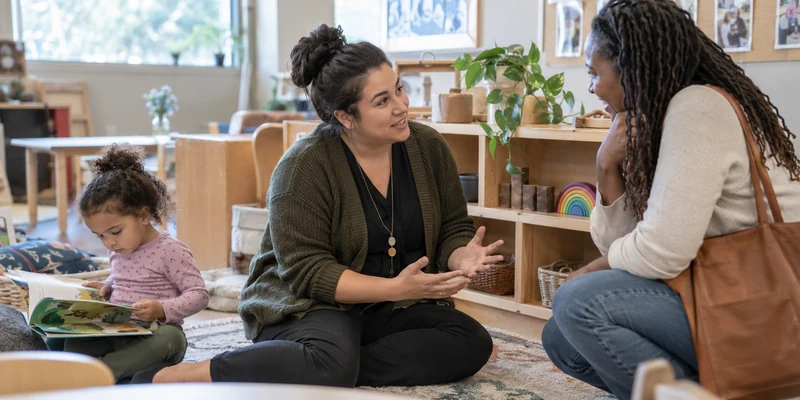
Visit in person so you can see how the program operates, how teachers interact with children, and what the play spaces look like. If you want a second checklist for your visit, this quality child-care visit guide covers the same practical questions. Use your visit to answer these questions:
- Can children reach and return materials? Low, open storage supports choice and reduces waiting. Staff should keep small parts, cleaning products, and other hazards secured.
- Can the teacher see the whole room? Shelves and partitions can define areas without creating blind corners. Ask how staff supervise quiet corners, messy work, and active play at the same time.
- Is there a real balance of play and intentional teaching? Look for blocks, pretend play, books, art, science, manipulatives, music, and outdoor movement—not a room dominated by worksheets or a room with no clear learning purpose.
- Does the schedule match your child? Ask about arrival, meals, rest, outdoor time, transitions, and the length of teacher-led groups. A schedule that looks good on paper may still be tiring for your child.
- How does the program document progress? Strong teachers use observations, conversations, work samples, and family input to plan next steps. Ask how they share progress and how they adapt activities for different abilities.
- What happens when a child struggles? You want calm guidance, visual cues, choices, and co-regulation—not shame or a one-size-fits-all behavior chart.
What Preschool and Pre-K Classrooms Need From the Environment
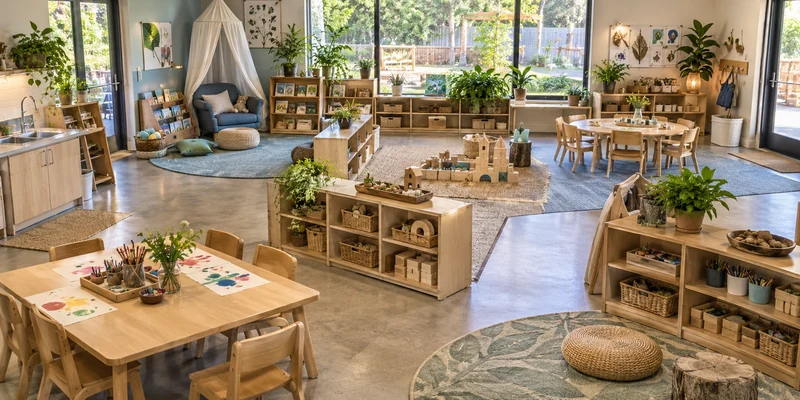
If you operate a center, the room should reflect the children’s developmental step without forcing a false divide between “play” and “school.” Younger preschoolers need clear pathways, low storage, stable child-sized seating, open-ended materials, and a quiet place to reset. Older pre-K children need those same foundations plus work surfaces and display areas that support longer projects, collaborative problem-solving, early writing, and group discussion.
Plan the layout around three practical questions: what children can use independently, what teachers must supervise, and how quickly the room can change from one part of the day to the next. A low shelf can separate a reading space from active building while preserving sightlines. Mobile or stackable seating can clear the floor for movement. Storage should place everyday materials at children’s height while keeping teacher supplies and safety items out of reach.
West Shore’s age-group planning follows this same logic: a preschool room commonly needs support for social interaction, fine-motor development, and school readiness, while a kindergarten or pre-K space typically needs more support for concentration, early writing, teamwork, and independent access to materials. Use the age-group furniture guide as a starting point, then adjust the mix for your enrollment, room dimensions, teaching approach, and schedule.
For a complete room, map learning zones before selecting individual pieces. The learning-center setup guide explains how to place reading, blocks, art, sensory, and role-play areas without blocking supervision.
If you are opening or remodeling, the classroom design service can help connect the floor plan, furniture list, storage, and circulation route. Treat that plan as a working tool: revisit it when enrollment, age mix, or the daily schedule changes.
Preschool vs Pre-K FAQs
What age is preschool?
Many preschool programs serve children around ages three and four, but providers may accept younger children or include five-year-olds who are not starting kindergarten yet. Check the program’s birth-date cutoff and toileting policy.
What age is pre-K?
Pre-K commonly serves four-year-olds in the year before kindergarten. Eligibility can depend on your state, district, funding source, and the date your child turns four or five.
Can my child skip preschool and attend pre-K?
Yes. Pre-K is not always a second required year. A child who has been at home or in another care setting can start pre-K, provided the program’s age and enrollment rules fit. Talk with the teacher about routines, communication, toileting, and separation so the transition is supported.
Is pre-K the same as kindergarten?
No. Pre-K comes before kindergarten and is usually optional. Pre-K builds the habits, language, social skills, and early concepts children will use in kindergarten; it does not replace the kindergarten year.
Is pre-K free?
Some state-funded programs are free or low-cost for eligible families, while private and community programs set their own tuition and schedules. Confirm eligibility, hours, meals, transportation, and extended-care fees with the program or your state child-care resource.
What should you ask before enrolling?
Ask which children the program serves, how the day is structured, how teachers support behavior and development, what the teacher-child group looks like, how families receive updates, and what happens during transitions to kindergarten. Then visit and observe the room.
The Bottom Line
Preschool vs pre-K is usually a question of timing, readiness, and program design—not two completely separate teaching philosophies. Preschool often gives children their first sustained experience with group learning. Pre-K usually adds a clearer bridge to kindergarten. The right choice is the program that matches your child’s development, your schedule, and the quality of the daily interactions you can see when you visit.
For local eligibility, licensing, and funding rules, start with your state’s child-care resource. For classroom planning, choose furniture and learning zones that can grow with the children instead of locking the room into one kind of activity.