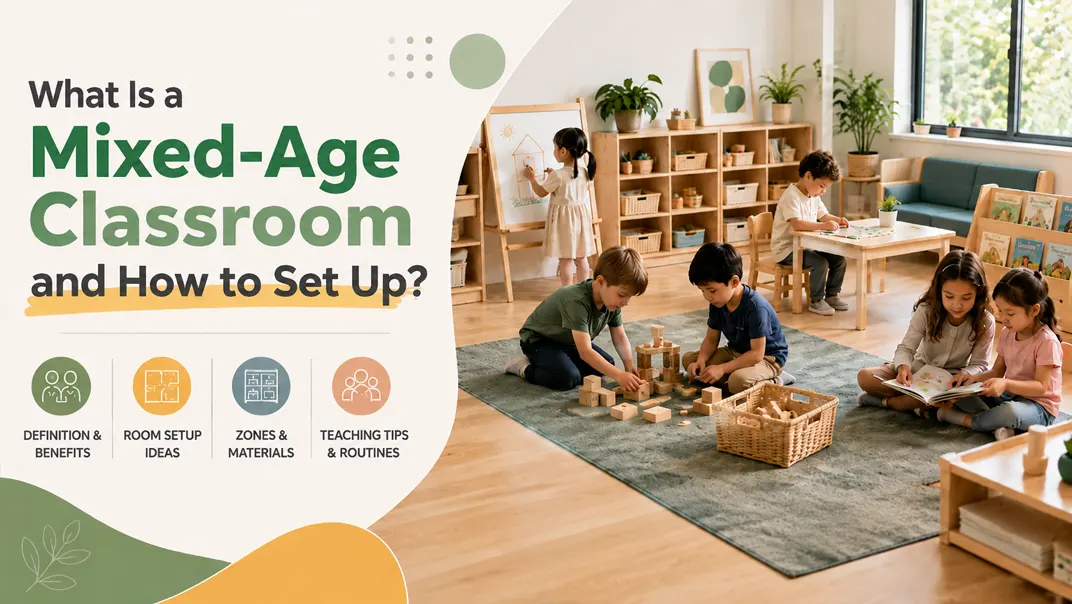
Mixed-age classrooms are becoming more common in modern early childhood education because schools are looking for a more flexible and efficient way to organize learning spaces.
Instead of separating children strictly by age, many preschools now combine different age groups within one classroom. This shift is not only educational—it is also practical.
For many early learning centres and kindergarten operators, the main reasons include:
- Limited classroom space that needs higher utilization
- Growing demand for more flexible enrollment systems
- Increasing adoption of Montessori and Reggio-inspired learning models
- A need to reduce duplicated teaching resources across age groups
From an operational perspective, mixed-age classrooms help schools run more efficiently while still supporting different learning levels within the same environment.
However, this model also brings new challenges for classroom design, furniture selection, and daily management. That is why proper planning of space and equipment becomes critical before implementation.
What Is a Mixed-Age Classroom?
In traditional educational models, children are typically assigned to specific grade levels based strictly on their birth year. However, within Montessori and many other progressive educational philosophies, a vastly different approach is gaining increasing favor: the mixed-age classroom. This model challenges the conventional concept of “same-age peers,” offering a unique ecosystem that fosters children’s social, emotional, and cognitive development. The following is a comprehensive overview of the mixed-age classroom.
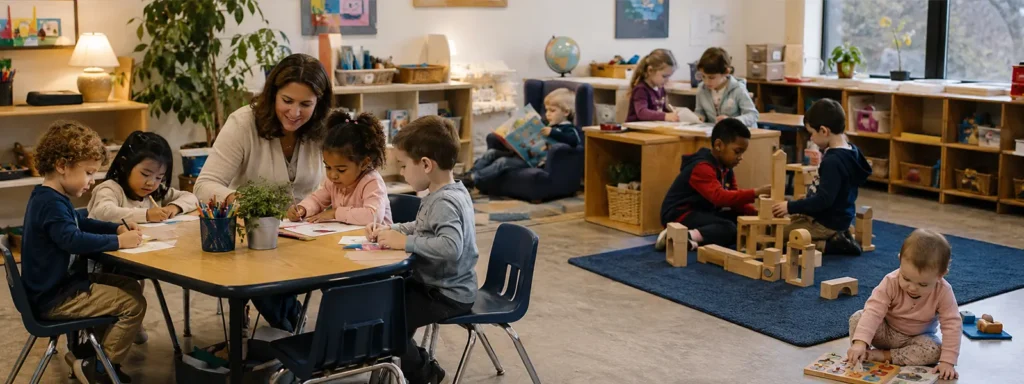
A mixed-age classroom is a learning environment where children from different age groups share the same classroom. In preschool settings, this may include children aged 2–5, 3–6, or another age range based on the school’s program design, licensing requirements, and teaching philosophy.
The purpose of a mixed-age classroom is not simply to place younger and older children together. The real goal is to create a classroom where children can learn from each other, work at their own level, and take part in activities that match their abilities.
Key characteristics of a mixed-age classroom:
- Children share the same learning environment across age levels
- Learning is often based on group activities and individual progress
- Older children naturally support younger children through observation and interaction
- Teachers act more like guides rather than strict instructors
For schools and education planners, this model requires careful attention to classroom zoning, furniture flexibility, and safety design, because the same space must support different physical sizes, attention spans, and learning abilities.
Benefits of a Mixed-Age Classroom
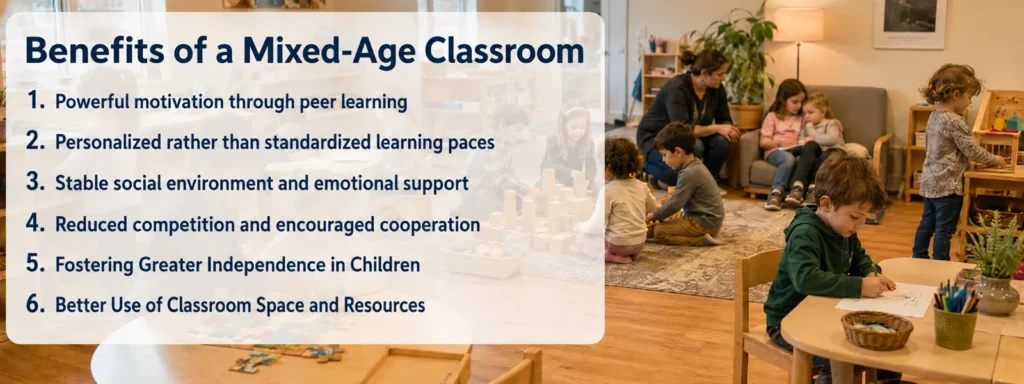
A mixed-age classroom can support children’s social, emotional, language, and cognitive development. The value comes from daily interaction between children at different stages, combined with a classroom environment that allows each child to participate at the right level.
Powerful Motivation Through Peer Learning
As older children help their younger peers, they spontaneously review and reinforce the knowledge and skills they have already mastered. This process of “teaching” significantly boosts their self-confidence, sense of responsibility, and leadership abilities.
Personalized Rather Than Standardized Learning Paces
In a mixed-age classroom, teachers do not require all children to master the same concepts at the same time. Each child can select learning materials and activities suited to their own interests and abilities, avoiding the “one-size-fits-all” pitfalls common in same-age classes.
Stable Social Environment and Emotional Support
Children spend three years in the same classroom with the same group of peers, allowing them to form deep, stable emotional bonds. Younger children learn rules and social etiquette from older role models, while older children learn to care for and be inclusive of others. These long-term relationships serve as a vital foundation for healthy psychological development.
Reduced Competition and Encouraged Cooperation
A mixed-age environment naturally minimizes the direct competition often seen among same-age peers. Children are more inclined to cooperate, help one another, and learn through imitation rather than vying for the same “top spot.” This fosters a positive and inclusive community atmosphere.
Fostering Greater Independence in Children
Mixed-age classrooms work best when children can independently engage in daily activities. This includes selecting materials, carrying trays, returning items, tidying up, and moving between different activity areas.
When children are able to complete simple tasks independently, teachers have more time to observe, guide, and support them in deeper learning.
Better Use of Classroom Space and Resources
For many early learning centres, space is a major limitation.
A mixed-age classroom allows schools to:
- Reduce duplicated classroom setups for each age group
- Share learning materials across different developmental levels
- Maximize the use of one flexible learning space
Challenges of Mixed-Age Classrooms
While mixed-age classrooms bring flexibility and educational benefits, they also introduce practical challenges that schools need to solve before implementation.
Understanding these challenges helps schools avoid design mistakes and operational difficulties later.
1. Variation in Furniture Dimensions
In mixed-age classrooms (e.g., ages 3–5), there is significant variation in children’s heights and body sizes.
Strategies:
- Use height-adjustable tables: This is the most flexible solution. Tables with adjustable legs can simultaneously meet the needs of children across different age groups.
- Provide chairs of varying heights: Intentionally include chairs with different seat heights (e.g., 25 cm, 28 cm, 30 cm) in the same classroom and encourage children to choose a seat that suits their height independently.
- Implement differentiated zoning: For example, place low tables for younger children in the construction area, while placing higher tables for older preschoolers in the art area.
2. Balancing Activity Zones and Facility Allocation
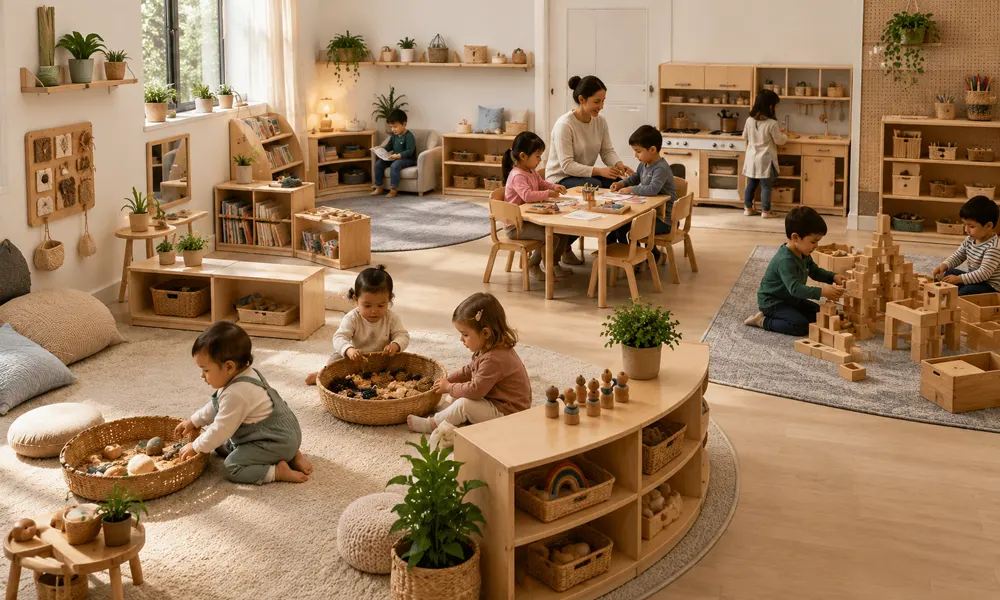
Younger children require spacious, soft areas for crawling and sensory exploration, whereas older children need more complex zones for role-play, construction, and fine-motor activities.
Strategies:
- “Soft Zoning” Instead of “Hard Partitions”: Define functional areas using low, curved bookshelves, rugs, and the natural arrangement of furniture rather than walls or tall cabinets. This maintains a sense of spatial flow and visual openness.
- Staggered Use of Activity Areas: Schedule specific activity zones (such as sensory tables or art corners) for use by different age groups at different times to prevent overcrowding.
- Utilizing Vertical Space: Install wall-mounted activity and storage systems at varying heights, reserving the lower levels for infants and toddlers and the upper levels for older children.
3. Older Children Require a Higher Level of Challenge and Stimulation
In mixed-age classrooms, teachers often focus most of their energy on ensuring the safety and meeting the basic needs of younger children, potentially overlooking the fact that older children require more complex, higher-level cognitive and hands-on challenges. This can lead to boredom and behavioral issues among older children.
Strategies:
- Provide materials with graduated complexity: Ensure that materials within the same activity area are designed with varying levels of difficulty. Younger children can use basic sensory materials, while older children can engage with more complex, multi-part, or task-oriented tools.
- Differentiate guidance based on age groups: Teachers should observe and provide guidance intentionally. For older children, the focus should be on fostering leadership, a sense of responsibility, and problem-solving skills; they can be encouraged to act as “peer mentors” or “little teachers.”
- Regularly rotate “advanced” materials: Prepare specific, rotatable learning materials for older children to sustain their motivation and curiosity.

4. Managing Social Conflict
While peer learning offers advantages, it can also lead to conflict. Younger children may disrupt the work of older children due to a lack of proficiency, while older children might treat younger ones harshly out of impatience.
Strategies:
- Establish clear classroom rules and etiquette: Clearly define rules—such as designated work areas and “quiet voices”—so that children of all ages understand and follow them.
- Effective teacher intervention and modeling: Teachers should proactively model how to ask for help politely and offer assistance gently. They should also intervene impartially when conflicts arise, guiding both parties to communicate and resolve the issue.
- Create specific opportunities for collaboration: Design activities that require mixed-age cooperation to foster positive peer interactions.
5. Teacher Training and Pedagogical Adaptation
Mixed-age classrooms place significantly higher demands on teachers than traditional same-age classrooms. Teachers must possess the ability to observe developmental characteristics across different age groups, design differentiated curricula, and manage complex social dynamics.
Strategies:
- Provide specialized Montessori or Reggio Emilia teacher training: These educational philosophies inherently require mixed-age teaching and possess well-established teacher training systems.
- Establish teacher collaboration mechanisms: Mixed-age classrooms are typically staffed by a lead teacher and an assistant teacher; roles and responsibilities should be clearly defined.
- Ongoing in-school professional development and support: School management should regularly organize teacher seminars to share successful experiences and challenges encountered in mixed-age teaching, thereby fostering a supportive professional community.
How to Plan a Mixed-Age Classroom Space?
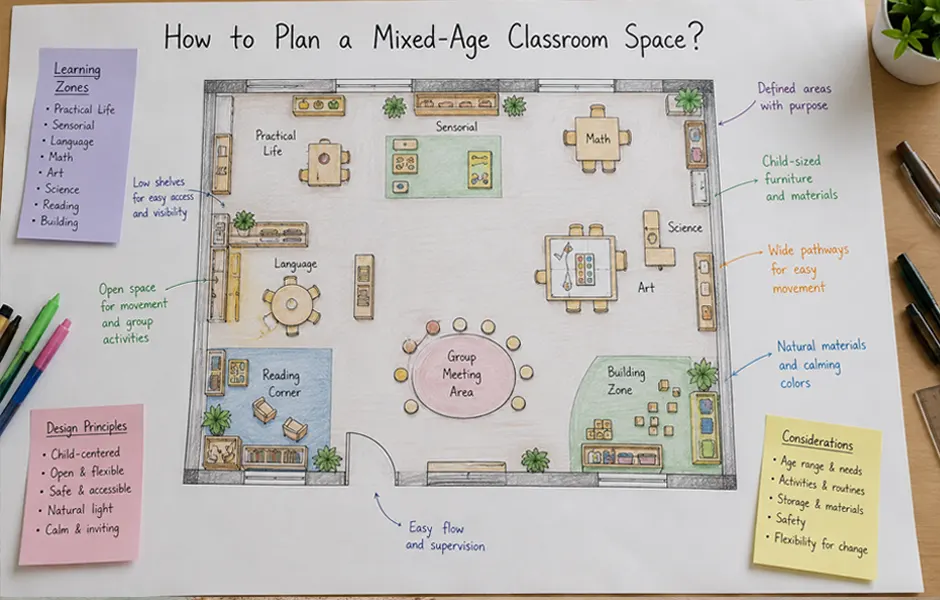
Planning a successful mixed-age classroom is far more complex than planning a traditional classroom where children are of the same age. It involves more than simply placing children of different ages in the same room; it requires a systematic spatial design strategy to ensure that children of every age group have access to suitable areas for learning, play, and rest. The following is a set of proven planning steps derived from actual client projects.
Step 1: Assess the Age Span and the Ratio of Children Across Age Groups
Before you begin drafting the floor plan, you need to clarify two key pieces of information.
- What is the age span? The most common mixed-age model covers three years (e.g., 0–3, 3–6, or 6–9 years old). The wider the span, the greater the challenge for spatial planning.
- What is the ratio of children in each age group? For instance, in a mixed-age classroom of 25 children aged 3 to 5, are there more younger children or older children? This will directly influence how you allocate space for different functional areas.
| Age Group | Typical Ratio (Based on 25 Children) | Main Space Requirements |
|---|---|---|
| 3–4 Years Old (Younger Group) | 10–12 children | Large sensory exploration area, low-level quiet transition area, safe soft activity area |
| 4–5 Years Old (Older Group) | 13–15 children | More complex building area, dramatic play area, reading and writing area, small-group work tables |
Step 2: Create Clear Activity Zones
Mixed-age classrooms work better when each area has a clear purpose. Children should be able to understand where to read, where to build, where to create art, where to rest, and where to join group activities.
Common activity zones include:
- Reading area
- Block center
- Art area
- Dramatic play area
- Practical life or Montessori shelf area
- Sensory area
- Quiet corner
- Group meeting area
Step 3: Avoid Rigid Partitions
In a mixed-age classroom, never use tall, fixed cabinetry to completely partition the space into enclosed, separate rooms. Doing so obstructs the teacher’s line of sight and can isolate younger children from the rest of the group. Instead, use furniture to create natural, “soft boundaries.”
- Use low bookshelves: This is the most common method for zoning. A low, open bookshelf (60–90 cm high) can define the entrance to a reading area while allowing the teacher to see all the children from the center of the room.
- Use curved furniture: Curved bookshelves or sofas create soft, curvilinear boundaries that guide children naturally from one functional area to another, while also adding a sense of flow and playfulness to the space.
- Use rugs of different materials: These serve as a key visual tool for clearly defining functional zones.
Step 4: Arrange Functional Areas Based on Noise Levels
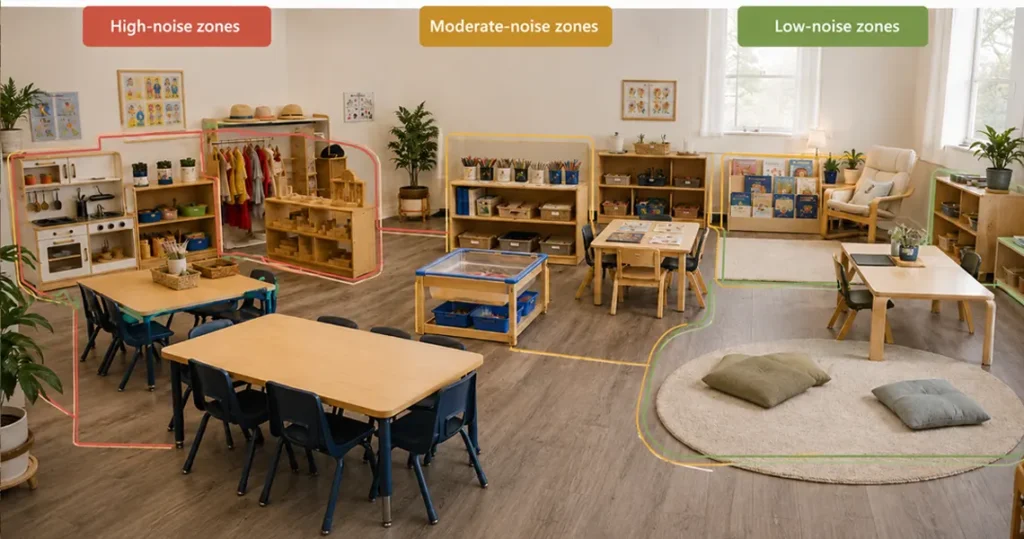
This is a golden rule for planning a mixed-age classroom. Categorize the noise levels of all functional areas into three groups, then separate the “noisy zones” from the “quiet zones.”
High-noise zones (lively, high interaction):
- Role-play area (mini-kitchen, market, dress-up corner)
- Block building area
- Small-group discussion tables (for collaborative activities)
Moderate-noise zones (require focus but allow for conversation):
- Art/craft area
- Sensory table/water table
- Puzzle and tabletop game area
Low-noise zones (require absolute quiet):
- Reading area
- Writing/fine-motor activity area
- Circle-time rug (waiting area)
Place high-noise zones near the classroom entrance or on the side furthest from the reading area. Position low-noise zones in quiet spots, such as near windows or in corners. Use bookshelves or cabinets to create natural buffer zones between them.
Step 5: Achieving “Differentiated” Furniture Configuration
Furniture in a mixed-age classroom should by no means be uniform in size; it is essential to provide furnishings that suit children of varying ages and body sizes. Alternatively, consider using height-adjustable furniture that can be flexibly adapted to each child’s stature.
For storage units, opt for a tiered design: place the simplest toys on the lower, open shelves, while reserving the middle and upper shelves for more complex puzzles and tools.
Step 6: Allow for Ample Floor Space
Mixed-age classrooms require open floor space because children utilize the room in diverse ways. Younger children may need room for movement, crawling, carrying objects, and simple play, while older children may require space for construction projects, group activities, and role-playing.
Excessive furniture makes a room feel cluttered while actually reducing its functionality. It also leads to narrow aisles and obstructed pathways, increasing the risk of collisions.
How to Organize Materials for Different Ages?
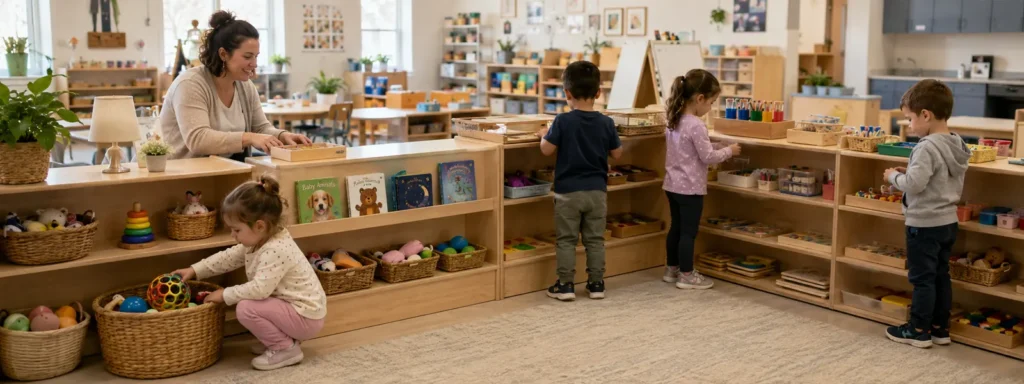
In a mixed-age classroom, enabling children of various ages to easily locate, use, and return their work materials is crucial for both instructional efficiency and the development of child independence. A well-organized system for materials not only minimizes classroom disorder but also serves as an “invisible mentor” for learning, guiding children toward autonomous exploration.
- Make materials visible and accessible: All materials must be placed at a height that is level with the children’s line of sight and within easy reach. Any material requiring a teacher’s assistance to retrieve disrupts the child’s independent workflow.
- Categorize materials by functional area: When planning a mixed-age space, materials should first be zoned horizontally based on their function. Different age groups require varying levels of complexity for materials within the same functional area.
- Arranging Materials by Height on Shared Shelves: When materials share a shelving unit within a single functional area, vertical placement serves as a primary indicator of age-appropriateness.
- Standardized containers and visual markers: A visual identification system is essential to enable children of different ages to independently return materials to their proper places.
- Establishing a material rotation system: The organization of a mixed-age classroom is not static; it should be dynamic and adaptable to the children’s developmental needs.
FAQs
Is a mixed-age classroom suitable for all preschools?
Not necessarily. It works best for schools that focus on flexible learning approaches, smaller class sizes, or Montessori/Reggio-inspired systems. Traditional academic preschools may prefer age-based grouping.
How many children should be in a mixed-age classroom?
Class size depends on space and teacher ratio, but smaller groups are usually more effective to ensure proper supervision and learning balance across ages.
Do mixed-age classrooms require special furniture?
Yes. Furniture should support:
- Multiple height levels
- Easy access for younger children
- Flexible grouping and movement
- Clear storage organization
Can mixed-age classrooms improve learning outcomes?
When well designed, yes. They encourage peer learning, independence, and social development, especially in early childhood education environments.
What age groups work best in a mixed-age classroom?
The best age range depends on the preschool program, teacher-child ratio, licensing rules, and classroom size. In many preschool settings, mixed-age classrooms may include children aged 2–5 or 3–6. Montessori programs often use a wider age range so children can learn through observation, repetition, and peer interaction.
Are mixed-age classrooms only used in Montessori schools?
Mixed-age classrooms are common in Montessori education, but they can also be used in preschools, daycare centers, early learning centers, and small childcare programs. The idea can work in different teaching models as long as the classroom environment supports children at different ages and ability levels.
Conclusion
A mixed-age classroom is much more than a classroom with children of different ages. It is a learning environment that needs careful planning, clear organization, and furniture that supports children at different stages of development.
For schools and early learning centres, this model offers more than flexibility. It creates a learning ecosystem where children develop at different speeds while still sharing the same environment in a meaningful way.
However, the effectiveness of this model depends heavily on three core factors:
- A well-structured classroom layout
- Age-flexible and functional furniture systems
- Clear teaching and management strategies
Without these foundations, mixed-age classrooms can quickly become difficult to manage and inconsistent in learning outcomes.
For schools planning to adopt this model, the next step is not only curriculum design—but also building the right physical learning environment that supports it.
West Shore provides preschool classroom furniture, storage solutions, activity tables, book displays, open shelves, and customized classroom layout support for early learning spaces. If you are planning a mixed-age classroom, we can help you create a furniture solution that fits your room size, age range, teaching model, and daily classroom needs.