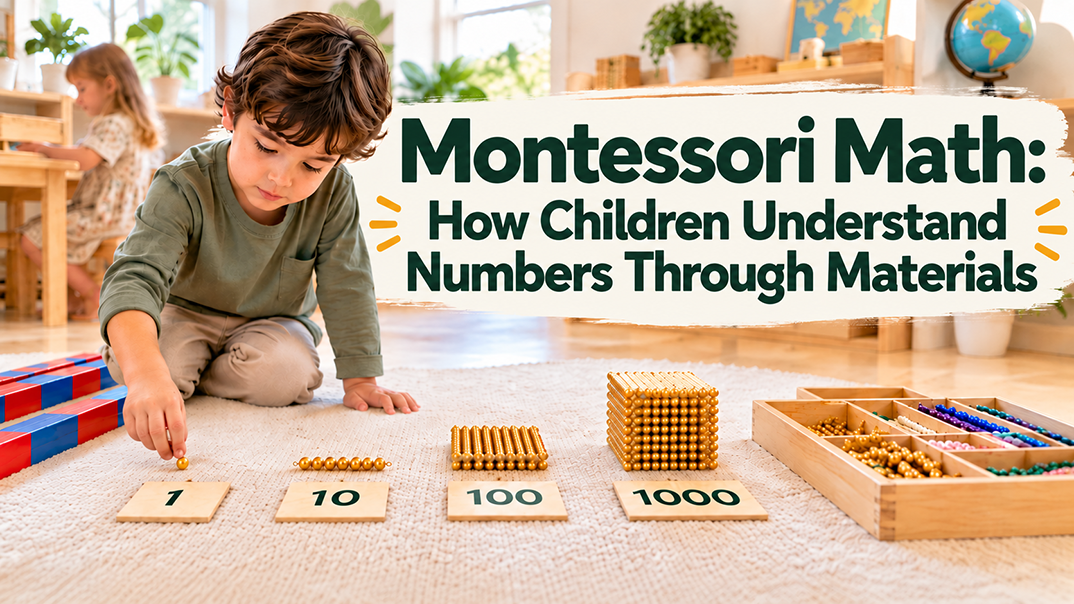
When children are first introduced to mathematics, numbers often seem abstract. If a child does not yet grasp what the quantity “five” actually represents, the written numeral “5” is difficult to truly comprehend.
The Montessori math approach makes these concepts easier to understand by allowing children to visualize quantities, manipulate materials, and explore numerical relationships. This article outlines the Montessori math curriculum, explains how the materials facilitate understanding, introduces common materials, and offers guidance on selecting and arranging them in the classroom.
What Is Montessori Math?

Montessori math helps children understand numbers by giving them something real to work with. Children may count beads, compare lengths, match numerals with quantities, or move objects to see how numbers change.
Each material focuses on a specific math idea. Some help children understand quantity, some introduce number symbols, and others are used for place value or basic operations. When children can see and handle these ideas, the numbers on paper usually become easier to understand.
Montessori math is really about helping children know what a number means, not just recognize it. A child may be able to say “10,” but the materials help them see what ten looks like, how it relates to other quantities, and how it can be used in later math work.
What Math Concepts Do Children Learn in Montessori?
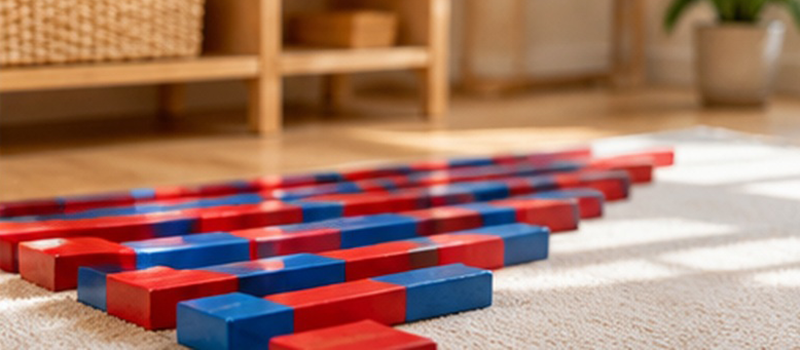
Montessori math usually begins with quantities that children can see and handle, then gradually moves toward numbers, place value, operations, and number patterns. Instead of memorizing rules first, children build their understanding through practical experience.
Numbers and Quantity
Children first need to understand that a number represents an actual quantity.
For example, a child may already be able to say “4” and recognize the numeral 4, but still not fully understand what “four” means. When working with Number Rods, Spindle Boxes, or Cards and Counters, they gradually connect the quantity they see, the number they hear, and the written numeral.
As this connection becomes stronger, children also begin to understand differences in quantity, number order, and which amounts are greater or smaller.
Place Value and the Decimal System
When children begin working with larger numbers, the focus shifts from “what number is this?” to “how is this number made?” Montessori mathematics commonly presents units, tens, hundreds, and thousands through concrete materials before children rely on written notation alone.
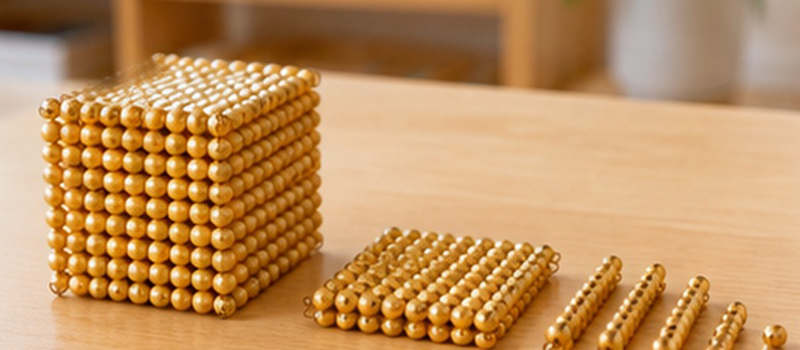
For example, when working with Golden Beads, children can clearly see the difference between one unit, one ten, one hundred, and one thousand. This makes the idea that ten units make one ten, and ten tens make one hundred, much easier to understand.
Over time, children begin to understand the relationship between ones, tens, hundreds, and thousands, which prepares them for reading and writing larger numbers.
Arithmetic Operations
When children begin learning addition, subtraction, multiplication, and division, they usually start by observing how quantities change.
When two quantities are combined, the total becomes larger. When part of a quantity is removed, it becomes smaller. Repeating equal quantities helps children understand multiplication, while sharing a quantity equally introduces the idea of division.
While working with materials such as Golden Beads or the Stamp Game, children can observe these changes first and then gradually connect them with written calculations. This helps them understand what each operation means instead of simply memorizing calculation steps.
Number Patterns and Relationships
As children become more familiar with numbers, they also begin to notice patterns between them.
For example, when counting 2, 4, 6, 8, children can see that the number increases by two each time. The same pattern appears in sequences such as 5, 10, 15, 20. Activities with Bead Chains or Cards and Counters can make these relationships easier to notice.
Children also begin to explore odd and even numbers, skip counting, repeated groups, and other number relationships. At this stage, they are moving beyond recognizing individual numbers and beginning to understand how numbers are connected and how they change.
How Do Montessori Math Materials Help Children Understand Math?
The value of Montessori math materials is not simply that children can touch them. What matters is how clearly the material represents the idea you are trying to teach.
Making Quantity Visible
Young children often understand something more easily when they can see the difference in front of them.
If you write 10 and 100 on paper, the two numbers are visually quite similar. If you place a ten bar beside a hundred square, the difference in quantity becomes much easier to grasp.
This is especially useful when you are working with children who can recite numbers but are still building a real sense of quantity. The material gives the number a size, a form, or an amount that the child can refer back to.
Showing Mathematical Relationships
Montessori materials also let children do something with the relationship they are learning.
They can put quantities together, separate them, line them up, compare their size, or distribute them into groups. That gives you a practical way to introduce ideas that would otherwise need a long verbal explanation.
A child comparing two Number Rods can see which quantity is larger. A child sharing counters between several groups can see whether they divide evenly. The relationship is built into the activity, so you do not have to explain every step before the child can begin to notice it.
Moving From Concrete to Abstract
The goal is not for children to depend on materials every time they solve a math problem.The material is there to help them build an understanding that can eventually stand on its own.
As children become familiar with an idea, they can begin to work with number cards, written symbols, equations, and mental calculation without recreating every quantity first. The physical experience gives them something to refer back to when the symbols become more abstract. This concrete-to-abstract movement is one of the reasons Montessori math materials are usually introduced with a very specific purpose rather than used as general play objects.
What Are the Main Montessori Math Materials?
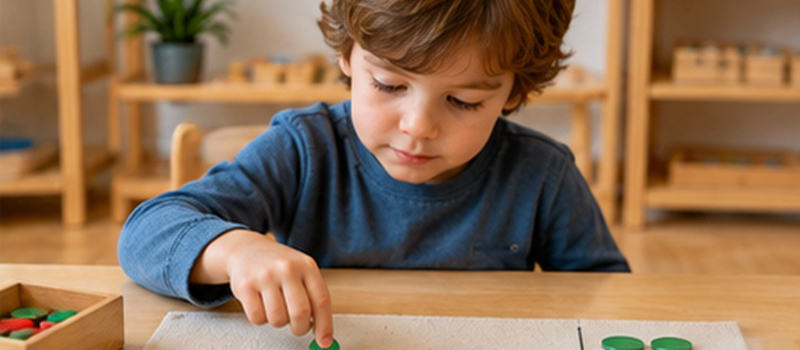
If you are choosing materials for a classroom, it helps to look at what each one is actually meant to support. Several products may all look like “math materials,” but they are not doing the same job.
| Montessori Math Material | Main Purpose |
|---|---|
| Number Rods | Quantities from 1 to 10 |
| Sandpaper Numerals | Recognizing number symbols |
| Spindle Box | Counting, quantity, and zero |
| Cards and Counters | Counting and odd/even numbers |
| Golden Beads | Place value and the decimal system |
| Teen Board | Numbers 11 to 19 |
| Ten Board | Tens and larger number formation |
| Bead Chains | Skip counting and number patterns |
| Stamp Game | Place value and arithmetic |
| Multiplication Board | Multiplication |
| Division Board | Division and equal sharing |
You do not need to fill a shelf with every possible Montessori math product. A more useful approach is to check whether your selection covers the mathematical ideas you actually want children to explore.
For example, if your classroom already has several counting materials, adding another similar activity may not give you much more. You may get more value from adding something that introduces place value or a new type of number relationship. If you are planning a complete classroom, a broader preschool supply list can also help you see how math materials fit alongside the rest of your learning resources.
How to Set Up a Montessori Math Area
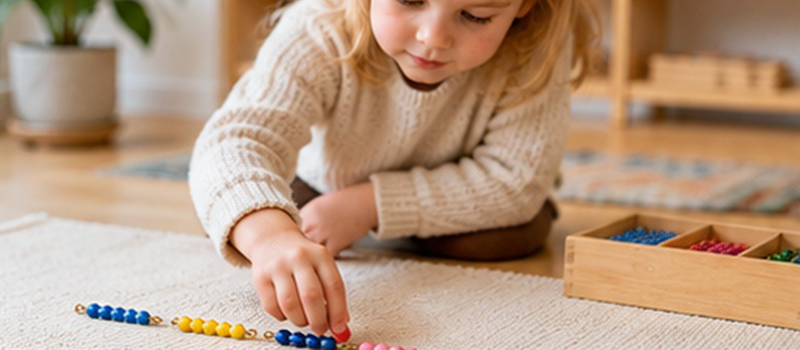
A good math area should make it easy for children to find a material, take it to a suitable workspace, and return it when they are finished. You do not need a complicated layout, but you do need to think about how the materials will actually be used during the day.
Shelving and Material Placement
Low, open shelving works well because children can see the available materials without opening cupboards or waiting for an adult to reach them. Try to leave enough space around each activity so that one tray or set does not disappear behind another.
You can also think about the order in which materials appear on the shelf. The arrangement does not need to become a rigid display, but related materials should be easy to identify and return to the same place.
If you are planning the furniture at the same time, look at the depth of the shelves as well as the height. Some Montessori materials need more room than standard trays or books. West Shore Group’s classroom storage cabinets and open shelving include different shelf configurations that can be matched to the materials you need to store.
Table and Floor Workspaces
Some math activities fit naturally on a child-sized table. Others need more room.
A Stamp Game or card activity can usually stay within a small tabletop area, while Number Rods or longer Bead Chains may be easier to lay out on the floor. If your math area gives children both options, you avoid forcing every activity into the same type of workspace.
What matters most is circulation. Leave enough clear space that a child working on the floor is not constantly interrupted by other children walking between the shelf and the rest of the classroom. If you are setting up several learning areas at once, this is where an overall learning center layout becomes useful because the math area needs to work with the rest of the room rather than as an isolated corner.
Storage and Organization
Small pieces are usually where a math area becomes difficult to manage. Beads, counters, cards, stamps, and number tiles are easy to mix between sets if they do not have a clear place.
Use trays, boxes, or divided containers that make it obvious which pieces belong together. The storage should also be simple enough for children to restore without needing the teacher to reorganize it after every activity.
You will usually notice very quickly whether the system works. If materials are constantly mixed, missing, or left on another shelf, the problem may be the way they are stored rather than the way the child is using them.
How to Choose Montessori Math Materials

When you are buying for a classroom, it is easy to focus on how many materials you can include. A better starting point is to look at what each material adds to the room and whether children will actually be able to use it well.
Start With the Math Concept
Before choosing a product, ask what you want the child to understand through it.
If the purpose is number recognition, you need something different from a material used for decimal place value. If children are already comfortable with basic quantity, another 1 to 10 counting activity may not be the most useful addition.
This keeps your selection purposeful and helps you avoid buying several materials that cover almost the same idea.
Match the Material to the Child’s Current Ability
Age is useful as a general reference, but children in the same classroom will not always be working at exactly the same level.
One child may still be matching numerals with quantities, while another is ready to explore larger numbers or operations. You can prepare materials that give children somewhere to begin and somewhere to move next without expecting everyone to use the same activity.
When choosing, look at what the child already understands and how much new information the material introduces. A good activity should be understandable enough to begin but still give the child something new to work out.
Check Dimensions and Ease of Daily Use
Some materials may have strong educational value but still be inconvenient to use in a real classroom.
Before purchasing, check whether children can:
- Carry the Material Independently
- Comfortably Grasp and Handle Small Pieces
- Return All Parts to the Correct Place After Use
- Move the Material Without Pieces Easily Falling Out
- Take It From the Shelf Without Disturbing Nearby Materials
These may seem like small details, but they often determine whether a material becomes part of daily classroom use or ends up staying on the shelf.
Consider Storage and Classroom Space
Before adding more math materials, look at the space you already have.
Large materials need enough shelf depth. Small-piece activities need containers. Floor work needs open space nearby, and table activities need a suitable surface. If all of those compete for the same small corner, the area will quickly feel crowded.
It can help to plan the math area as part of your full classroom design rather than choosing the materials first and finding a place for them later. That way, you can match shelving, table space, floor space, and the amount of material to the room you actually have.
FAQs
1. At What Age Should Children Start Montessori Math?
There is no single age that works for every child. You can usually begin with simple activities involving counting, comparing quantities, and matching numbers with amounts. What matters more than age is whether the child is beginning to show interest in numbers and quantities.
2. When Can Children Move From Montessori Materials to Written Math?
Children can gradually begin working with number cards, written symbols, and simple equations once they no longer need materials every time they solve a problem. The transition does not need to happen all at once. Concrete materials and written math can be used together for a period of time.
3. Should You Introduce a New Activity If a Child Keeps Repeating the Same Montessori Math Material?
Not necessarily. Repetition is a normal part of Montessori learning. If the child is still focused and becoming more confident with the material, there is usually no need to replace it immediately. You can introduce the next activity when the current one becomes very easy and no longer offers much new challenge.
4. Can You Use Montessori Math Materials Without Following a Full Montessori Program?
Yes, but it helps to understand the mathematical purpose behind each material. Montessori math materials are designed to represent specific concepts, so they are most useful when children are guided toward the idea the material is meant to demonstrate rather than using it only as a general play activity.
5. Can Children at Different Math Levels Share the Same Montessori Math Area?
Yes. You can prepare materials at different levels so children can work according to their current understanding. Some children may still be matching numerals with quantities, while others may already be exploring larger numbers, place value, or basic operations. This allows one math area to support different stages of learning.
Conclusion
A Montessori math area works best when every material has a clear purpose and a practical place in the room. You do not need to make the area complicated. Choose materials that suit what your children are ready to explore, then give them enough space to use those materials comfortably.
If you are planning a Montessori classroom, West Shore can help you coordinate math materials, shelving, tables, storage, and the overall classroom layout so the space works together from the beginning.