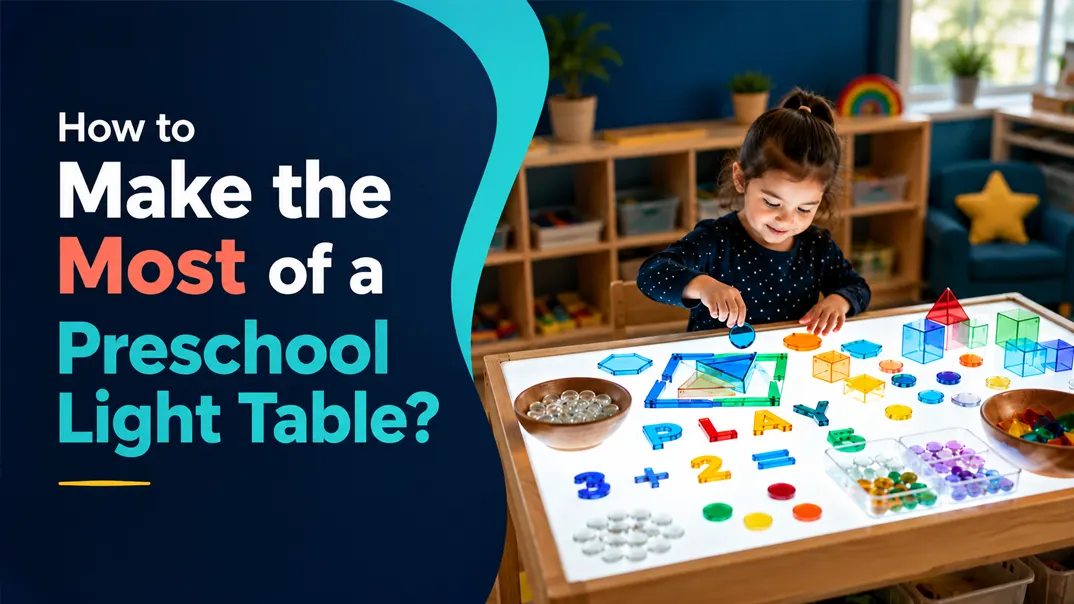
Many preschools purchase Light Tables but only use them for simple color observation or building with transparent blocks. Activities lack variety, and the tables are often poorly placed, failing to maximize the value of the preschool Light Table.
Light itself doesn’t create valuable learning experiences. If you don’t know how to fully utilize a preschool Light Table, it may quickly become just an expensive table for stacking transparent blocks.
The Benefits of Light Tables in Early Childhood Classrooms
In early childhood education environments, the Light Table has become an increasingly popular teaching tool. It’s more than just a table that lights up; it’s a multifunctional table that can stimulate children’s exploration, creativity, and sensory development.
Stimulating Sensory Exploration and Focus
The core value of the Light Table lies in its unique visual appeal. You can use it to attract children’s attention and focus their gaze on objects placed on the table. On a regular table, children may only notice the general color and shape of objects. On a light-transmitting table, features such as the outline, internal details, transparency, and color overlap of objects are more easily observed.
Promoting Multidisciplinary Learning and Teaching
You can’t think of the Light Table as a single-purpose sensory device. It’s a highly flexible, interdisciplinary teaching tool that can be applied to multiple learning areas. For example, in scientific research, you can use the Light Table to let children observe the translucency of objects or engage in simple light and shadow activities. You can also use the Light Table for spelling or language learning, enhancing visual feedback and writing interest through light illumination.
Supporting Learning for Children with Special Needs
If your classroom has children with special needs, a light table can provide a soft, calming atmosphere, helping children with sensitive or overstimulated senses to self-regulate and relax. The light from the light table can also help children with difficulty focusing to concentrate better.
Versatility and Space Utilization
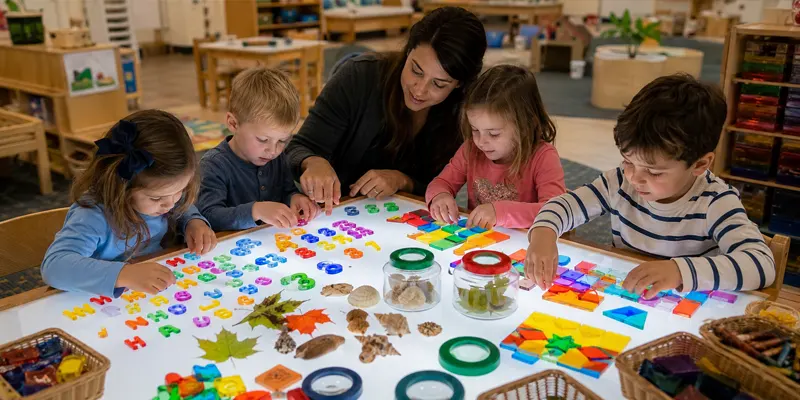
Light tables can enrich your classroom activities, providing a space for individual exploration by a single child or for collaborative group activities of 2-4 children, promoting social interaction and language.
You can also combine light tables with sensory tables or sand-water tables. For example, placing a transparent sand tray or water dish on the light table allows children to observe the subtle changes in sand and water under the light, enhancing sensory experiences while reducing the space required.
Choosing the Right Light Table
First, determine how you will use this light table in your classroom. The right choice depends on the space, the number of children, and your expected frequency of use.
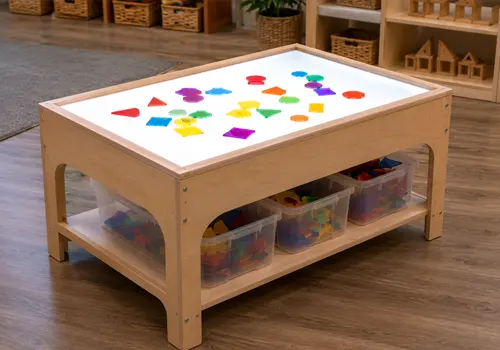
Standard Light Tables
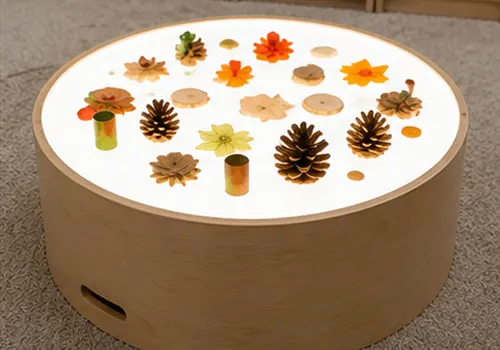
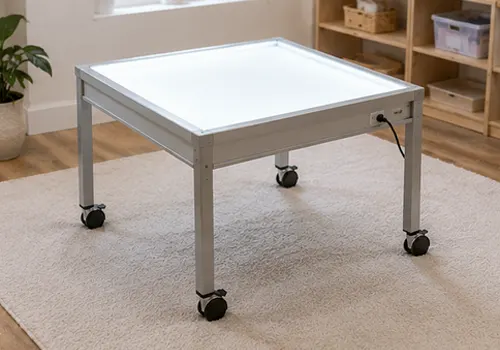
Common light tables have their own legs, base, or cabinet structure. They are relatively larger, allowing multiple children to work simultaneously, making them more suitable for long-term use in learning centers, but they are also more expensive. It’s recommended to choose a light table with storage to increase storage space and make it easier to tidy up materials on the table.
These are also larger, allowing multiple students to use them at the same time. Although they are more expensive, they can be used in your center for a long time. It’s recommended to choose a model with shelves to increase storage space! Laying a cloth along the edge can cover items on the shelves.
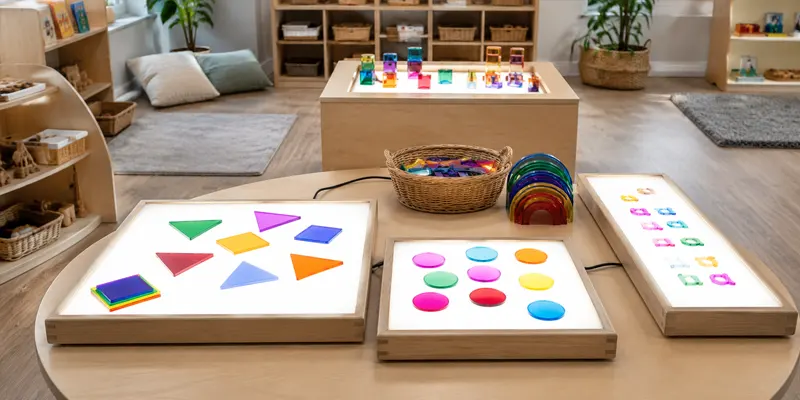
Light Panels
These small light tables have become increasingly popular in recent years. They are a good option if you have limited classroom space and a limited budget. Light panels are small and can be placed directly on existing tables or low surfaces, making them easier to move and store.
Light Table Supplies and Materials
You don’t need to buy a lot of Light Table activity materials. You can use some teaching materials and supplies that are already in the classroom for Light Table activities. For example, some transparent or semi-transparent sensory toys or art and craft materials, etc.
Below is a list of materials and supplies that our clients frequently purchase for Light Table activities:
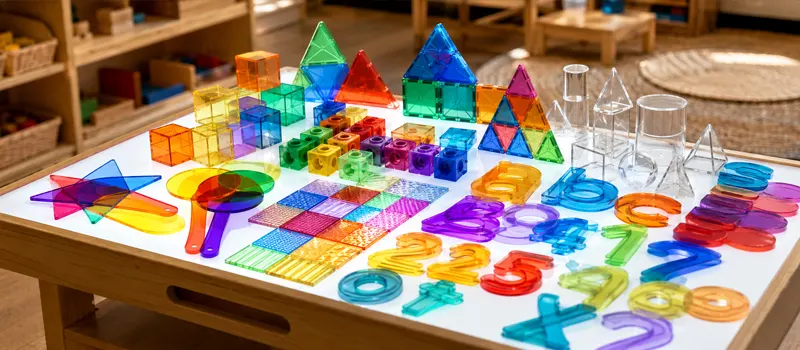
Transparent and Translucent Materials
These materials allow colors, edges, and overlapping areas to be clearly visible. They are also the most common light table materials in classrooms.
- Acrylic shapes
- Transparent blocks
- Magnetic tiles
- Colored paddles
- Transparent letters and numbers
- Patterned blocks
- Connecting cubes
- Clear geometric shapes
- Translucent letters and numbers
Don’t pile all translucent items on the table. Choose a small group of items that support the current learning objective.
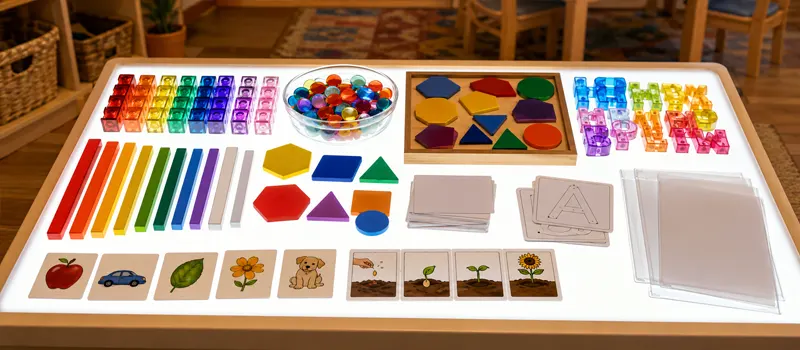
Math and Literacy Materials
For early learning, you can use:
- Transparent number blocks
- Counting chips
- Shape sorting
- Measurement bars
- Geometric shapes
- Transparent letter blocks
- Business cards
- Letter outlines
- Picture cards
- Story sequence images
- Clear writing paper
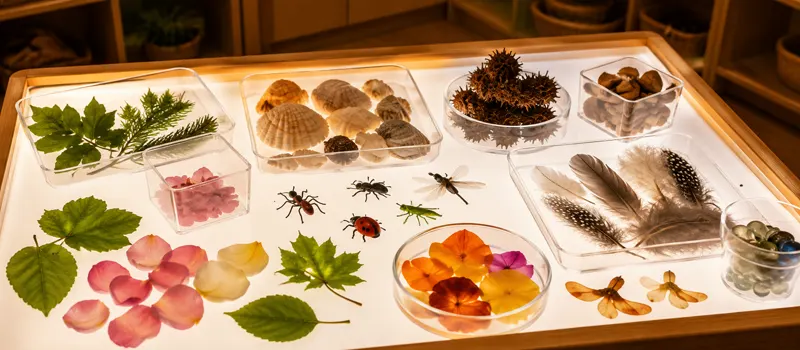
Scientific and Natural Materials
Scientific materials may include:
- Leaves
- Petals
- Feathers
- Seashells
- Seed pods
- Transparent containers
- Insect models
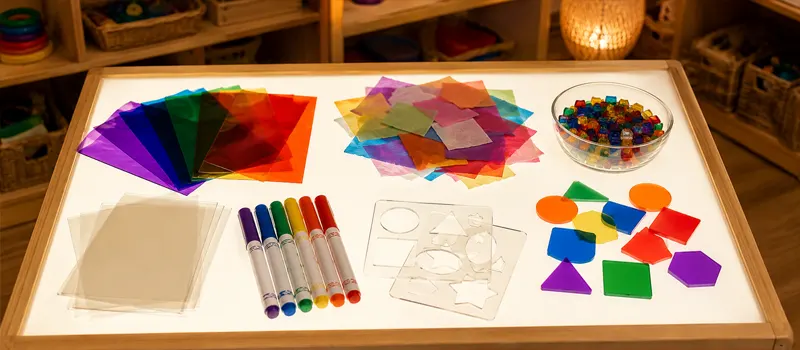
Art Supplies
You can use:
- Colored cellophane
- Tissue paper
- Acrylic mosaic tiles
- Transparent drawing paper
- Washable markers
- Clear pattern templates
- Colored plastic shapes
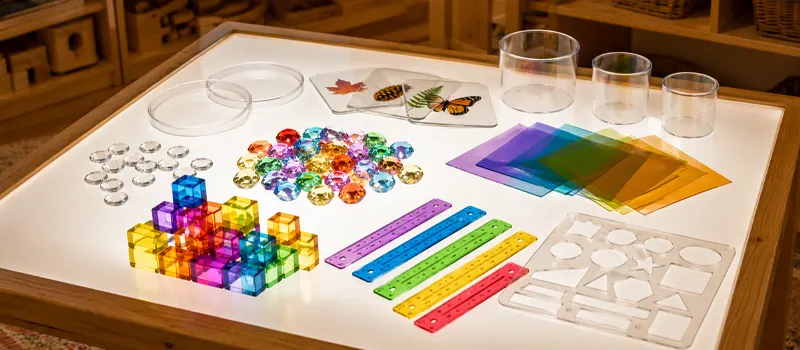
Everyday Classroom Supplies
You may already have many usable items:
- Transparent plastic lids
- Laminated images
- Transparent containers
- Clear buttons
- Plastic gems
- Acetate sheets
- Transparent building blocks
- Colored rulers
- Template
Place the Light Table in the Correct Area of the Classroom
Once you have your Light Table and materials ready, don’t just place them wherever you like. Placing the Light Table in the correct classroom area maximizes its educational value and creates synergy with other learning activities.
Below are our best area selection and layout suggestions based on working with many clients.
Positioning it as a “Transition Zone” and “Collaboration Hub”
The best location for a light table isn’t necessarily a specific area of the classroom. You can use it to connect multiple activity centers or serve as a central area for group collaboration.
The unique visual appeal of the light table naturally attracts the attention of passing children. Placing it at the intersection of multiple areas encourages children to switch and extend between different activities, promoting interdisciplinary learning.
For example, placing the light table between the science and art areas allows children to naturally transition from scientific exploration to artistic creation, expressing their observations through drawing or light and shadow games.

Surrounding Environment
The light table should not be placed in isolation; it needs to form a cohesive learning center with other furniture. You can place tables and chairs, soft flooring elements, and storage cabinets around it.
You also need to pay attention to lighting. It’s recommended to place it in a location with adjustable lighting or away from strong light sources to maximize the visual effect of the light table.
Orientation and Safety
The orientation and placement of the light table directly affect the interactive experience and safety. You can position the long side of the light table towards the center of the classroom or the main activity aisle, rather than facing a wall. This allows children to conduct group discussions and collaborations around the table, and teachers can observe the children’s activities from various angles.
The light table needs to be connected to a power source, so ensure there is a power outlet nearby when choosing a location. All cords should be run along the base of the wall or secured with cord storage channels to prevent cords from crossing aisles and tripping children.
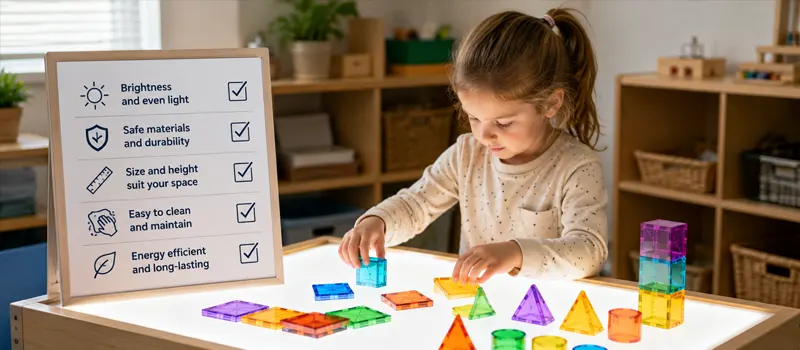
What to Look for When Buying a Light Table?
Light Source Type and Integration Method
This is the core function of a Light Table, and also the most easily overlooked issue when purchasing one.
You need to confirm whether the Light Table uses an integrated LED light source. An LED light table has built-in LEDs on the desktop; it’s plug-and-play, requiring no complicated installation or additional purchase.
Regarding light color and adjustment functions, we recommend choosing a light table with multiple color adjustment options. You can choose different light colors according to the teaching theme or the child’s mood. For example, use cool white light for scientific observation and colored light for artistic creation.
Electrical Safety and Certification Standards
Since the light table is an electrical product, you must pay attention to electrical safety.
Different countries have different safety certification requirements for electrical products:
- North American market: Usually requires UL or CSA certification.
- European market: Requires CE certification.
- Australian market: Requires compliance with Australian standards (such as AS/NZS).
Ensure the light table’s power adapter is compatible with the voltage standards of the target country (e.g., North America 110V/120V, Europe 220V/240V).
Desktop Material and Durability
The desktop of a light table needs to withstand the high frequency of daily use by children. For kindergarten environments, you can choose acrylic material. Although its light transmittance is slightly lower than tempered glass, it is more impact-resistant and less prone to breakage.
When inspecting the product or asking about product details, observe whether the desktop is smooth, free of burrs, and easy to clean. Ensure that the edges are rounded to ensure children’s safety.
Size and Height Suitability
The size and height of the light table need to be matched to the age group of children using it and the classroom space.
Common light table sizes need to accommodate 2-4 children for group activities at the same time. You can choose a light table with adjustable legs to accommodate the height needs of children of different ages.
Light Table Creative Activities
The following activities use simple materials and can be adapted to different age groups. You do not need to complete all the activities at once; please choose one based on your current learning goals.
Magic Light Easel: Children can draw directly on the illuminated surface of the lamp table, creating artworks with different feelings by changing the color of the light. This experience of “creating artworks with different feelings by changing the light” greatly stimulates children’s creativity.
Color Mixing Experiments: Place transparent cups or plastic sheets on the lamp table and let children stack red and blue gel sheets together to observe how purple is formed under light. This intuitive visual feedback helps children deeply understand the relationship between primary and secondary colors.
Transparent Object Observation: The backlighting of the lamp table perfectly highlights the details of translucent objects. Children can observe the veins of leaves, colored blocks, crystals, seashells, and other objects on the lamp table.
Sand/Salt Writing Tray: Place a shallow, transparent tray on the lamp table and spread fine sand or salt on it. Children can use their fingers or small sticks to write letters, numbers, or draw on it. The soft backlighting clearly outlines the strokes. Letter Spelling & Tracing: Place transparent letter cards on a lamp table and let children trace the letter shapes under the light using sticks or their fingers. Alternatively, use transparent letter puzzles to let children spell simple words under the light.
FAQs
Does a light table need to be used in a dark room?
No. Avoid direct sunlight and strong reflections, but keep enough ambient light for safe movement and supervision.
How many children should use a light table at once?
Base the limit on the usable surface and the activity. Each child should have enough room to move materials without reaching across another child’s work.
How often should you change the materials?
Change them when interest or learning begins to slow. An activity can remain for several days or longer when children are still developing new ideas.
Can you leave a light table on all day?
Follow the manufacturer’s instructions. Turn it off when it is not being used unless the product guidance states otherwise.
How should you clean a preschool light table?
Switch it off and disconnect the power before cleaning. Use a soft cloth and a cleaning product approved by the manufacturer. Keep liquid away from seams, switches, plugs, and electrical components.
How long should a preschool light table activity last?
There is no fixed session length. Let children continue while they remain focused, purposeful, and comfortable. For guided activities, 10 to 20 minutes is often enough, while open ended construction or investigation may continue much longer.
Conclusion
Making the most of a kindergarten’s light tables doesn’t require a lot of specialized toys. All you need is a table suitable for the children and the room size, a carefully selected set of materials, and a clear reason for each placement.
You can purchase light tables at West Shore. We offer various types of light tables and customization services. We will also help you with the placement and arrangement of light tables based on your classroom situation.