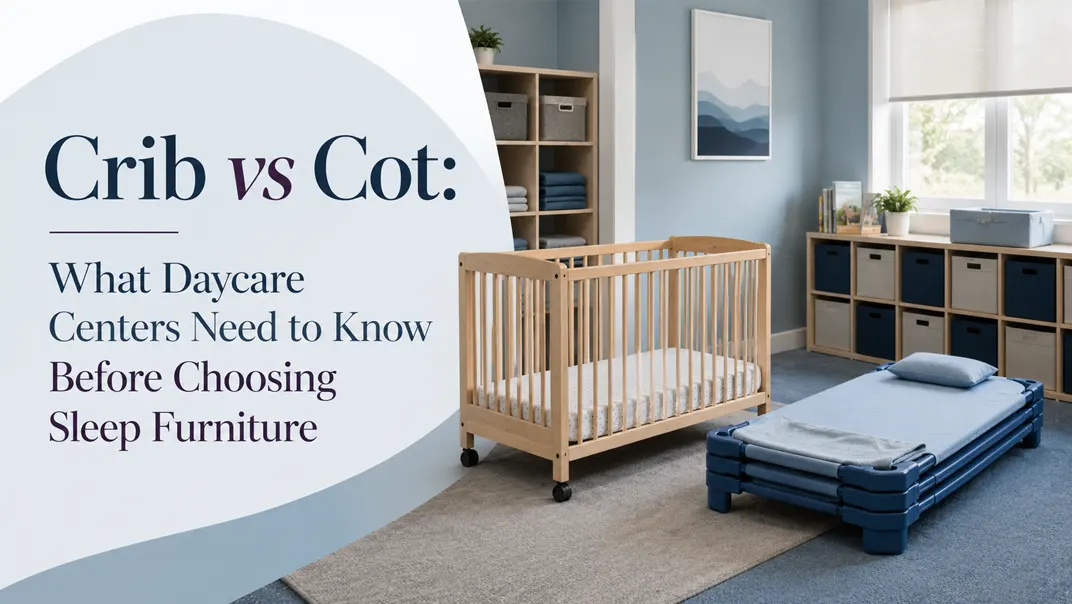
When schools, early learning classrooms, and childcare projects choose sleep furniture, the words crib and cot can easily confuse. In some countries, these two words may describe almost the same type of baby bed. In other markets, they may refer to very different products.
This difference matters because sleep furniture is closely connected with age group, classroom layout, daily supervision, cleaning, storage, and safety requirements. A product called a cot in one market may be understood as a crib in another. A supplier may use one word, while a school buyer, classroom planner, or project designer may use another.
For classroom projects, the key question is not simply which word is correct. The real question is:
Which sleep furniture is suitable for the children’s age, the classroom space, and the way the room is used every day?
In this guide, we will explain what a crib is, what a cot is, and how to understand the difference between crib vs cot before choosing sleep furniture for infant, toddler, or preschool classrooms.
What Is a Crib?
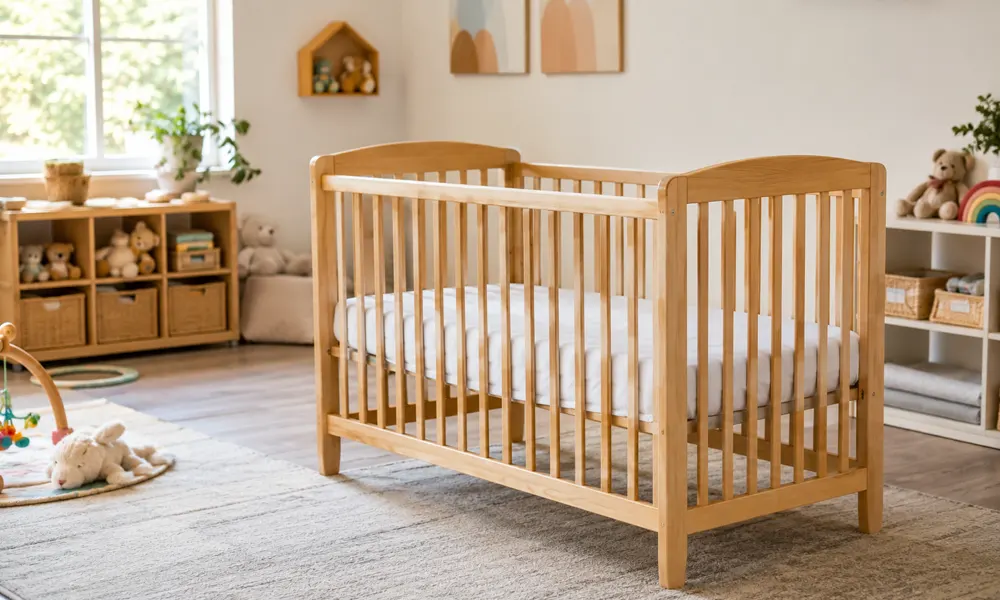
A crib usually refers to a small bed designed for babies and young infants. It has raised sides or rails to create a protected sleeping space. In North America, especially in the United States and Canada, crib is the most common word used for this type of baby sleep furniture.
In classroom settings, cribs are usually used in infant rooms or baby care areas. They are designed for children who still need a secure sleeping space and cannot safely use a low bed, nap cot, or floor mat by themselves.
- Enclosed railings: Vertical barriers of sufficient height on all four sides (or at least three) to prevent the child from rolling out or falling during sleep.
- Fixed dimensions: Whether for home use (approx. 100 x 56 cm) or the smaller sizes common in daycares (e.g., 100 x 60 cm), the length and width specifications are fixed and relatively compact.
- Safety standards: All compliant cribs must meet strict safety standards, such as specific spacing between railings (usually no wider than 6 cm to prevent a child’s head from becoming trapped).
What Is a Cot?
The meaning of cot depends strongly on the country and the product context.
In British English, Australian English, and New Zealand English, a cot usually means a baby bed with raised sides. In this sense, a cot is very close to what North American buyers call a crib.
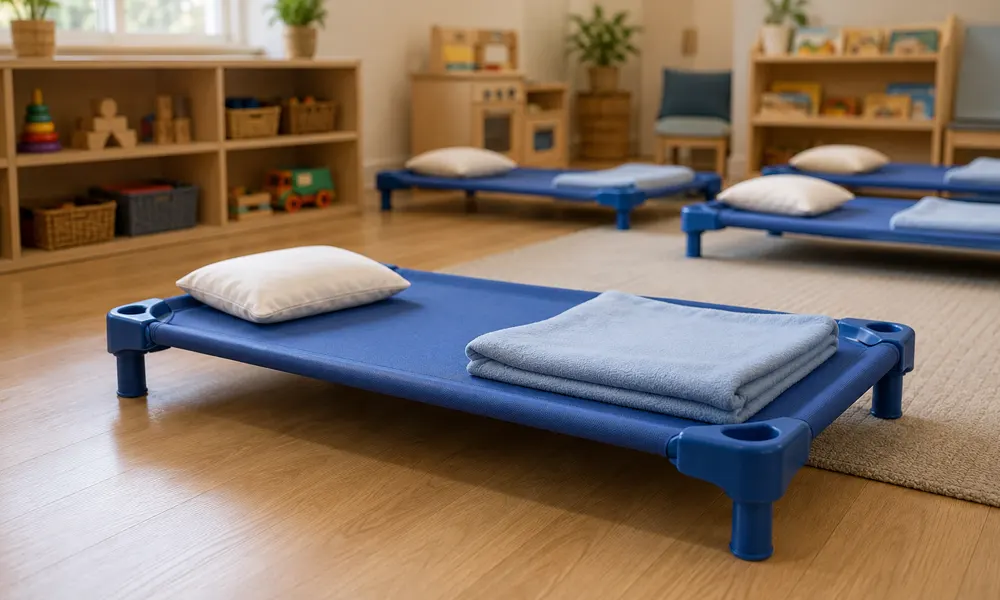
Common cot features may include low height, lightweight structure, easy-clean materials, rounded corners, breathable fabric or mesh surfaces, and space-saving storage design.
- Low-profile design: These cots are typically very low to the ground—around 14 cm high. This allows toddlers to get in and out easily with a teacher’s assistance, without needing to climb over guardrails.
- Open structure: Many of these cots are stackable and lack high side rails, resembling low, cushioned platforms instead. This design facilitates easy storage and allows teachers to monitor and care for the children during naptime.
- Clear age guidelines: Stackable cots are intended for toddlers aged one year and older. Use by 11-month-old infants is permissible only under the close supervision of a teacher.
Crib vs Cot: Are They the Same?
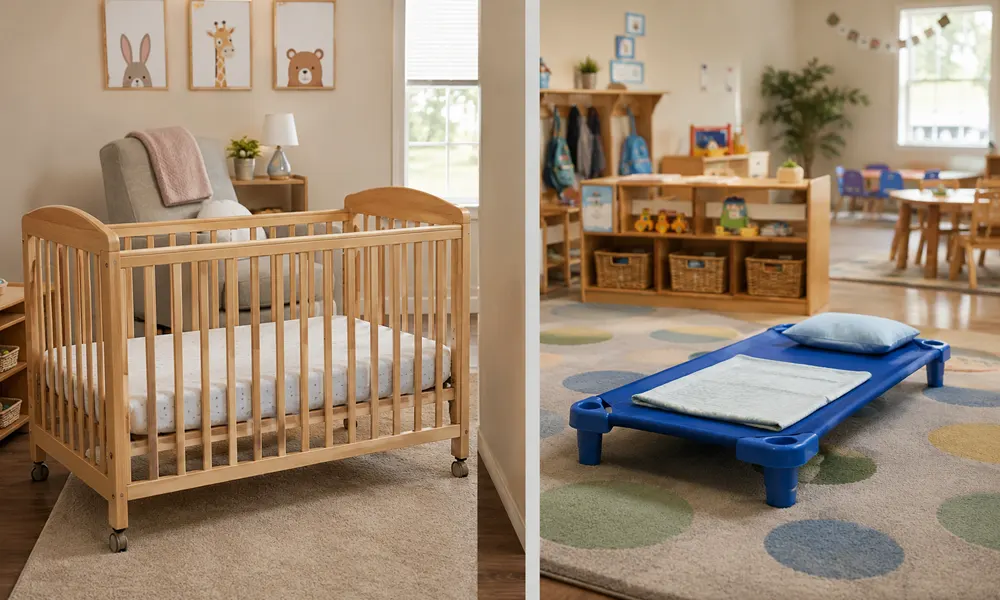
In daycare centers or home-based childcare settings, the terms “crib” and “cot” are often used interchangeably; however, they differ fundamentally in terms of product design, age suitability, and core functionality. For those setting up a preschool or home childcare space, accurately understanding the distinctions between the two is the first step toward making the right purchasing decisions.
The following is a key comparative analysis of the two.
1. Distinctly Different Target Age Groups
Crib: Designed specifically for infants aged 0 to 1.5 years. Babies at this stage cannot yet climb out of the enclosure on their own and require a safe sleeping space that is fully enclosed on all sides with high railings. In a home setting, a crib may also serve as a bedside sleeper to facilitate close co-sleeping during the newborn phase.
Cot: Designed specifically for toddlers (aged 1+) and preschoolers. In daycare centers, cots are the primary equipment used for toddler naps.
2. Differences in Core Structure and Functional Design
| Comparison Dimension | Crib | Cot |
|---|---|---|
| Guardrail Structure | High guardrails on all four sides with an enclosed design to prevent babies from climbing or falling out. | Low and open structure, usually with no guardrails or very low side rails, making it easy for toddlers to get on and off independently. |
| Height Design | The sleeping surface is relatively high and usually comes with an adjustable mattress base. | Very low to the ground. A common height is around 14 cm, allowing toddlers to get on and off easily by themselves. |
| Mobility & Storage | Usually used as fixed furniture. Some models come with wheels for moving within a room. | The key advantage is stackability, making it easy to store quickly after nap time and save classroom space. |
| Additional Functions | May include rocking functions or bedside connection features for use with parents’ beds. | Designed mainly for bulk use and efficient classroom management, usually without extra functions. |
3. Usage Scenarios: Home vs. Daycare
Cribs are more commonly found in home environments. They are pieces of nursery furniture that need to complement the home’s décor while offering both functionality and aesthetic appeal. When communicating with us, customers prioritize features such as rocking capabilities, methods for attaching the crib to the parents’ bed, and the materials used.
Cots, on the other hand, are a standard fixture in daycare centers. Key considerations here include ease of stacking, compatibility with cot carriers, color uniformity, and cost-effectiveness.
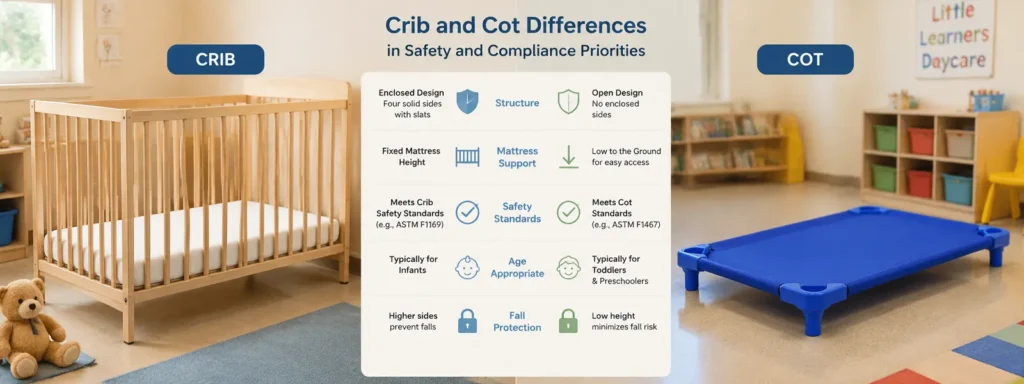
4. Differences in Safety and Compliance Priorities
Safety standards for cribs primarily focus on the spacing between slats, the use of non-toxic materials, and structural stability.
Safety standards for cots, on the other hand, focus more on low profiles to prevent falls, smooth surfaces free of sharp edges, and ease of supervision by caregivers. Cots place greater emphasis on age-appropriateness and safety monitoring.
5. No Need to Specify the Country or Background
| Market or Context | Common Word | Usual Meaning |
|---|---|---|
| United States | Crib | Baby bed with raised sides |
| Canada | Crib | Baby bed with raised sides |
| United Kingdom | Cot | Baby bed with raised sides |
| Australia | Cot | Baby bed with raised sides |
| New Zealand | Cot | Baby bed with raised sides |
| North American classroom setting | Cot / Nap Cot | Low nap-time bed for toddlers or preschool children |
This difference is very important for classroom planning. If the product is for an infant room, buyers usually need a crib or baby cot with raised sides. If the product is for a toddler or preschool nap area, a low nap cot, stackable cot, or rest mat may be more practical.
Before choosing between crib and cot, buyers should confirm several basic points:
- What age group will use the product?
- Does the product have raised sides?
- Is it for infants, toddlers, or preschool children?
- Will it stay in one place, or be stored after nap time?
- Is the mattress or sleeping surface included?
- Is the product easy for teachers to clean and manage?
- Does the design fit the classroom layout?
Crib vs Cot for Daycare Centers
Below is a guide to making the right choice based on different scenarios, compiled from our years of experience working with daycare centers worldwide.
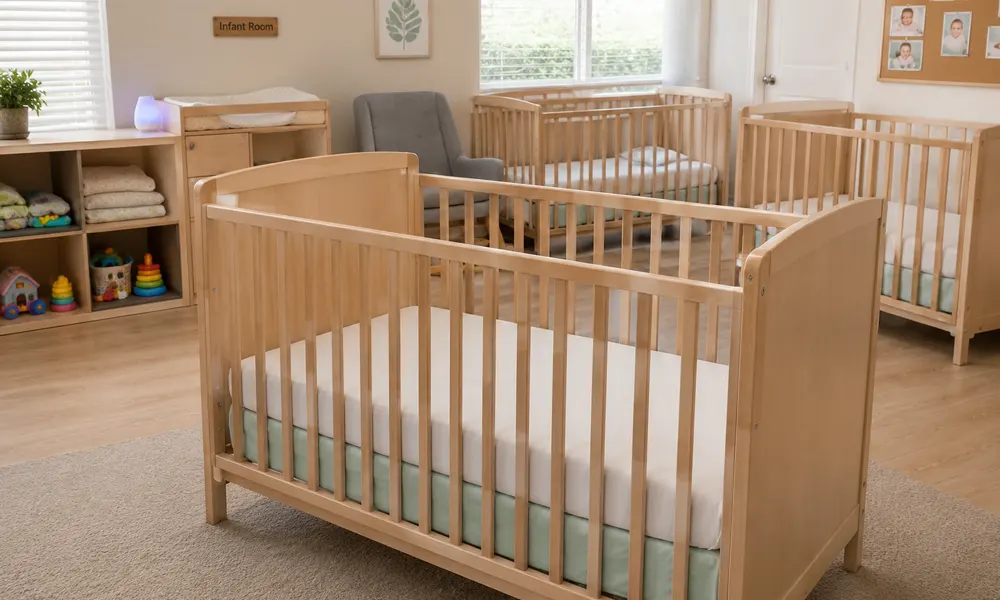
For Infant Rooms
In the nursery, the only criterion for selection is to provide the child with a safe, independent, regulatory-compliant sleeping space.
Recommended product: Crib
Reasons for Recommendation:
- Safety First: Infants (aged 0–1.5 years) cannot climb out of an enclosure on their own; they require an enclosed sleeping space with high sides to prevent them from rolling out or falling while asleep. Standard daycare cribs must meet strict safety regulations, such as having rail spacing of no more than 6 cm.
- Dedicated, Individual Setup: Each crib is assigned to a single child; stackable functionality is not required.
- Regulatory Compliance: In countries like Canada, sleeping equipment in infant rooms must meet standards set by agencies such as the CPSC (Consumer Product Safety Commission).
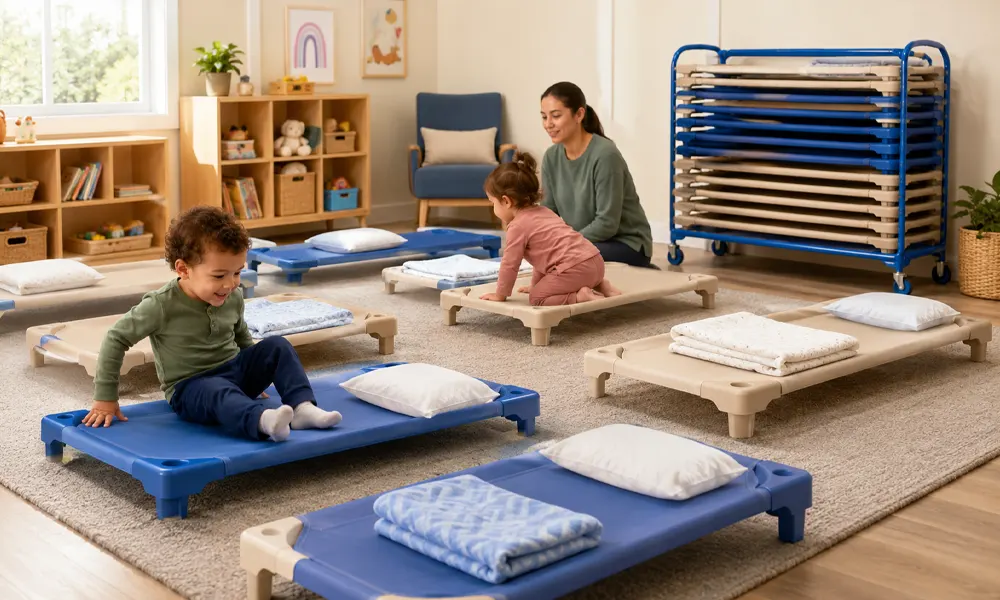
For Toddler Rooms
In the toddler room, children are already capable of crawling and standing independently, and may even be attempting to walk. The goal is to ensure safety while effectively managing daytime naps and optimizing space utilization.
Recommended Product: Cot
Reasons for Recommendation:
- Low-profile design for independent use: Toddlers can get in and out of bed on their own, eliminating the need for high railings. Standard toddler cots are very low (e.g., the common 100x53x14cm size), allowing teachers to easily assist children in lying down and to monitor each child during naptime clearly.
- Stackable design for space efficiency: This is the cot’s primary advantage. After naptime, dozens of cots can be quickly stacked or stored together using a cot carrier, freeing up floor space for other activities.
- Clear size differentiation: Toddler rooms often require cots of various sizes to accommodate children of different ages and body types.
- Color and identification: Cots are typically available in colors such as blue and beige, making it easy for teachers to assign them and for children to recognize their own, which helps foster a sense of personal ownership.

For Preschool Nap Areas
In preschool classrooms, nap time remains a key part of the daily routine; however, the children are older and larger, and there is a need for greater efficiency in transitioning the space.
Recommended Product: Standard-sized cot
Reasons for Recommendation:
- Accommodating Physical Size: Preschoolers (ages 3–5) are significantly larger than toddlers, so they require longer cots. A common choice is the standard cot measuring 138 x 58 x 14 cm.
- Maximizing Batch Management Efficiency: Preschool classrooms often have the highest number of students (up to 24–25), placing a premium on the efficiency of stacking and moving cots. Using uniform standard cots paired with matching cot trolleys minimizes the time required to transform the nap area.
- Prioritizing Functionality: In preschool settings, furniture functionality and durability take precedence over aesthetics. Since children only take short midday naps, complex sleep features are unnecessary; instead, the focus is on stackability, durability, and regulatory compliance.
- Management of Spares and Wear Parts: Due to frequent use, it is essential to maintain an adequate supply of spare parts for preschool cots.

How to Choose Between a Crib and a Cot for Childcare Projects?
When choosing between a crib and a cot for a classroom project, buyers should start from the actual room use. The right product is the one that fits the children, the space, and the daily routine.
Consider the Age Group First
Age is the most important starting point. Different choices are required depending on the stage of development.
A practical guide:
| Age Group | Common Sleep Furniture |
|---|---|
| 0–12 months | Crib / baby cot |
| 12–24 months | Crib, low cot, or nap bed depending on readiness |
| 2–3 years | Nap cot, low nap bed, or rest mat |
| 3–5 years | Stackable cot, preschool nap bed, or rest mat |
Assess your space and storage needs
This is the second key factor in deciding between a crib and a cot.
If space is limited and you need to quickly switch between activity areas, choose a cot. Its main advantage is stackability; after nap time, teachers can rapidly stack dozens of cots or load them onto a cot carrier, freeing up space for other activities.
If you have ample space and a dedicated sleeping area, you might choose a crib. Cribs are typically placed as permanent fixtures in a specific area of the nursery, eliminating the need to put them away or rearrange the room daily.
Consider Your Operational Model and Compliance Requirements
For baby cribs: It is necessary to confirm compliance with the stringent US CPSC safety standards or the Canadian ASTM F963 standard.
For cribs: An overly strict “anti-rollover” design is not necessary, as they are inherently very low. However, you need to confirm that they meet local specifications for daycare center nap supplies.
Check the Product Material
Classroom furniture is used every day, so material quality matters. Wooden cribs should have smooth surfaces, rounded corners, strong joints, and safe finishes. Cots should have stable frames, easy-clean surfaces, and durable fabric or panels that can handle repeated use.
Partnering with Preschool Furniture Manufacturers
Preschool furniture manufacturers can help determine the appropriate furniture types, dimensions, materials, construction, and quantities based on actual classroom layouts.
For those responsible for procuring classroom supplies, this level of support is particularly valuable when outfitting multiple classrooms simultaneously. It minimizes product mismatches, saves time on communication, and helps create sleeping areas that are better suited to the needs of both children and teachers.
West Shore is dedicated to providing age-appropriate sleeping furniture and comprehensive classroom solutions for educational projects. From cribs to stackable nap cots and storage units, we help buyers plan their product selection based on room size, daily usage patterns, and specific project requirements.
FAQs
Is a cot the same as a crib?
In some countries, yes. In the UK, Australia, and New Zealand, a cot often means the same type of baby bed that North American buyers call a crib. In the United States, cot may also mean a nap cot or rest bed used by older children in classrooms.
Which is better for an infant room, a crib or a cot?
A crib or baby cot is usually better for an infant room because it has raised sides and provides a protected sleeping space. Buyers should also check mattress fit, stability, visibility, and cleaning convenience.
When should children move from a crib to a cot?
The timing depends on the child’s age, mobility, development, and local childcare rules. In general, older toddlers and preschool children may use low nap cots, rest mats, or nap beds when they can rest safely in an open sleeping space.
What should buyers check before ordering cribs or cots?
Buyers should check the product size, age range, structure, material, mattress size, safety details, cleaning method, storage requirements, packing details, and whether assembly instructions are included.
Do cribs and cots need safety certificates?
For classroom and childcare projects, buyers should ask suppliers for product specifications, material information, test reports, and safety certificates where required. The exact requirements may depend on the destination country or local regulations.
How many cots does a classroom need?
The quantity depends on the number of children, classroom size, nap routine, and storage space. Buyers should also leave enough room for teachers to walk between sleeping areas and supervise children during rest time.
What is the best sleep furniture for preschool classrooms?
For preschool classrooms, stackable nap cots, low nap beds, or rest mats are often practical choices.
Conclusion
The difference between crib and cot is not only about wording. In real classroom projects, it affects age suitability, room planning, safety, storage, cleaning, and teacher workflow.
For classroom buyers, the best choice comes from the actual use scene. Before deciding between a crib and a cot, consider the children’s age, the room layout, the daily nap routine, the cleaning process, and the storage space. A product that fits the classroom will make rest time safer, smoother, and easier to manage.
When planning a full classroom project, working with an experienced preschool furniture manufacturer can help buyers choose the right sleep furniture for each age group and avoid costly purchasing mistakes.