If you have ever looked around a Montessori classroom, you may notice toys made of wood are common because they usually have natural colors, simple designs, and very few lights, sounds, or complex electronic features. This is not only about making toys look more natural. It also fits well with the Montessori focus on sensory exploration, concentration, and independent activity.
So why has wood become one of the most common materials for Montessori toys? This article explains why Montessori toys made of wood remain so widely used and what you should pay attention to when choosing them.
Why Did Early Montessori Toys Made of Wood?
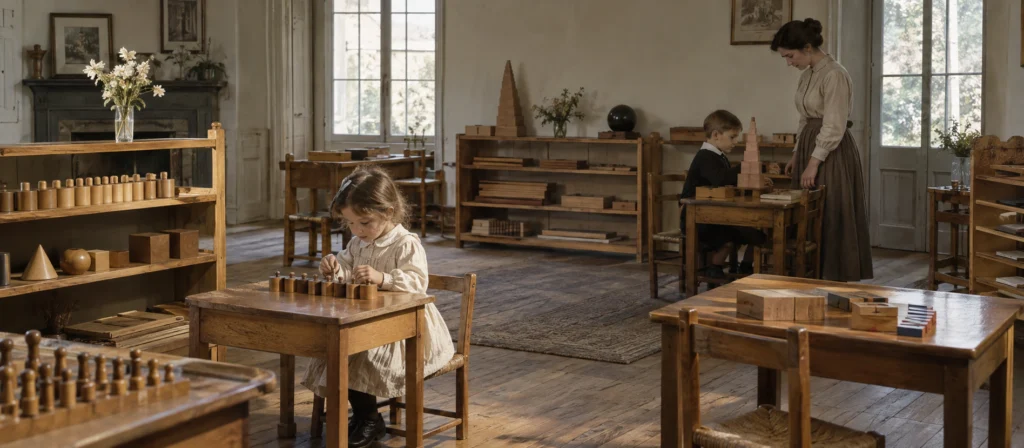
In the early 20th century, wood was one of the most common materials for children’s furniture and educational aids, and woodworking techniques were already quite mature. Early Montessori materials were made of wood largely because it was a common and readily available material for making toys at the time. Many Montessori teaching aids need to be made into regular squares, cylinders, and geometric shapes, while maintaining accurate dimensional variations, and wood is well-suited for this processing method.
Early educational materials also needed to withstand repeated handling, arrangement, and manipulation by children. Wood is inherently sturdy and possesses a certain weight; furthermore, if damaged, it could be repaired and remain in use. Compared to other available materials of the era, wood offered an optimal balance of manufacturability, durability, and cost-effectiveness.
Thus, the use of wood in early Montessori materials was primarily driven by its compatibility with the manufacturing technologies of the time and its ability to meet the requirements regarding dimensions, structure, and long-term durability.
Why Are Montessori Toys Still Commonly Made of Wood Today?
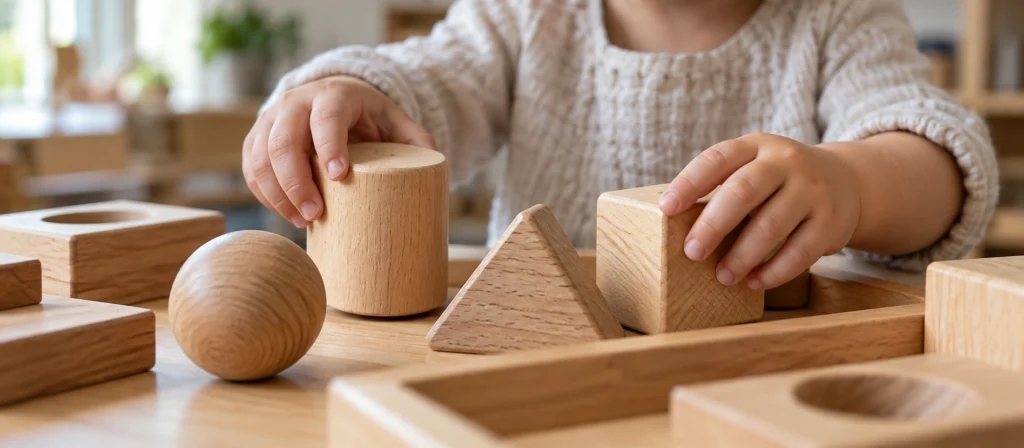
Today, children’s products can be made from many more materials, but wood is still common in Montessori environments. One reason is simple. The basic way children use Montessori materials has not changed just because manufacturing technology has improved.
Children still pick materials up, compare them, arrange them, insert pieces, combine parts, complete an activity, and start again. The weight, feel, stability, and durability of wood still work very well for this kind of repeated hands-on use.
Wood Offers a Richer Sensory Experience
If you pick up a wooden Montessori material yourself, you will notice that the experience is not only about color and shape. Wood has its own weight, temperature, and texture. Pieces with different shapes and sizes can also feel noticeably different in the hand.
That is part of what makes wood interesting. When children use it, they are not only looking at an object. They can also feel its weight, notice whether the surface is smooth, and sense changes in its edges and shape. Research on the tactile perception of wooden surfaces has also found that surface treatment, texture, and smoothness can affect how people experience wood through touch.
So when you choose wooden Montessori toys, color is worth considering, but it is not the only thing to look at. Pick the material up and feel it. The surface, weight, size, and how comfortably it sits in the hand all affect the actual experience of using it.
Wooden Toys Support Concentration and Repetition
Many Montessori activities ask children to repeat the same action several times. A child might return cylinders to the correct spaces, arrange objects by size, or finish a puzzle and then start again. The child picks up the material, looks at the result, and adjusts the action when needed.
Wood works well for this kind of activity. It has enough weight to provide noticeable feedback in the hand and usually stays stable on a table. Many wooden materials are also simple in design and do not rely on lights, music, or automatic effects to attract attention. This makes it easier for the child to focus on the material and the action being completed.
When the activity itself is clear, children can also return to it and repeat the process more easily. A typical Montessori classroom setup often places materials where children can see and reach them independently, so they can choose an activity, use it, and return it when they are finished.
Wooden Toys Are Suitable for Long-Term Use
In a Montessori school, preschool, or daycare, the same materials may be handled by many children every day. They are picked up, moved, used, and returned again and again, so long-term durability matters.
When properly dried and processed, wood can possess excellent strength; its structure is not easily damaged by frequent handling, minor impacts, or repeated use. In the event of minor surface wear, some wood materials can also be sanded or refinished rather than requiring immediate replacement.
This is one reason wooden toys continue to work well in school environments. They are not immune to wear, but good wooden products can stay stable through frequent use and often offer some room for maintenance later.
What Types of Wood Are Commonly Used for Montessori Toys?
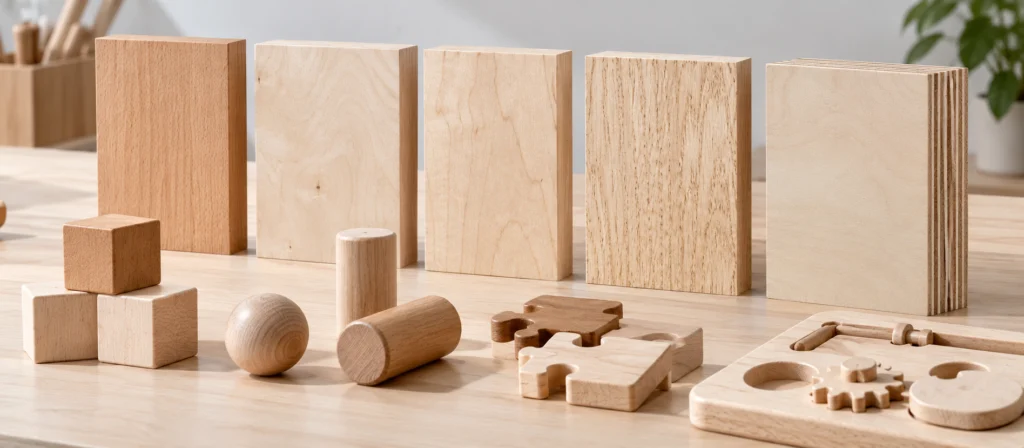
Wooden Montessori toys are not made from just one type of wood. Beech, birch, maple, and rubberwood are all common choices. Larger products also often use birch plywood.
There is no simple answer to which material is best. It depends more on how the product is made and how it will be used. Small grasping or sorting materials may place more importance on hardness and feel, while larger activity boards and structural toys may need better dimensional stability.
| Material | Main Characteristics | Common Uses | Best Suited For |
|---|---|---|---|
| Beech | Hard and wear-resistant, with a fine grain that can be sanded very smooth | Peg toys, blocks, sorting toys, and grasping toys | Small learning materials used frequently |
| Birch | Light in color, with a good balance of strength and workability | Puzzles, blocks, shape sorters, and tabletop materials | General Montessori toys |
| Maple | Hard, wear-resistant, and fine-grained | Fitting toys and fine motor materials | Products that need higher wear resistance |
| Rubberwood | Stable, easy to machine, and relatively affordable | Blocks, pretend play toys, and larger products | Products balancing durability and cost |
| Birch Plywood | Dimensionally stable and suitable for larger flat or structural parts | Puzzle bases, activity boards, wall-mounted materials, and large structural toys | Large panels and structural products |
Plywood is not a separate wood species. It is an engineered wood product made by bonding multiple layers of wood veneer together in alternating directions. This construction usually makes it easier to keep larger panels stable.
The wood name alone also does not tell you the quality of a toy. Two products both labeled Beech or Birch can feel and perform very differently. How well the wood has been dried, how smoothly it has been sanded, and how securely the parts are connected all affect the final result.
So the type of wood matters, but it should never be the only thing you look at.
Is Every Wooden Toy a Montessori Toy?
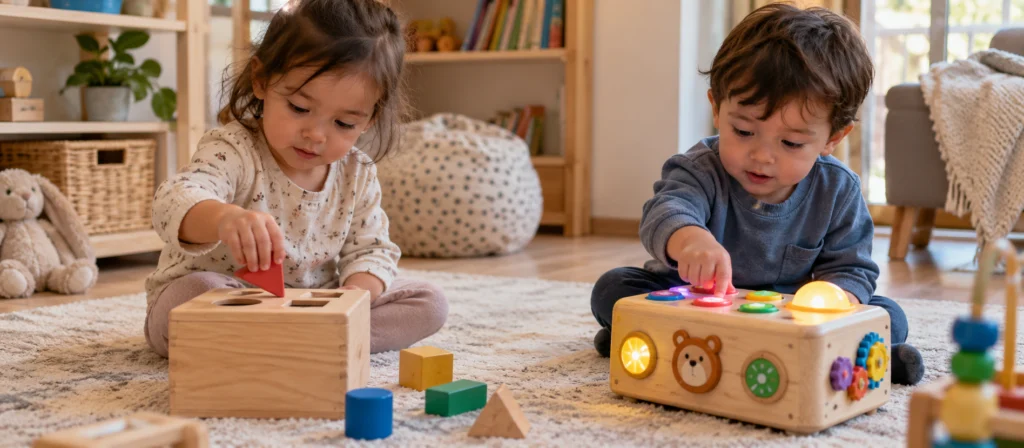
Not all wooden toys are Montessori toys. The key is not the material itself, but whether the toy supports children’s active exploration and independent learning.
Toys suitable for a Montessori educational environment typically possess the following characteristics:
- Encourage hands-on learning Children can complete activities through grasping, sorting, arranging, matching, or combining objects instead of simply watching.
- Have a simple and clear design They avoid unnecessary lights, sounds, or complex features, allowing children to focus on the activity itself.
- Support repetition and practice Children can repeat the activity and adjust their actions through observation and trial.
- Match children’s developmental needs The difficulty level should be appropriate for children’s age and abilities.
Therefore, when choosing Montessori wooden toys, do not focus only on labels such as “wooden” or “Montessori.” More importantly, consider whether the materials help children work independently, practice repeatedly, and develop essential skills.ctivity.
How to Choose Wooden Montessori Toys
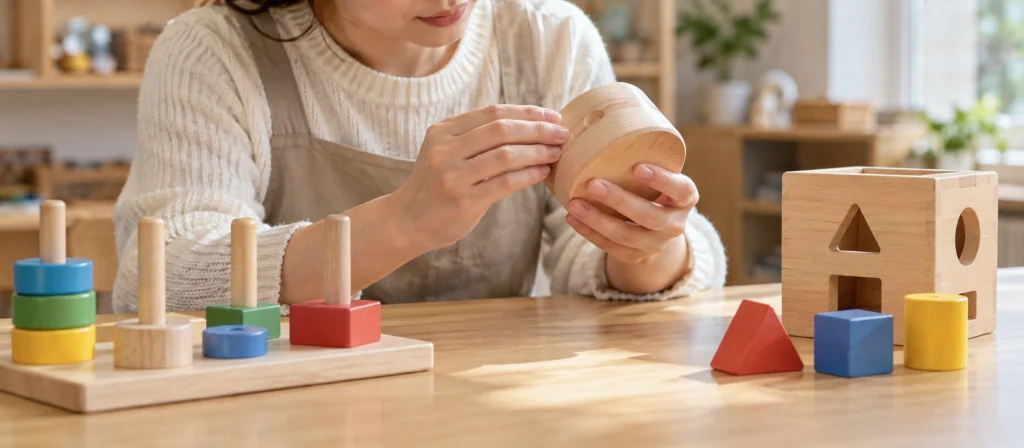
If you are purchasing Montessori wooden toys for a preschool or early learning center, you can focus on the following points:
- Age Appropriateness
Choose activities based on the children’s age and ability level. Younger children may need grasping, matching, sorting, and simple manipulation activities, while older preschoolers can use sequencing, puzzles, threading, and more advanced fine motor activities. - Fit With Learning Areas
Do not look at each product in isolation. Consider where it will be used in the classroom and what learning need it supports. This helps reduce unnecessary duplication and makes it easier to build a complete classroom material plan. - Safety Compliance
Check the wood, coating, edges, component size, and connection structure. For products with small parts, confirm that they are suitable for the intended age group and meet the child product safety requirements of your target market. - Durability
Preschool toys are used repeatedly by many children, so pay attention to material thickness, structural stability, joints, and surface finishing rather than appearance alone. - Quantity Planning
Decide quantities based on class size, activity frequency, and how the materials will be used. Frequently used small-group materials may need more units, while low-frequency products do not need to be overstocked. - Cleaning and Storage
Toys that are easy to wipe, easy to inspect, and simple to organize are more practical for daily preschool use. Products with trays, bases, or fixed storage systems can also reduce teachers’ cleanup time.
What Are Some Common Wooden Montessori Toys?
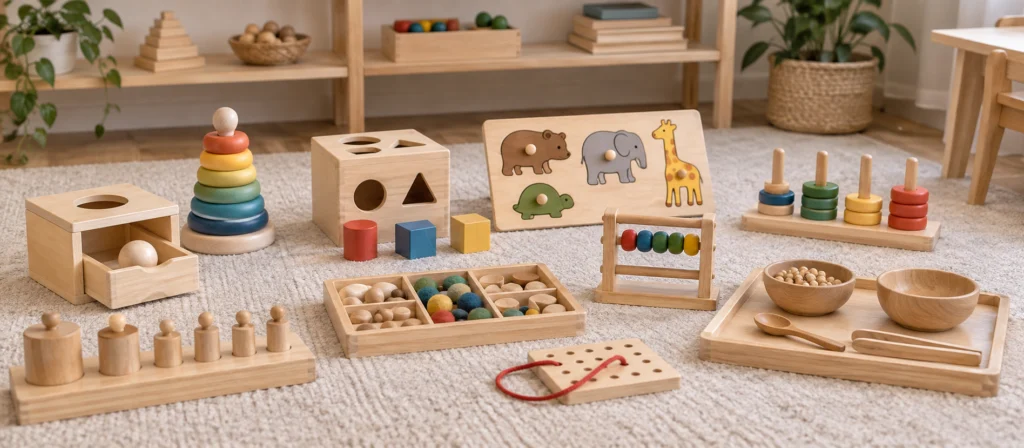
When purchasing Montessori toys in bulk for kindergartens and early learning centers, the priority should not be simply acquiring the largest volume of products, but rather curating a balanced and practical assortment of educational materials. You can prioritize essential, frequently used materials based on class size, the children’s ages, and curriculum goals, while supplementing with other types of activities according to actual teaching needs. This approach optimizes space utilization and makes it easier to manage procurement costs and ongoing inventory maintenance.
| Toy Type | What the Child Does | Typical Experience |
|---|---|---|
| Object Permanence Toys | Insert, observe, and find | Watch objects appear and disappear while practicing hand-eye coordination |
| Stacking Toys | Stack, arrange, and compare | Explore size relationships, order, and balance |
| Shape Sorters | Match and insert | Compare shapes and spatial positions |
| Wooden Puzzles | Find, match, and fit pieces together | Observe details and try different positions |
| Sorting Materials | Sort, arrange, and compare | Compare colors, shapes, and sizes |
| Fine Motor Toys | Insert, turn, grip, and thread | Practice finger control and coordination between both hands |
| Counting Materials | Count, arrange, and match quantities | Explore quantity and early mathematical relationships |
| Practical Life Materials | Scoop, pour, grip, and transfer | Practice everyday movements and independent activity |
How Do You Clean and Maintain Wooden Toys?
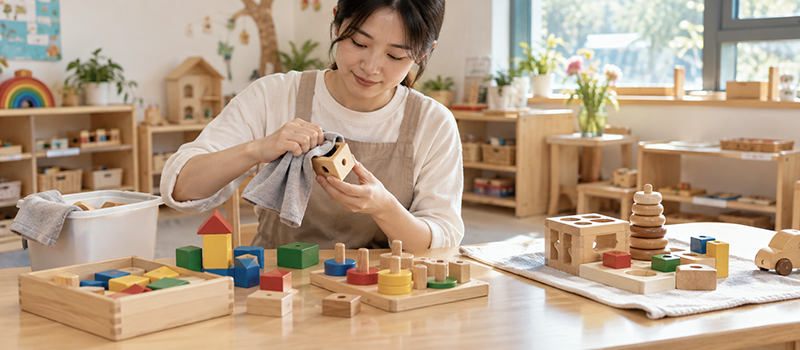
In a preschool environment, wooden toys are used frequently and handled by many children, so cleaning and maintenance should take hygiene, safety, and long-term durability into account.
- Wipe With a Damp Cloth for Daily Cleaning
For regular cleaning, wipe the surface of wooden toys with a soft damp cloth. If there are visible stains, use a small amount of mild neutral detergent, then wipe away any residue with a clean damp cloth. Do not rinse wooden toys with large amounts of water or soak them for long periods. - Dry Thoroughly After Cleaning
Wood can swell, warp, or crack after absorbing too much moisture. After cleaning, wipe the surface dry and leave the toys in a well-ventilated area to air-dry completely. - Disinfect Based on Use Frequency
Wooden toys that are handled frequently by multiple children can be disinfected according to your preschool’s hygiene procedures. Before using a disinfectant, make sure it is suitable for wooden children’s products and follow the recommended concentration and contact time. - Check the Surface and Structure Regularly
Inspect toys for cracks, splinters, loose parts, peeling finishes, or damaged joints. If you find any damage, remove the toy from use until it has been repaired or replaced. - Store Only After the Toys Are Fully Dry
Wooden toys should be completely dry before they are returned to shelves or storage containers. Toys with multiple pieces should have a fixed storage location so teachers can check quantities easily and reduce the risk of missing parts. - Avoid Damp Areas and Direct Sunlight
Do not store wooden toys for long periods in damp areas, direct sunlight, or close to heating sources. A stable, dry indoor environment helps protect both the wood and its surface finish.
FAQs
1. Why do many Montessori classrooms avoid using electronic toys?
Montessori environments emphasize active exploration and the independent completion of activities by the child. Excessive noise, lights, or automatic feedback can distract the child from the manipulation process itself. Consequently, many Montessori materials feature simple designs, allowing children to discover results through their own actions.
2. Are wooden Montessori toys safer than plastic ones?
The material itself does not solely determine safety. Whether wood or plastic, safety depends on product design, manufacturing quality, surface finishing, and compliance with safety standards for children’s products. When selecting toys, one should look for smooth edges, secure components, and child-safe coatings and materials.
3. Why are wooden Montessori toys suitable for open classroom environments?
Montessori classrooms typically place materials where children can see and access them, enabling them to choose activities based on their interests. Wooden toys often feature clear structures and specific placement methods; this makes it easier for children to understand how to use the materials and helps them develop the habit of independently tidying up and returning items to their proper places.
4. How long do wooden Montessori toys last?
Their lifespan depends on the quality of the wood, the craftsmanship, and daily maintenance. High-quality wooden toys, when properly crafted, can withstand long-term, repeated use. Furthermore, minor wear and tear can often be remedied through sanding or refinishing rather than requiring immediate replacement.
5. Why do Montessori toys typically feature simple designs?
Simple designs allow children to focus on the activity itself rather than being distracted by extraneous features. Many Montessori materials avoid complex sound effects, lights, or automated functions, instead facilitating the learning process through the child’s own manipulation, observation, and adjustments.
Conclusion
Wood has remained common in Montessori environments not because Montessori toys must be wooden. The more practical reason is that wood is easy to shape, has noticeable weight and texture, and can be made into stable, durable materials that work well for repeated hands-on use.
When choosing wooden Montessori toys, do not focus only on the words wooden or Montessori. Look at what the child will actually do with the material, how well the product is made, whether the size is suitable, and whether it can handle the level of use you expect.
If you are choosing wooden learning materials for a Montessori school, preschool, or early learning centre, West Shore can help with product selection, material customization, and classroom planning based on the children’s age group, learning areas, and expected frequency of use, so the products are better matched to the actual space.