If you have worked in a kindergarten or early childhood education center, you may have seen children suddenly cry or become upset when a block tower falls, an activity ends, or their daily routine changes. Rather than trying to calm them down immediately, it is more helpful to give them opportunities to practice waiting, trying again, and recovering. In everyday practice, Montessori helps children manage emotions through an orderly environment, independent activities, and hands-on experiences that gradually build confidence and self-control.
Why Do Children Have Strong Emotions?
When a child suddenly cries, becomes angry, or refuses to continue an activity, what you see is often only the final expression of the emotion. What happened before that may be more important. The child may not know how to express a need, may feel frustrated by a failure, or may be facing changes in the environment so quickly that they do not know what will happen next. Instead of immediately seeing these behaviors as “not listening,” it is better to first look at what happened before the emotional reaction.
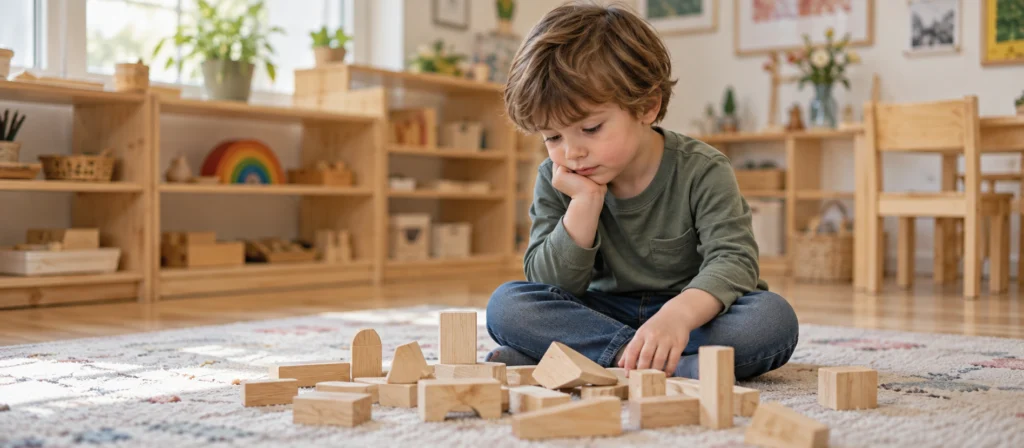
They Have Feelings but Cannot Yet Express Them
Many preschool children can already feel disappointment, fear, anxiety, and frustration, but they may not yet have enough language to clearly explain these feelings. You may see a child grab something, push materials away, or suddenly start crying, but this does not necessarily mean the child is intentionally causing trouble. Sometimes, the child simply does not yet know how to tell you, “I don’t like this,” “I’m not ready yet,” or “This is too difficult for me.”
Failure May Be Harder for Children Than You Think
When a block structure that a child has spent a long time building suddenly falls down, an adult may simply think about rebuilding it, but for the child, the disappointment in that moment is very real. You do not necessarily need to help rebuild it immediately. It can be more valuable to give the child some time and let them decide whether they want to try again. Experiences like this gradually help children understand that when something does not go as planned, it does not mean everything is over.
Too Many Changes Can Make Children Feel Less Secure
A new classroom, a different teacher, a sudden change in the activity sequence, or even materials being moved to another place can make children feel uneasy. Younger children especially rely on familiar routines to understand “what will happen next.” When this sense of predictability is disrupted, their emotional reactions often become more noticeable.
This is also why a stable environment and daily rhythm are important. When children know where materials are, how an activity begins and ends, and what they can do next, they do not need to spend as much energy trying to understand the environment and can return to what they were doing more easily.
So, when you are dealing with a child’s strong emotions, you can ask “Why is this happening again?” less often and spend more time observing what happened beforehand. In many cases, identifying the point where the child lost their sense of control is more helpful than simply asking them to control their emotions.
When Do Children Need Emotional Support?
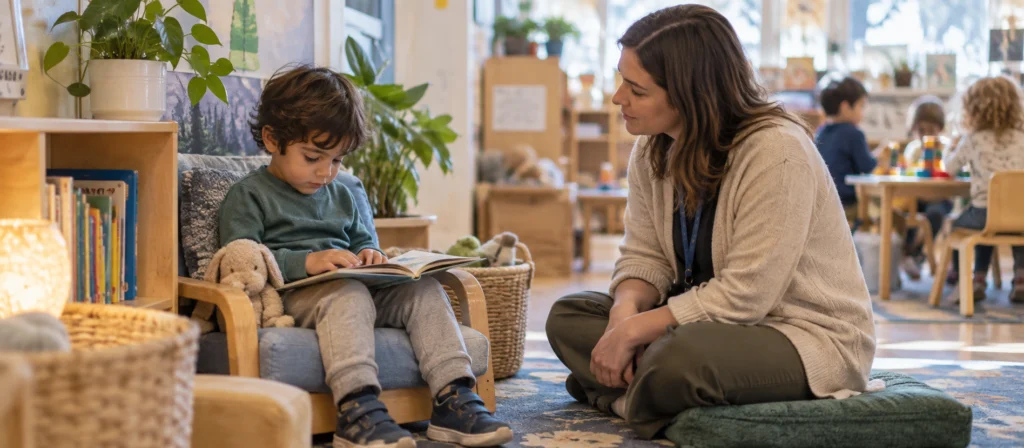
Children cry, become angry, and feel disappointed. These are all normal parts of growing up. What you really need to observe is not whether the child “has emotions” that day, but how often these reactions happen, how long they last, and whether they are already affecting normal learning, play, and social interaction.
If you notice that a child frequently has a very strong reaction to small changes, remains emotional for a long time, or repeatedly finds it difficult to return to the original activity, it may be worth giving them more support instead of simply asking them to “control themselves.”
You can pay particular attention to the following situations:
- Similar emotional reactions happen repeatedly and are becoming easier to trigger;
- The child needs a long time to become calm again;
- Emotional reactions frequently prevent the child from continuing classroom activities or play;
- Emotional reactions frequently lead to conflict when interacting with peers;
- Changes in daily routines, people, or the environment cause noticeable stress.
Children may also temporarily need more support when they enter a new classroom, change caregivers, join a new class, or begin dealing with new social relationships. At these times, what you see as “difficulty adapting” does not necessarily need to be corrected immediately. Giving children some time to become familiar with the environment and build relationships is often more important.
When deciding whether a situation needs further attention, you can focus on three things: frequency, duration, and impact. Occasionally crying because of frustration is not unusual. But if this happens frequently or continues over a long period and consistently affects the child’s participation in daily life, it is worth looking more carefully at what the child is experiencing.
How Does Montessori Education Help Children Develop Emotional Regulation Skills?
Montessori education does not separately teach children how to control their emotions. Instead, it uses the environment and daily activities to help children gradually build the ability to cope with emotions. Through repeated experiences of choosing, trying, and solving problems, children slowly learn how to deal with difficulties and adjust their responses.
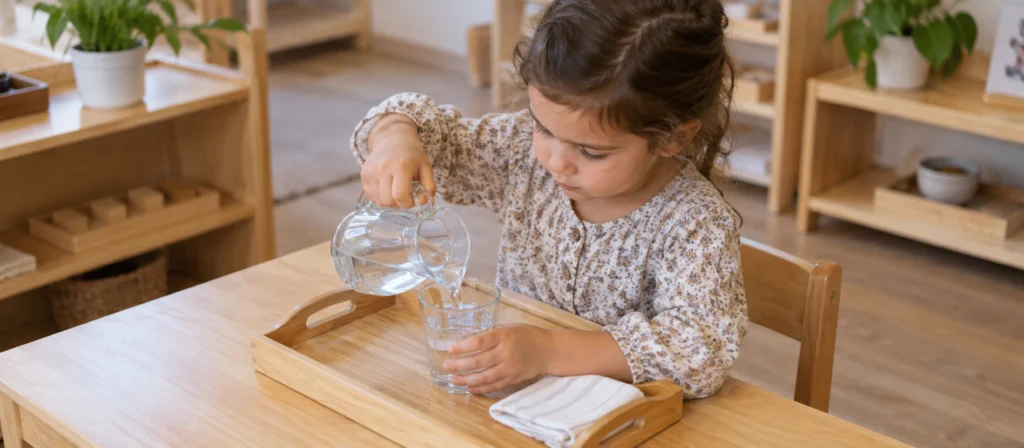
Completing Activities Independently Helps Children Build Confidence
When children are able to choose materials, complete activities, and tidy up their belongings on their own, they gradually develop the confidence that “I can do it myself.” When faced with minor issues, they are more willing to try solving them on their own rather than immediately waiting for adult assistance.
This experience of independent accomplishment gives children greater assurance when facing new tasks or minor challenges, making it easier for them to maintain emotional stability.
Practical Experience Helps Children Practice Self-Control
Montessori activities typically require children to follow certain steps. For example, pouring water requires controlling the speed, solving puzzles requires observing shapes, and sorting requires maintaining focus.
These activities allow children to practice controlling their movements, waiting, and making adjustments. Through repeated practice over time, they become accustomed to observing before acting, rather than reacting impulsively.
An Organized Environment Reduces Children’s Uncertainty
Fixed material locations, clearly defined activity areas, and stable daily routines make it easier for children to know where they are, what to do next, and how to clean up after the activity. For young children, familiarity itself can create a sense of security.
When the environment is easy to understand, children do not need to constantly guess what will happen next, which reduces the anxiety caused by change and chaos.
Repeated Attempts Help Children Cope With Setbacks
Montessori activities allow children to repeat the process. A puzzle piece placed incorrectly can be adjusted; a failed structure can be rebuilt; and a lack of proficiency with materials can be overcome through repetition.
This experience helps children understand that a single failure does not mean the activity is over. When facing difficulties, they can try again rather than giving up immediately.
A Clear Activity Flow Helps Children Regain Focus
When children know how to start, how to proceed, and how to end an activity, they are more likely to get back on track after experiencing minor setbacks.
For instance, if an activity is interrupted, a child can proceed to the next step based on the familiar routine without relying entirely on an adult to reorganize the task. Such daily experiences help children gradually learn to re-engage with an activity after experiencing emotional fluctuations. The focus of Montessori education in fostering emotional regulation is not to eliminate a child’s emotions, but to enable them to gradually learn independence, self-control, how to face setbacks, and how to readjust through real-life daily activities.
How Does Montessori Education Support Children With Different Emotional Responses?
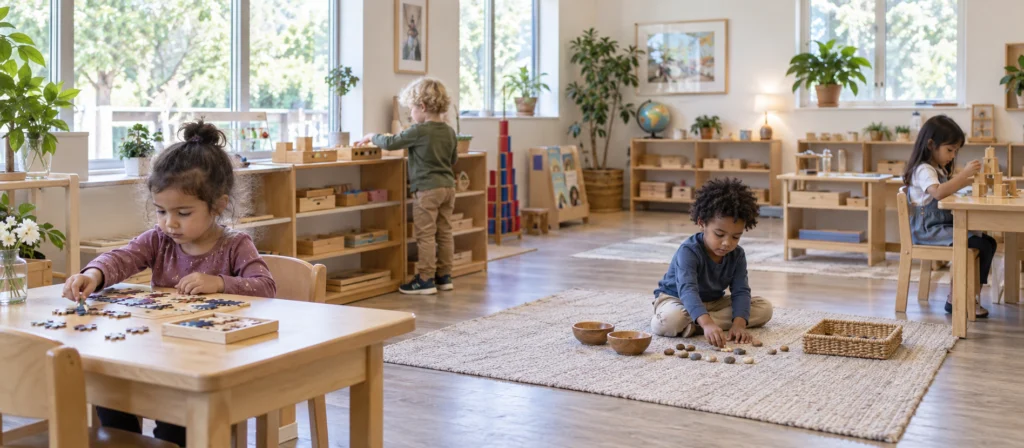
Every child can participate in Montessori activities, but you may notice that some children respond especially well to an environment that is stable, repeatable, and allows them to complete things independently. This is not about categorizing children. It is about helping you observe what kind of support a child needs most at that moment.
Children Who Become Easily Frustrated by Failure
If a child wants to leave whenever something does not go well, repetitive hands-on activities can give them more opportunities to try again. You do not need to keep reminding them to “try again.” The materials themselves and the consistent steps can help children realize: I can try another way and keep going.
Children Who Are More Sensitive to Change and Need a Stable Routine
Some children become noticeably uneasy when their seat changes or the order of activities is different. For these children, fixed material locations, clearly defined activity areas, and relatively stable daily routines can make the day easier to understand. Allowing children to first become familiar with the environment and then gradually experience changes often works better than expecting them to adapt immediately.
Children Who Easily Become Restless From Waiting or Sitting Still for Long Periods
Some children become increasingly restless when they sit and listen for a long time. But once they are able to pick up materials, move objects, sort, pour water, or build something, they may find it much easier to become engaged. You can use this type of participation to help children focus their attention on specific actions and tasks instead of relying on repeated verbal reminders to manage their behavior.
Of course, a Montessori environment is not a solution to every emotional difficulty. If a child continues to have very strong emotional reactions that affect learning, daily life, or interactions with peers, environmental support can still continue, but it is also important to work with the family, teachers, and appropriate child development professionals to better understand the underlying reasons.
Which environmental design features in a Montessori classroom facilitate emotional regulation?
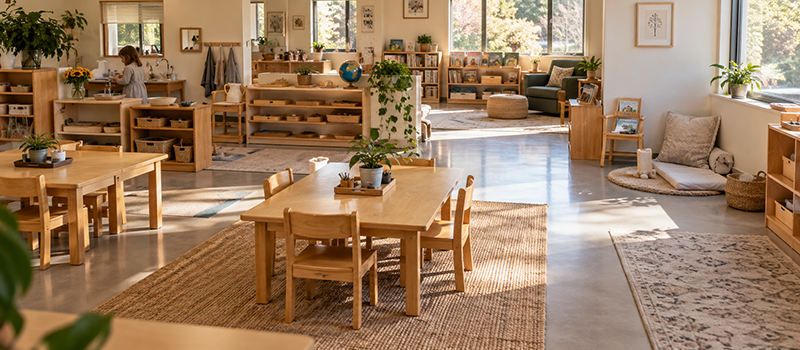
- A Prepared Environment In a Montessori classroom, materials, furniture, and activity areas are arranged in advance so that upon entering the space, children clearly know where materials are located, where to use them, and where to return them after use. A stable, predictable environment helps minimize emotional fluctuations caused by uncertainty.
- Designated Locations for Materials Montessori materials typically have fixed locations and are returned to their original spots after use. Children do not need to repeatedly search for materials or constantly ask adults for help; familiarity with these locations allows them to maintain a steady rhythm in their activities.
- Defining Activity Areas with Work Mats and Trays Work mats and trays clearly define the boundaries of a child’s current activity. Children know exactly which materials belong to their work, and these boundaries help prevent other children from casually intruding, taking materials, or interrupting the activity.
- Self-Correcting Materials Many Montessori materials feature a “control of error” design, allowing children to identify and correct mistakes themselves without needing an adult to constantly point out errors. This reduces the frustration often associated with frequent correction.
- Freedom of Choice Within Defined Limits Children are free to choose from a selection of prepared activities rather than facing an overwhelming array of options. These clear parameters provide a sense of autonomy while making it easier for children to make decisions, thereby reducing the confusion and anxiety that can arise from having too many choices.
FAQs
1. Does Montessori Emotional Support Affect Every Child in the Same Way?
No, it varies. Different children react differently to changes in daily routines, activities, and the environment. Some children adjust better through hands-on activity, while others need more time to familiarize themselves with new spaces or procedures. The key is to observe the child’s reactions and adjust the support provided accordingly.
2. Why Is Independence Important for Children’s Emotional Development?
When children can choose materials, complete activities, and clean up on their own, they build confidence in their ability to handle everyday tasks. This can make them less dependent on adult help when small problems arise.
3. How Can Teachers Help Children Resolve Emotional Conflicts With Peers?
When two children become upset over the same toy or activity, help them take turns expressing what happened instead of immediately deciding who is at fault. Use simple language to acknowledge each child’s feelings, then guide them toward a practical solution, such as taking turns or choosing another available activity. Repeated experiences like these help children gradually learn to manage disagreements with support.
4. Why Is Child-Sized Furniture Important for Emotional Regulation?
Furniture that children can use independently allows them to reach materials, sit down, complete activities, and tidy up without repeatedly waiting for adult help. This can reduce frustration and give children more control over everyday tasks.
5. How Can a Child’s Anxiety Be Minimized If There Are Changes to the Classroom Setup?
Try to preserve familiar elements, such as the placement of materials, the sequence of activities, and daily routines. Even if adjustments are necessary, avoid changing too many things at once. When children can still make sense of their environment and know what comes next, they adapt more easily to change and experience fewer emotional reactions stemming from uncertainty.
Conclusion
Strong emotions are a normal part of preschool development. With a predictable environment and daily opportunities to practise independence, children can gradually learn to express their feelings and cope with frustration.If you are planning a Montessori classroom, West Shore can help you with classroom layout planning and furniture selection tailored to your space, age group, and educational approach.