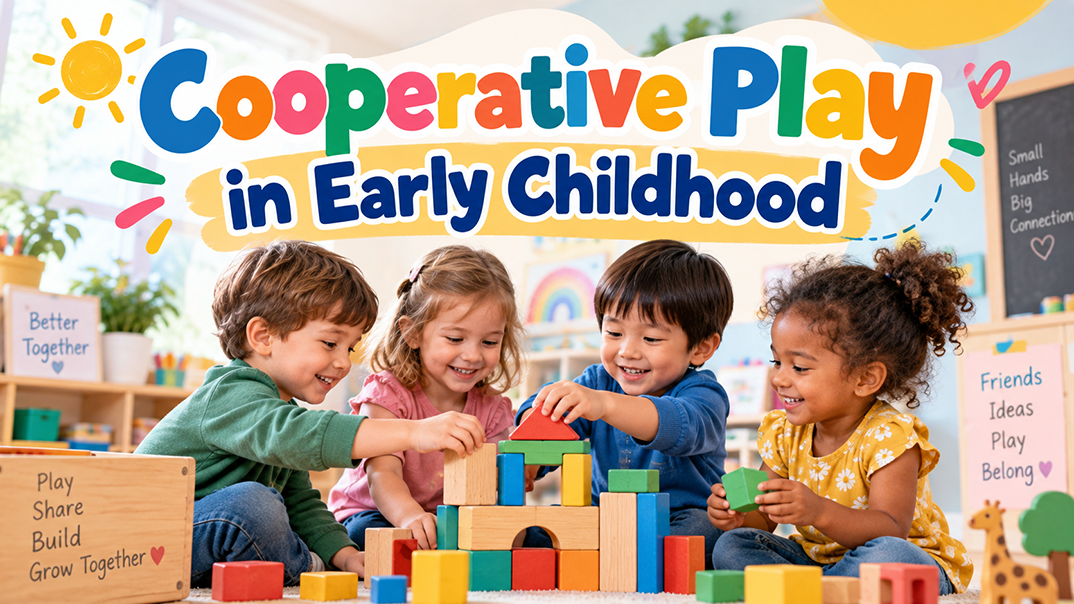
When you watch free play in a preschool classroom, you will notice that “playing near each other” and “really playing together” are not the same. Cooperative Play begins when children move beyond simply sharing the same space and start working around the same idea. They may decide who will do what, use materials together, respond to one another, and adjust their plans as the game develops. These ordinary moments give children real opportunities to practice cooperation, communication, and problem-solving.
What Is Cooperative Play in Early Childhood?
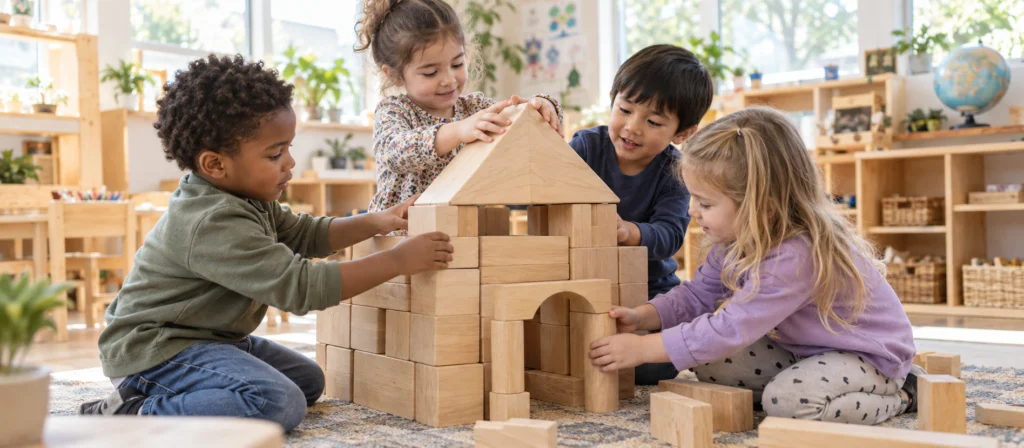
You can think of cooperative play this way: instead of playing in isolation, several children coordinate their actions within the same game. They communicate with one another, adjust their own approaches based on others’ ideas, and the progression of the game is no longer determined by just one person.
For instance, imagine three children building a house out of blocks: one builds the walls, another constructs the roof, and the third creates the entrance. Although each child has a different task, they are creating a single, shared structure; this requires them to discuss the sequence of construction and how the various parts should connect. If one child changes their approach, the others adjust accordingly.
This dynamic extends beyond just playing with blocks. Cooperative play also occurs when children negotiate roles for pretend play, collaborate on a single drawing, help each other find the right pieces for a puzzle, or work together to complete a task during an active game. What truly matters is whether the children are responding to one another and continuing to play together around a shared activity.
What Are Common Types of Cooperative Play in Early Childhood?
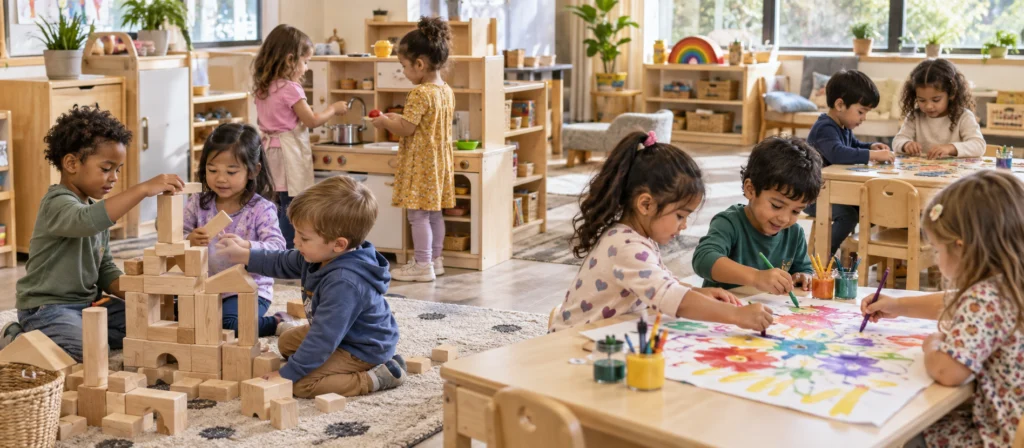
Common cooperative play activities during early childhood include cooperative construction, role-playing, art creation, puzzle-solving, and physical games.
Cooperative Construction Games
Common cooperative construction games include:
- Building houses: Completing various parts such as walls, roofs, and entrances.
- Building cities: Designing roads, buildings, and public areas.
- Building bridges: Attempting to connect roads or different architectural zones.
- Building zoos: Designing enclosures, entrances, and animal activity areas.
- Building tracks: Connecting tracks and planning stations and routes.
You can provide wooden blocks, magnetic tiles, tracks, and other open-ended construction materials, allowing children to discuss, divide tasks, and adjust their designs while working on a shared project.
Cooperative Role-Playing Games
Common cooperative role-playing games include:
- Restaurant play: Assigning roles such as chef, server, and customer.
- Shop play: Assigning roles such as shop assistant, cashier, and customer.
- Hospital play: Assigning roles such as doctor, nurse, and patient.
- Family play: Developing storylines around cooking, caring for dolls, and daily family life.
- Fire station play: Simulating receiving a call, preparing gear, and carrying out a rescue.
You can prepare props for kitchen play, dolls, or household items, but avoid pre-assigning roles or plots; let the children decide how to play.
Cooperative Art Creation Games
Common cooperative art creation games include:
- Large-scale painting: Creating a piece based on a single theme on a large sheet of paper.
- Collage creation: Combining paper, fabric, and other materials to form a complete artwork.
- Clay scene creation: Crafting scenes based on themes like zoos, neighborhoods, or others.
- Cardboard construction: Transforming cardboard boxes into houses, shops, or castles.
- Nature-based art: Using leaves, twigs, and stones to create patterns or shapes.
You can provide ample space for children to work and place commonly used materials such as paintbrushes, paper, and glue in easily accessible locations. If there are many types of materials, you can also use an art supplies storage cart to classify them, making it easier for children to take and share them.
Cooperative Puzzle Games
Common cooperative puzzle games include:
- Large-scale puzzles: Finding the right pieces and completing the entire image together.
- Maze building: Design a route that allows a small ball or toy car to pass through smoothly.
- Track challenge: Adjust various track sections so the toy car can successfully reach the finish line.
- Pattern building: Construct a specific pattern based on an image or a target design.
- Engineering challenge: Tasks such as building a bridge to span a “river” or creating a stable structure.
You can choose puzzle or construction materials that have clear goals but no fixed solutions; this gives children more opportunities to discuss, experiment, and refine their approaches.
Cooperative Active Games
Common cooperative active games include:
- Ball-passing games: Pass the ball continuously while trying to keep it off the ground.
- Transport tasks: Carry a ball or other object to a designated location.
- Parachute games: Complete tasks by coordinating the height and movement of a large play parachute.
- Obstacle courses: Navigate through obstacles while transporting a specific item to the finish line.
- Relay games: Complete tasks in stages to finish the entire course.
You can design simple, clear rules so that children focus on cooperation, taking turns, and achieving a shared goal.
What Can Children Learn From Cooperative Play?
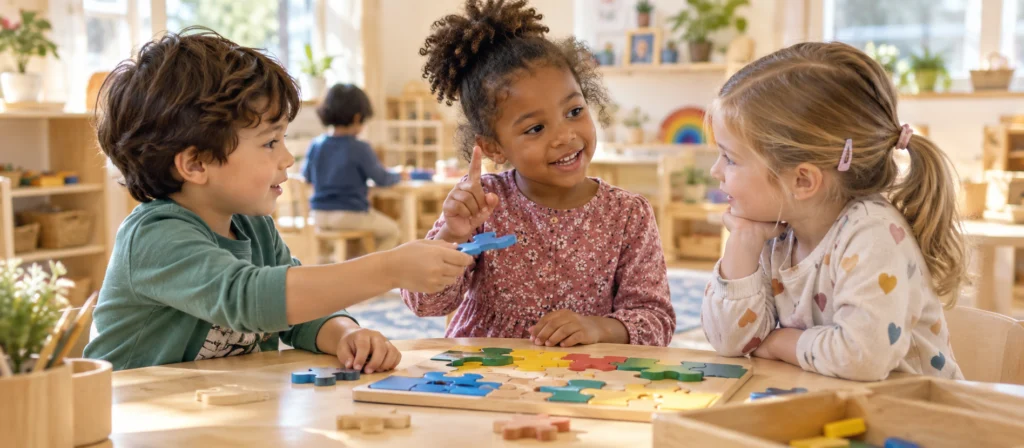
Cooperative play offers children numerous opportunities for genuine interaction with their peers. They must articulate their ideas and navigate challenges such as insufficient materials, role conflicts, and differing opinions. Many social skills are honed through these small, concrete situations, and strong peer-play abilities are linked to successful school adjustment and social competence later on.
- Express themselves clearly and understand others
Children need to explain what they want to do and listen when someone else has a different idea. Over time, they become better at putting their thoughts into words, paying attention to what others say, and responding instead of only following their own plan. - Learn to share, wait, and take turns
Materials and roles are not always available for everyone at the same time. Children may need to wait, exchange materials, or decide who goes first. Through repeated practice, they begin to understand that they do not always have to get what they want immediately. - Understand teamwork and shared roles
Children learn that everyone does not need to do the same thing to complete one goal. One child may collect materials, another may build, and another may add details. Different roles still contribute to the same result, helping children see how their own actions affect the group. - Learn to solve problems and handle conflict
When the game gets stuck, children need to find a way forward. They may choose a different material, change roles, or adjust the original plan. These experiences help them understand that disagreement does not have to end the game and that many problems can be worked through with discussion and flexibility.
These skills do not develop from one reminder or one activity. Children build them gradually through repeated experiences of playing with others, running into problems, and finding ways to keep the play going.
Why Do Some Children Find Cooperative Play Difficult?
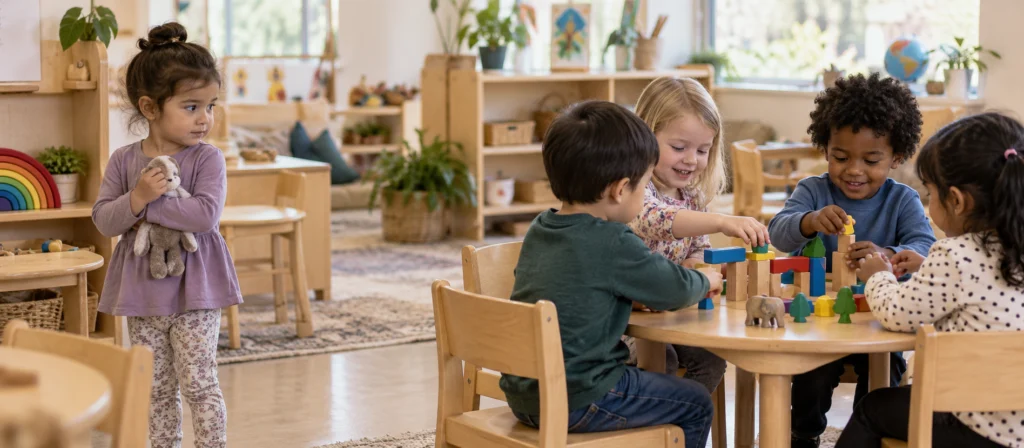
You might encounter a child who stands on the sidelines watching others play but hesitates to join in, or who joins briefly only to withdraw because of differences regarding materials, roles, or the rules of the game. In such situations, try to identify the specific obstacle rather than simply urging the child to “play with the others.”
- Not Knowing How to Join an Ongoing Game Some children observe for a long time but don’t know how to initiate contact or which role they could take on. You can help them find a natural entry point—for example, by asking the children already playing, “Is there a role available for someone else here?”
- Difficulty Articulating Ideas A child might have a plan in mind but struggle to explain it to others. If they aren’t understood, they might simply grab the materials or walk away. You can help by voicing part of their idea, then encouraging them to continue communicating with their peers.
- Difficulty Accepting Changes to Their Play Style Some children have a specific vision for how to build a structure or assign roles; if others suggest a different approach, they may become frustrated or quit. In this case, give them some time, or help them clearly understand the changes the other children are proposing.
- Unfamiliarity With Taking Turns and Sharing Materials Two children wanting the same toy is a common scenario in cooperative play. Some children have not yet mastered waiting, trading, or finding alternatives, so the interaction quickly turns into a squabble over the item.
- The play environment itself makes cooperation difficult Overcrowded activity areas, a scarcity of materials, or too many participants can hinder cooperation. Try adjusting the space, the supply of materials, or the number of children involved to see if participation becomes easier.
Therefore, when children encounter difficulties while engaging in cooperative play, it is necessary to observe where the problems arise, identify the specific issues, and provide targeted assistance.
How Can Teachers Help Children Develop Cooperative Play?
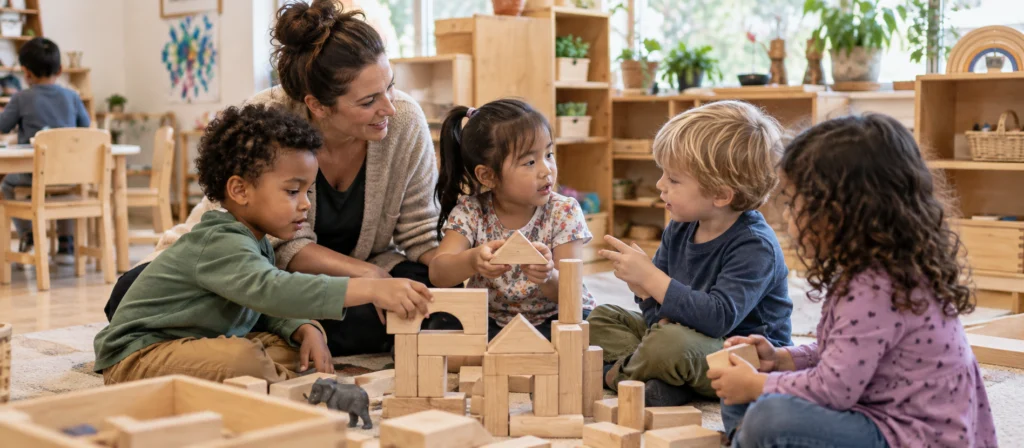
You don’t need to orchestrate every detail of the children’s cooperative play. Often, simply providing a task that requires collaboration—and offering a helping hand when they get stuck—is enough for them to keep the game going on their own. Allow them the opportunity to communicate with peers and attempt to solve problems themselves; avoid taking over the moment a disagreement arises.
Create Game Goals That Require Collaboration
You can modify activities that are typically done individually so that they require participation from several children. For example, in the block area, encourage them to build a larger zoo or city together; in the art area, provide a large sheet of paper for several children to work on a shared theme; or in track-building games, have them work together to connect the track to the finish line.
Simply setting the goal is enough; avoid assigning specific roles or tasks in advance. If you decide on the roles, sequence, and methods, the children are merely executing tasks, which actually reduces opportunities for genuine discussion and the division of labor.
Help Children Express Themselves and Negotiate
When two children reach an impasse over materials or how to play, you can start by clarifying the issue—for instance, “You both want to use this car,” or “You want to build the road here, but he wants to put a house there.” After stating the situation, simply ask, “What do you think we should do?”
You can also teach them practical phrases to use in these moments, such as “Can I join in?” “Can I have it when you’re done?” or “Shall we try a different way?” Once children know how to use these phrases, you won’t need to step in to resolve many of the minor conflicts that arise.
Give Children the Chance to Solve Problems Themselves
Unless there is pushing, grabbing, or obvious exclusion, try waiting a moment before intervening. Many children will come up with their own solutions—such as switching materials, taking turns, or completely changing the way they play.
You don’t need to insist that they adopt the method you consider most logical. As long as both parties are satisfied and the play can continue, let them give it a try. Children often learn how to solve problems through these small, everyday situations.
Intervene Appropriately When Cooperation Stalls
You should step in if pushing begins, if a child is repeatedly excluded, or if the group has been arguing for a long time without making any progress. Address the immediate, concrete issue first—for example, “You both want to build here, but there isn’t enough space; let’s figure out how to arrange things.”
Once the children resume communicating, you can hand the decision-making power back to them. You don’t need to reassign roles, nor do you need to plan out the rest of the game for them.
How Can You Create More Opportunities for Cooperative Play in the Classroom?
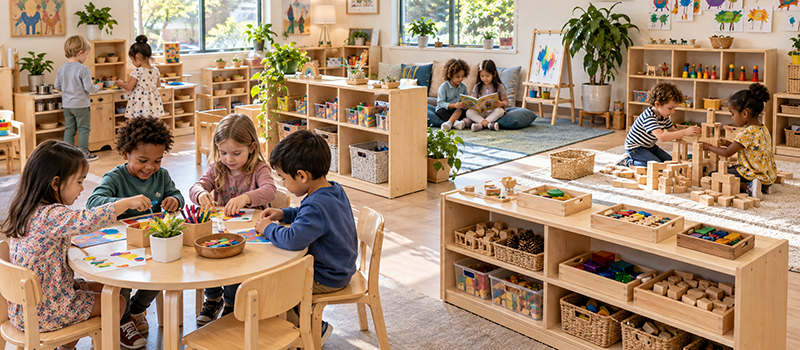
If you want children to play together more easily, start by observing where their play is most frequently interrupted. Is the space too cramped? Are there never enough materials? Do children constantly have to ask the teacher for items? These details determine whether cooperative play can continue smoothly.
Allocate sufficient space for group activities
When children build with blocks, engage in art projects, or role-play together, they need ample room to work. The block area should allow children to move around their creations; the art area needs space for two or three children to spread out their materials; and the role-play area should be arranged to prevent everyone from crowding into a single spot.
Observe how the children play. If they frequently knock over others’ creations, bump into neighbors when turning around, or if some children are forced to stand on the sidelines due to a lack of space, it indicates that the furniture layout or available area needs adjustment.
Select materials suitable for group use
Blocks, train tracks, large puzzles, role-play props, and art supplies naturally lend themselves to group participation. When selecting materials, consider whether they allow different children to work on different parts of a project simultaneously, rather than requiring a single user.
You do not need to provide a complete set for every child. While a shortage of key materials can lead to squabbling, providing everyone with a completely independent set can result in children playing in isolation. Instead, provide sufficient basic materials while keeping some components shared, which encourages natural interaction among the children.
Enable children to access and share materials independently
If a child has to call for you every time they want to get building blocks, art supplies, or role-play props, their play is easily interrupted. Frequently used materials should be placed where the child can see and reach them, organized in low, open storage units so they know exactly where to go to get what they need.
Use low, open shelving units to organize materials; you do not need to display everything at once. Keeping out materials relevant to current activities and rotating other items periodically makes it easier for children to use the resources than cramming the shelves full.
Designate appropriate areas for different types of cooperative play
Different cooperative games require different types of space. The block area should offer a large floor space for construction; the role-play area should feature props that support multiple characters; the art area should have tables large enough for several children to work simultaneously; and table areas can accommodate puzzles and educational games.
Observe whether every child has something to do when two to four children are using the area simultaneously. If someone is consistently left without a spot, materials are insufficient, or children frequently have to leave to fetch items, it indicates that the space, the quantity of materials, or the storage setup needs adjustment.
FAQs
1. At What Age Do Children Usually Start Cooperative Play?
Cooperative play usually becomes more noticeable around age 4. By ages 4 to 5, children are more likely to divide roles, negotiate, and work toward a shared play goal. Development can vary from child to child.
2. Do All Preschool Activities Need to Be Cooperative?
No. Preschool children also need independent play and individual exploration. Cooperative and independent activities can be balanced according to the learning goal and the children’s needs.
3. How Many Children Work Best in a Cooperative Play Group?
A group of 2 to 4 children usually works well. This size makes it easier for children to communicate, share roles, and gives each child a chance to participate.
4. Should Close Friends Always Be Grouped Together for Cooperative Play?
No. Teachers can change group combinations so children have opportunities to work with different classmates. Avoid forcing children into groups where they are clearly uncomfortable.
5. Should You Force a Child to Join Cooperative Play If They Do Not Want To?
No. Let the child observe first, then offer a simple role or an easy way to join when they are ready. Forcing participation can make the child more resistant to group play.
Conclusion
You can start with a simple group activity to observe how the children collaborate, then gradually adjust the space, materials, and group size based on their reactions. Collaboration doesn’t develop overnight, but by having daily opportunities to work together on tasks, children gain more chances to practice communication, sharing, and problem-solving.
Whether you are setting up a new preschool, daycare center, or childcare facility, or simply looking to create more opportunities for collaborative play in an existing classroom, West Shore can help you integrate these needs into the classroom layout, furniture selection, and the arrangement of learning resources.