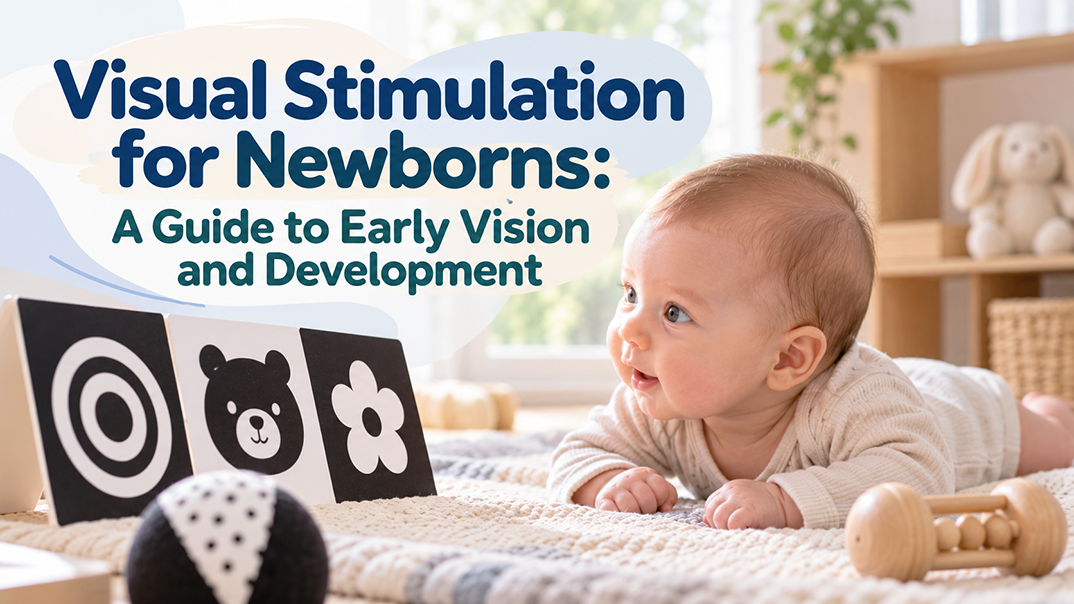
Newborns do not see the world as clearly as adults do, and their visual abilities continue to change during the first few months of life. The visual experiences they receive during this stage can come from simple things such as faces, movement, light, toys, and the surrounding environment. This guide explains how newborn vision develops, which materials and spaces are suitable, and how to provide Visual Stimulation for Newborns in a natural and age-appropriate way.
What Is Visual Stimulation for Newborns?
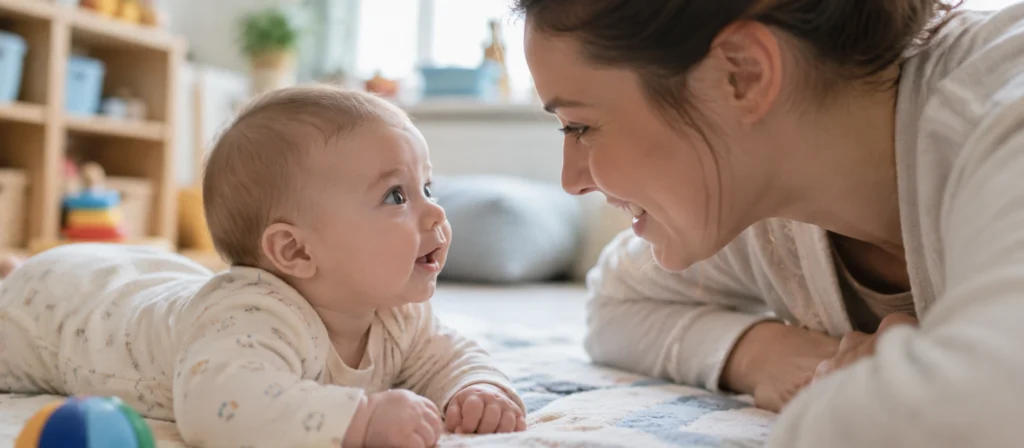
Visual stimulation for newborns means giving babies visual information that they can notice, such as faces, shapes, movement, light, and contrast.
At birth, a baby’s visual system is still developing. The retina, the light-sensitive tissue at the back of the eye, is not yet as mature as an adult’s, so newborns cannot distinguish colors, contrast, and fine details in the same way adults can. A nursery full of soft pastel colors may look rich and varied to you, while a newborn may see much less difference between those colors and notice clearer outlines or stronger contrast more easily.
This is why visual stimulation for newborns needs to match what they can actually see at this stage, rather than simply giving them more things to look at.
How Does a Newborn’s Vision Change After Birth?
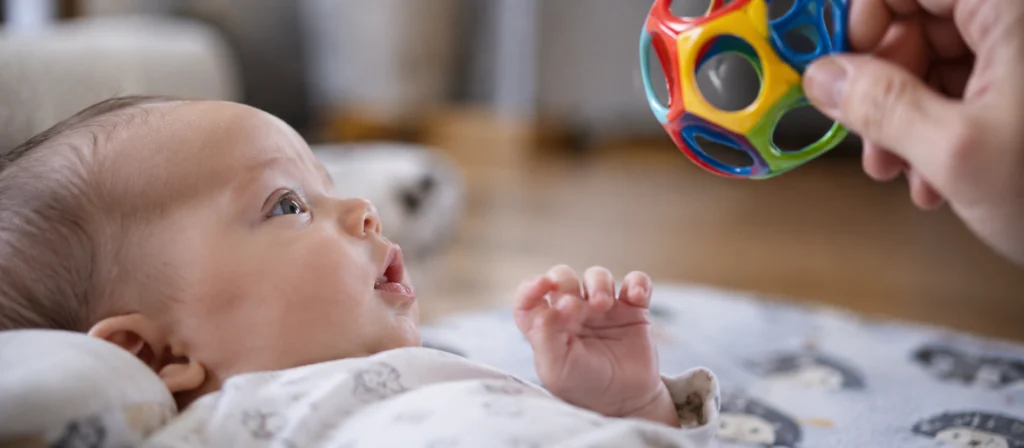
During the first few months after birth, a baby’s vision changes quickly. They gradually become better at focusing on faces and objects, following movement with their eyes, and noticing more colors and details. Their ability to notice differences between light and dark also improves, so the things that are easiest for them to see will change as they grow.
0–1 Month: Babies See Best at Close Range
During the first month, a baby’s vision is still blurry. They usually see nearby faces and objects more clearly than things farther away, especially at around 8–12 inches (20–30 cm).
At this stage, strong contrast and clear outlines are easier to notice than small details or similar colors. This is why faces, black-and-white patterns, and simple shapes often stand out more clearly.
1–3 Months: Babies Begin to Focus and Follow Movement
As vision develops, babies can hold their gaze on a face or object for longer. They also begin to follow slow movement with their eyes instead of only looking briefly and then losing the target.
By around 2–3 months, many babies are better able to watch a face move, follow a toy from side to side, and keep their eyes on one object for a longer period.
3–6 Months: Babies Start Seeing More Colors and Details
Between 3 and 6 months, babies become better at distinguishing colors, shapes, and finer details. They no longer rely as heavily on very strong contrast to notice what is around them.
They also begin to use vision more actively during play. A baby may look at an object, reach toward it, and pay more attention to differences in color, shape, and position.
6–12 Months: Babies Judge Distance and Explore With Vision
During the second half of the first year, babies become better at judging how far away objects are and using both eyes together. They can follow faster movement and notice objects across a wider area.
As crawling and reaching develop, vision becomes closely connected with movement. Babies may look toward an object, move closer to it, reach for it, and compare where different objects are in the space around them.
What Products and Materials Are Suitable for Visual Stimulation for Newborns?
High-Contrast Visual Materials
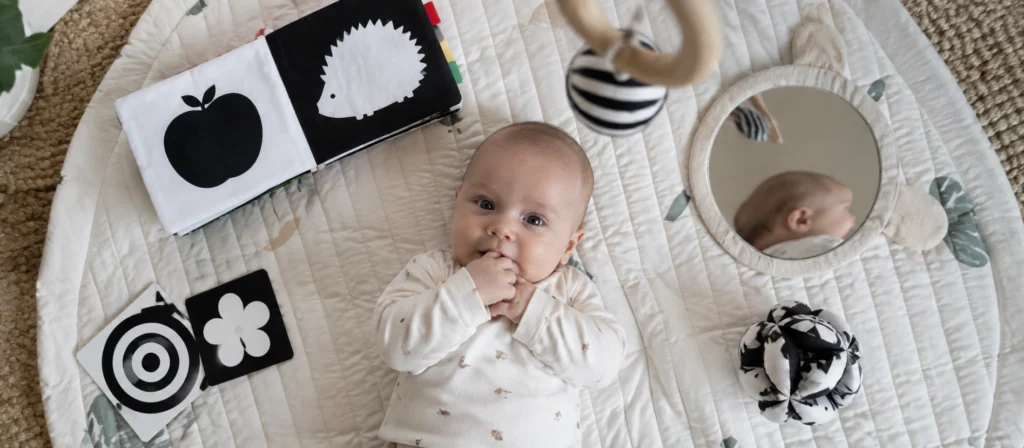
High-contrast visual materials are simple images that use strong differences between light and dark, such as black-and-white cards, fold-out books, and picture books with large, clear shapes.
Because newborns do not yet see fine details and similar colors clearly, these bold patterns are easier for them to notice. As their vision develops, you can gradually introduce more colors and slightly more detailed images.
Baby-Safe Mirrors
Baby-safe mirrors are mirrors made for infant environments. They are usually shatter-resistant and placed low enough for babies to see while lying down, doing tummy time, or sitting with support.
Unlike a picture, a mirror changes whenever the baby or caregiver moves. This gives babies a changing visual target without needing a complicated toy.
Hanging and Moving Visual Toys
Hanging and moving visual toys include mobiles, hanging shapes, and lightweight toys that move slowly above or beside the baby.
These toys give babies a moving object to watch. When babies begin reaching, the same toys may also become something they try to touch, so they need to be positioned and secured safely.
Floor-Based Visual Exploration Products
These products give babies visual targets they can explore while lying or playing on the floor. As babies begin turning, reaching, and rolling, suitable soft-play equipment can also provide opportunities for movement and exploration as they become more mobile.
Because young babies spend a lot of time close to the floor, these products place visual targets where they can actually see them. As babies begin turning, reaching, and rolling, the same products can also support movement and exploration.
How Can Space Planning Support Visual Exploration for Newborns?
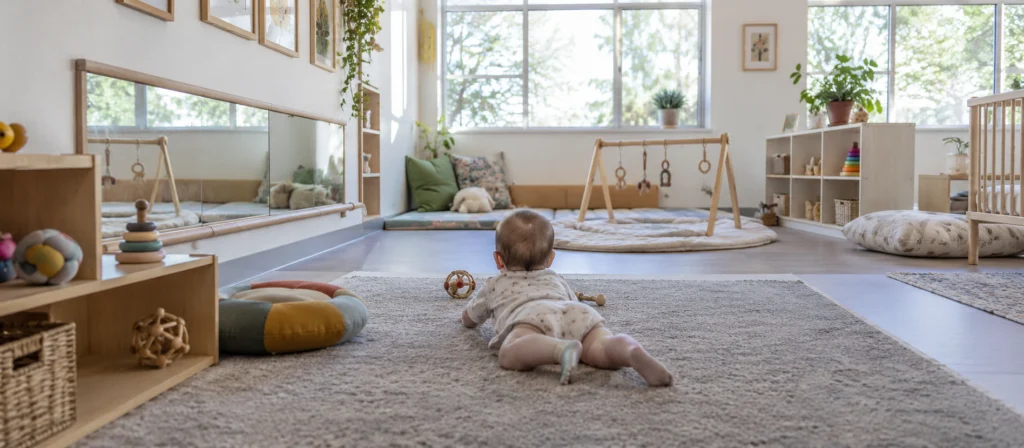
When you plan an infant space, the layout should match how babies actually use the room. Since much of their early activity happens close to the floor, furniture placement, wall content, functional zones, and lighting all affect what they can see and explore.
Keep Floor Activity Areas Open
When you set up a floor activity area, leave enough open space around it for babies to turn their heads, roll, reach, and gradually begin moving.
Avoid placing tall cabinets, storage units, or large equipment too close to the mat. An open area gives babies a wider field of view and also leaves enough room for their movement to develop.
Place Visual Materials at Baby Height
Pictures, visual cards, and baby-safe mirrors should be placed where babies can actually see them while lying down, doing tummy time, or beginning to sit.
You can use lower wall areas rather than placing all visual content at adult eye level. This makes the materials easier for babies to notice without changing the rest of the room.
Separate Active and Quiet Visual Zones
You do not need the same amount of visual information in every part of the room. Activity areas can include more images, toys, and visual features, while sleep and quiet areas can remain more visually simple.
When you plan the room, you can use furniture and clear functional zones to create this difference. This can also be considered together with daycare room layouts for different age groups.
Manage Light and Glare
Pay attention to how sunlight enters the room at different times of day. Strong direct light can make some areas uncomfortable, especially where babies spend long periods lying on their backs.
You should also check ceiling lights and other bright fixtures from floor level. If a light source sits directly in a baby’s line of sight, adjusting the activity area or using softer, more even lighting can make the space more comfortable.
What Other Sensory Experiences Can Be Combined With Visual Stimulation?
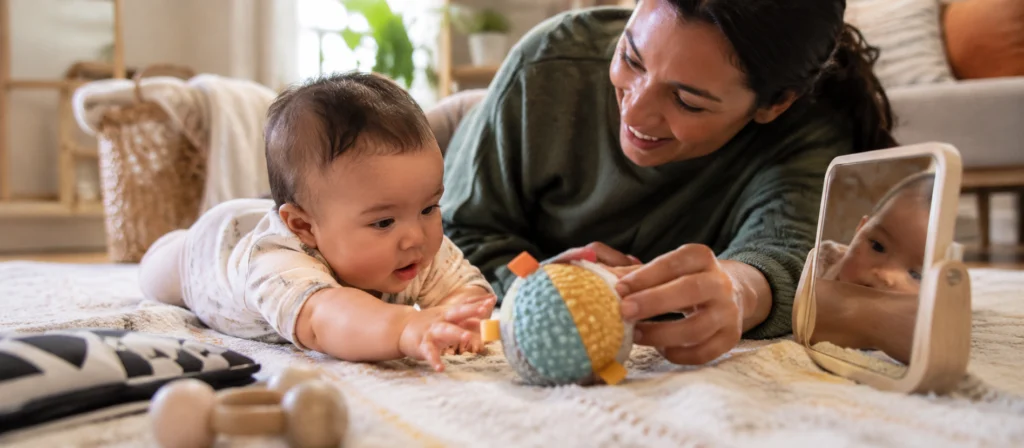
Babies do not experience the world by completely separating sight, sound, and touch. Many experiences naturally happen at the same time. Newborns can respond to some connections between visual and auditory information from very early in life, so you do not need to turn every sense into a separate exercise during everyday activities.
Combining Vision and Hearing
When a teacher speaks to a baby face to face, the baby sees changing facial expressions while also hearing the teacher’s voice. The same thing happens when you read a picture book: images and language naturally appear together.
If you want to provide more experiences like this, you do not necessarily need complicated toys that light up and make sounds. Face-to-face communication or simple reading can already bring vision and hearing together in a real situation.
Combining Vision and Touch
As babies gradually begin reaching out, seeing a target is often followed by trying to touch it. Vision helps them locate the object, while touch helps them discover what the object feels like.
When choosing materials for this type of exploration, you can keep the visual features relatively clear while adding surfaces with different textures that are suitable for touching. This allows babies to continue exploring after they notice something without requiring every product to have many complicated functions.
Combining Vision and Body Movement
During tummy time, you can easily see the connection between vision and movement. When a mirror or toy is placed in front of a baby, they may lift their head or try to turn toward the target. As their physical abilities develop, these movements may gradually become reaching and rolling.
When placing visual targets, you can also consider whether the baby has enough space to respond to what they see. If the target is easy to notice but there is no room to move around it, the connection between visual and physical exploration becomes difficult to continue.
Combining Vision and Early Social Interaction
Human faces are an important part of babies’ early visual experiences. When a teacher comes closer and responds to them, babies are not looking at a fixed image. They are seeing facial expressions and movements constantly change.
As babies begin noticing a wider area around them, they may also gradually observe other children nearby. At this point, visual experience is no longer only about “looking at things.” It also becomes part of social interaction. You do not need to depend entirely on specially purchased products for visual stimulation. Everyday communication itself is important.
How Can You Avoid Overstimulating a Newborn Visually?
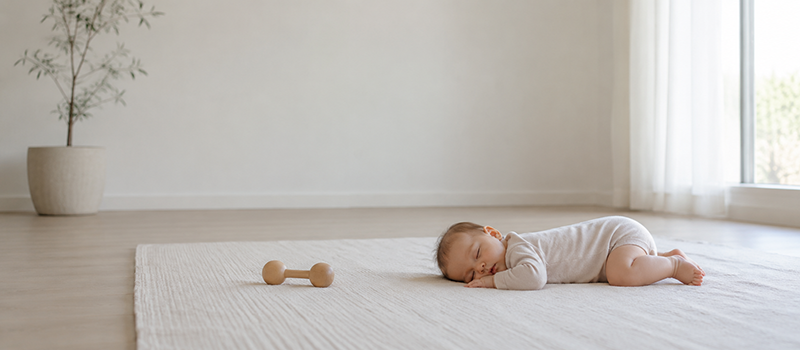
Visual stimulation can support a baby’s exploration, but more is not always better. This is especially true in group care environments, where there are already people moving around, sounds, and toys. If visual information continues to be added on top of everything else, the environment can easily become too complex for babies.
Choose the Right Time for Visual Interaction
Babies are more likely to engage in visual interaction when they are awake and calm. If they are already tired, hungry, or visibly upset, there is no need to keep using visual materials to attract their attention.
Different babies also have different daily rhythms, so visual activities do not need to involve every child at the same time. A more suitable approach is to decide whether to begin based on each baby’s condition at that moment.
Adjust the Duration Based on the Baby’s Response
There is no fixed number of minutes that works for every baby during a visual activity. As long as they are still willing to look or can calmly follow the target, the activity can continue naturally.
If you notice that a baby repeatedly looks away or clearly no longer wants to keep observing, you can pause. Rather than following the same fixed duration for everyone, the baby’s own response is a better indication of whether they have already received enough visual information.
Reduce the Amount of Visual Information Appearing at the Same Time
Sometimes the problem is not that one particular toy is too stimulating, but that too many things are appearing in the same space at once. If the walls already contain many patterns, the floor is covered with toys, and hanging objects are constantly moving above, it becomes difficult for babies to focus on a single target.
In this situation, you can reduce the number of materials displayed at the same time. Rotating toys and keeping some areas of the walls and floor visually simple can help the main visual elements stand out more clearly.
Allow Quiet Time Between Visual Activities
After one visual activity ends, there is no need to immediately move on to another source of stimulation. Feeding, resting, or simply looking quietly around the room can all provide natural pauses between activities.
This rhythm becomes especially important when you are caring for several infants at the same time. Not every baby needs the same activity at the same moment. Allowing the environment to shift naturally between active and quiet periods also makes it easier to respond to different needs.
FAQs
1. Can I use images on a smartphone or tablet for newborn visual stimulation?
Using a smartphone or tablet as the primary method is not recommended. For newborns, real human faces, physical objects, and face-to-face interactions are generally more suitable; they also allow the baby to experience natural distances, movements, and lighting changes. Screens may be used occasionally but are not appropriate as a main source of visual stimulation.
2. Can visual stimulation improve a baby’s eyesight?
Visual stimulation does not directly improve visual acuity, nor does it correct nearsightedness, strabismus (crossed eyes), or other vision problems. Instead, it provides opportunities for the baby to observe, track objects, and explore, helping them utilize their developing visual abilities within their daily environment.
3. Does visual stimulation require a dedicated daily schedule?
There is no need to set aside a specific, fixed time for it. Visual stimulation can be naturally integrated into daily care and interactions—such as holding the baby, face-to-face communication, diaper changes, reading picture books, or simply letting the baby observe their surroundings while awake.
4. When should visual stimulation for newborns begin?
It can start right after birth. In the earliest stages, complex content is unnecessary; you can begin with the caregiver’s face, clear outlines, and simple objects held at close range. As the baby’s ability to gaze and track objects stabilizes, you can gradually introduce more visual content.
5. How long should visual stimulation sessions last to be effective?
There is no fixed standard for duration. The length of each activity can be determined by the baby’s current state; you can continue as long as they remain calm and willing to observe. If the baby frequently looks away, becomes tired, or loses interest, the interaction can be brought to a close.
Conclusion
A newborn’s vision continues to develop, and the visual experiences that suit them will change along with it. Rather than constantly adding new materials, what matters more is adjusting the content to match the baby’s current abilities and allowing observation, interaction, and activity to remain natural.
If you are planning or updating an infant classroom, West Shore can help you consider suitable furniture, activity products, and classroom layouts based on the children’s ages, the size of your space, and the way activities actually take place, allowing visual exploration to become a more natural part of everyday care and learning.