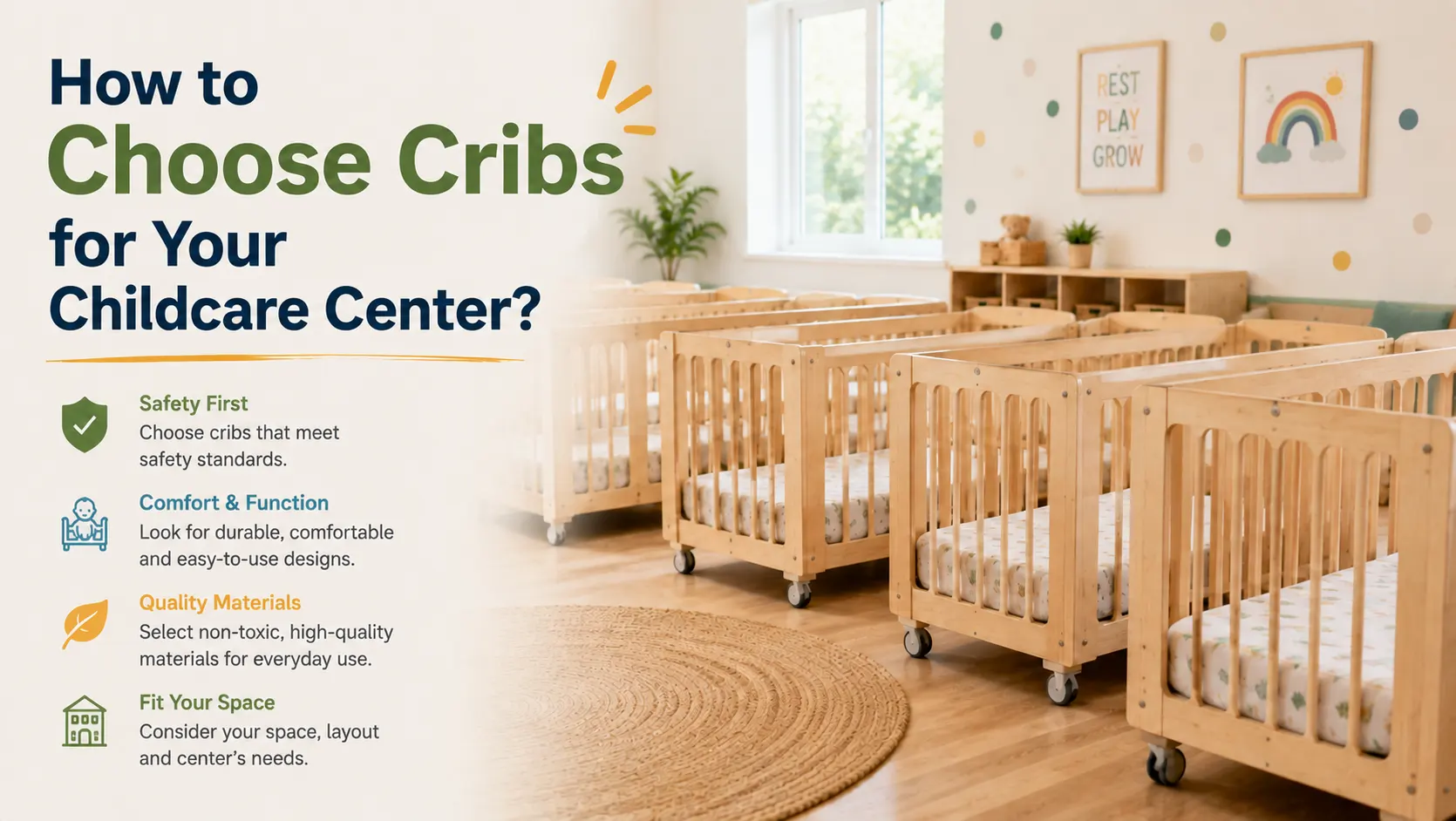
When considering how to choose cribs for your childcare center, it is important to look beyond dimensions and prices. You also need to consider local safety regulations, the age of the infants, available space in the sleeping area, staff handling procedures, emergency evacuation requirements, and long-term maintenance costs. This article covers the key factors that can help you choose the right crib for your childcare center, with safety and compliance at the center of every decision.
How to Choose Cribs for Your Childcare Center — Start With Your Facility’s Needs
What Age Group Will Use the Crib?
Before you look at a single product, pin down the age range your cribs need to cover. Not every crib works for every stage.
Your center likely serves three distinct groups:
- Newborns and young infants — Babies at this stage spend most of their time lying flat and have very limited mobility, so the key to safety is preventing suffocation, falls, and pinching injuries.
- Infants who can roll over or sit up — Once your baby starts rolling over, sitting up, or even kneeling while holding onto a playpen, the original safety features need to be reassessed. Fall risk becomes the primary concern.
- Toddlers who can stand or are starting to climb — This is the red line. Once a child can attempt to climb out, raising the crib rail is not the answer — it creates a higher fall. The child needs to transition to a bed, sleeping mat, or another facility-approved sleep arrangement. when a child’s height or mobility reaches the point of climbing out, the crib has served its purpose.
your crib fleet should match the youngest child you accept, but your transition plan must account for the oldest child who will use it. If your center takes infants from birth to 24 months, a full-size crib with adjustable mattress heights is the safest way to cover that span without switching equipment mid-year.
How Many Cribs Does Your Center Need?
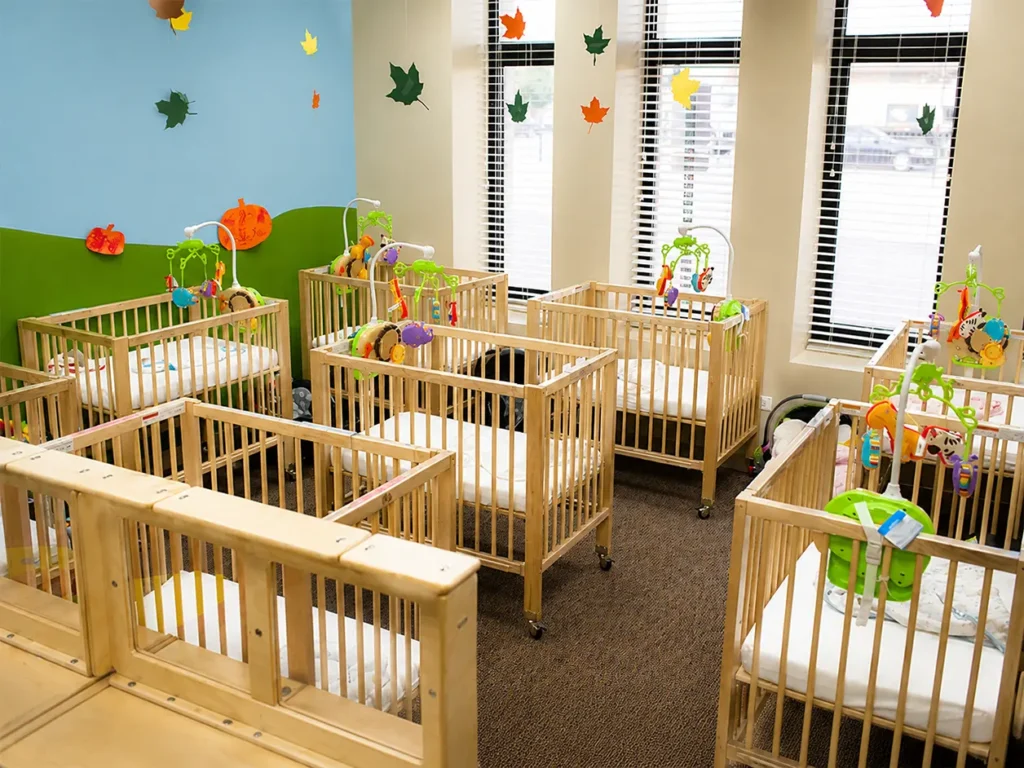
In most infant rooms, the number of cribs provided should be based on the actual number of infants being cared for, rather than just the number expected to be asleep at the same time.
Infant groups are typically smaller than toddler or preschool groups, and infants usually follow individual sleep schedules rather than sharing a communal nap time. This means that several infants may require sleeping space at different times throughout the day.
For example, a center may care for 30 infants, but after reviewing their daily sleep schedules, find that no more than 20 infants are usually asleep at the same time. Where local childcare regulations allow cribs to be shared between children at different times, the center may not need to purchase 30 cribs simply because 30 infants are enrolled. Planning around the peak sleep period — with a small allowance for changes in attendance or sleep routines — can help avoid unnecessary purchases and reduce the amount of floor space occupied by unused cribs.
Because sleep times are staggered, the number of cribs does not always need to match the total number of enrolled infants. Depending on daily attendance, sleep patterns, and local childcare regulations, some centers can plan based on the projected number of cribs in simultaneous use.
This approach reduces unnecessary furniture costs while freeing up valuable floor space—a true win-win.
How Much Space Should Be Reserved?
The fact that a crib fits into a room does not necessarily mean there is sufficient space. Staff members require adequate room to move around while providing care and performing daily tasks to ensure safety. Allocating space appropriately not only makes the sleeping area more comfortable and organized but also enhances traffic flow, daily management, and overall safety throughout the kindergarten.
When planning a sleeping area, consider not only the crib size but also staff access, supervision, and safe circulation.
- Between cribs: Allow about 900 mm (3 ft) where possible to provide comfortable separation and easier staff access.
- Main access aisle: Keep approximately 1,000–1,200 mm clear for daily care and movement.
- Overall space: As a practical planning reference, allow around 3–3.5 m² (32–38 sq. ft.) per crib, including circulation space.
Arrange cribs so teachers can easily see and reach each child without moving other furniture. Avoid placing cribs in narrow corners or areas where open doors may block access. Main walkways and emergency routes should always remain clear.
Cribs should also be positioned away from heaters, electrical equipment, windows, blind cords, and other potential hazards. Before confirming the final layout, check local childcare and fire safety requirements, as spacing rules may vary by location.
How to Choose Cribs for Your Childcare Center by Type and Size
| Crib Type | Best For | Key Safety Standard | Pros |
|---|---|---|---|
| Full-Size | Permanent Sleep Rooms | CPSC 16 CFR 1219 | Durable, Stable |
| Compact | Limited Spaces | CPSC 16 CFR 1220 | Space-saving |
| Evacuation | Emergency Exit | Locking Casters | Fast mobility |
| Foldable | Multipurpose Classrooms | Dual Locking Mechanism | Storage flexibility |
Full-Size Crib
Full-size cribs are best suited for infant classrooms that have ample space and where the cribs will remain in a fixed location for long-term use. The U.S. CPSC defines a full-size crib as having internal dimensions of approximately 28 by 52⅜ inches and includes childcare facilities within the scope of its regulations. If your facility’s sleep room offers sufficient space and does not require frequent folding or moving of the cribs, this type is an excellent choice for centers seeking to use standard mattress sizes while prioritizing stability and long-term durability.
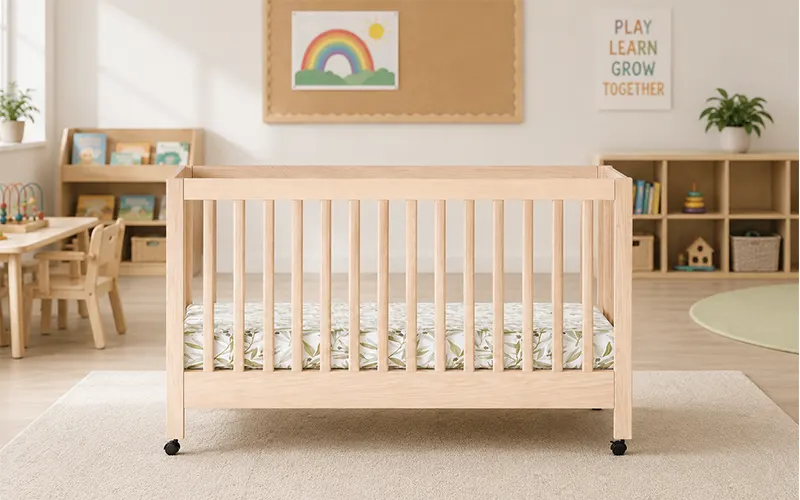
A full-size crib may not be the best choice in the following situations:
- Your sleeping area is cramped, leaving insufficient space for caregiving and movement once the beds are in place.
- The infant classroom must double as an activity area during the day, yet fixed, full-sized cribs cannot be easily moved aside.
- Your center is located in an older building with narrow doorways and corridors, making it impossible to maneuver full-sized cribs through them.
- Your enrollment fluctuates significantly by season, meaning fixed, full-sized cribs sit idle during off-peak periods.
- You need to temporarily transfer cribs from one classroom to another—but full-sized cribs are not designed for frequent relocation.
Non-Full-Size or Compact Crib
Non-full-size or compact cribs are better suited for childcare centers with limited space, provided they are paired with a mattress of the correct dimensions. This type of crib is recommended when classroom space is limited and maximizing space utilization is essential, yet there is also a need to move cribs flexibly between rooms; it offers great convenience by allowing for flexible adjustments to the number of children and sleep schedules as needed.
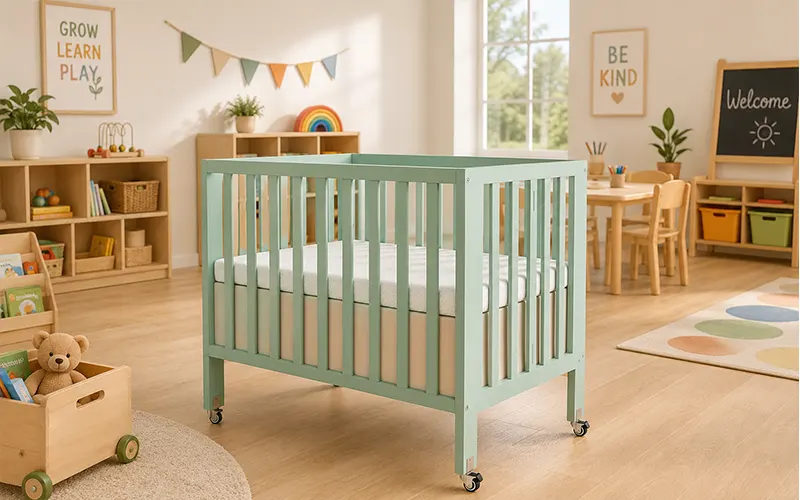
In the following situations, a non-full-size or compact crib may not be the best choice:
- You have ample space in your sleeping area and the cribs will remain in fixed locations—full-size cribs offer greater stability in this scenario, and standard-sized mattresses are easier to source.
- You plan to purchase in bulk and want to ensure the same mattress model remains available for future restocking—compact cribs have fewer suppliers and models, carrying a higher risk of the product being discontinued later.
- Your center cares for infants across a wide age range, requiring the same crib to serve a child from the newborn stage through to toddlerhood—compact cribs suffice for younger infants but quickly become unsafe once a child can stand, as they may climb or fall out.
- Local licensing authorities impose additional safety review requirements for non-full-size cribs—be sure to verify whether this type of crib is accepted in your area before purchasing.
Evacuation Crib
An evacuation crib is suitable for your childcare center if it is located in a multi-story building where the infant classroom is not on the ground floor; if evacuating multiple infants via stairs during a fire or earthquake is unfeasible; if the distance from the infant sleeping area to the nearest safe exit is significant; or if carrying infants individually is too inefficient. You should use an evacuation crib if you wish to have a dedicated piece of emergency equipment—distinct from standard cribs—that eliminates the need for time-consuming assembly or disassembly during an emergency.
When choosing an evacuation crib, focus on checking these points: whether the casters are lockable and can be unlocked quickly; whether it is easy to control the direction when pushing; whether the crib can pass smoothly through doors and corridors in your facility; whether the weight-bearing capacity meets emergency evacuation requirements; and whether the crib has a clear “Evacuation Only” label. Please remember—not all wheeled cribs are compliant evacuation cribs. Ultimately, you must verify each item against local fire regulations and product documentation; do not judge solely by appearance.
Do not assume a product is a compliant evacuation bed simply because it has wheels; you must still verify local regulations and product documentation.
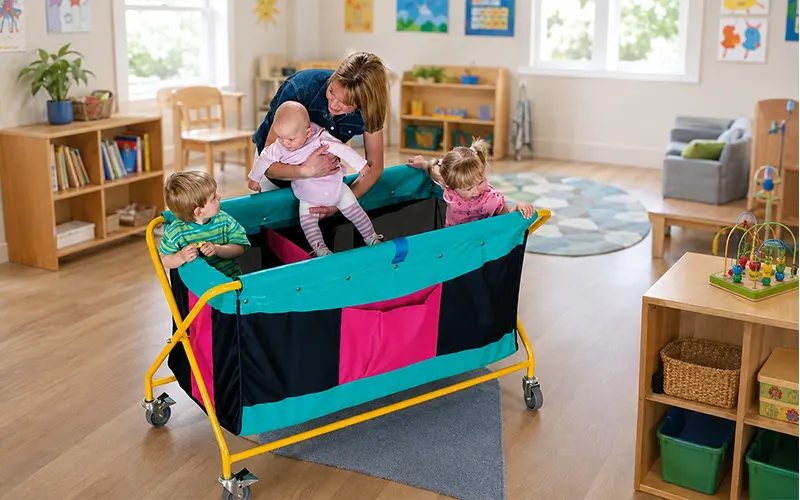
A dedicated evacuation crib may not be required in the following situations:
- The infant room is located on the ground floor with direct access to a safe outdoor area.
- Local regulations do not explicitly mandate this, and your sleeping area layout already complies with fire evacuation standards.
- In a home-based childcare setting with a small number of infants, evacuation can be accomplished simply by carrying them out.
Foldable and Stackable Cribs
You may face situations where the sleeping area must double as an activity room during the day—making fixed cribs an issue by occupying space that cannot be freed up—or where enrollment fluctuates seasonally, meaning not all beds are needed year-round. In such cases, you need spare beds to accommodate temporary admissions without having them permanently take up floor space.
If a childcare center needs to convert its sleeping area into an activity room during the day, or if enrollment fluctuates seasonally, a foldable/stackable crib is a flexible option. When purchasing, pay attention to the following: the locking mechanism should be sturdy and reliable when unfolded; check for stability after repeated folding and whether the hinges are loose; check for any risk of pinching fingers at the folding points; it should not easily tip over when stored; the crib frame may deform after repeated opening and closing, so regularly check whether the gap between the mattress and the frame exceeds 2cm.
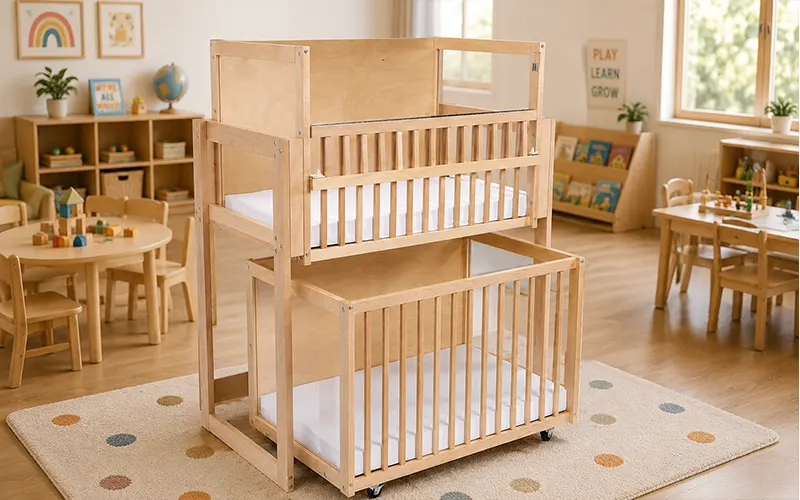
You might not need a foldable and stackable crib in the following situations:
- There is a dedicated, permanent sleeping room—the folding feature introduces points of failure without offering any real spatial benefit.
- Frequent folding and unfolding—multiple times a day—accelerates wear on the locking mechanism.
- Staff might skip checking the latches during peak periods; the safety of the folding bed relies entirely on the operator verifying every locking point.
Please Check for Safety Compliance Before Comparing Prices.
Safety compliance is an important part of understanding how to choose cribs for your childcare center, especially when comparing products from different suppliers.Request the correct safety documents.
Confirm with the supplier:
- Third-party testing reports — must be issued by accredited organizations such as CNAS, and the product model and manufacturer on the report must be consistent with the batch you purchased. Pay attention to the validity period of the report.
- Product and report consistency — Don’t just look at the brand; verify that the actual product matches the specific model and image in the report to avoid using a different model in the report.
- Production batch and label information — Different batches of the same model may have differences. When receiving the goods, check the batch number and production date on the product label of each unit to see if they are consistent with the documents provided by the supplier.
- Assembly and Usage Instructions — Clearly illustrated assembly steps and a safety checklist after assembly (such as shaking test, fence locking test) are required. It is recommended to keep a copy for future training reference.
- Recommended mattress size — The supplier must provide precise length, width, and thickness measurements (in mm). The mattress must be matched strictly according to these dimensions, and the gap must not exceed 2cm, otherwise there is a risk of suffocation if the mattress gets stuck.
- Warning labels and traceability information — Each bed should have a unique serial number or traceability code. The label content must include safety warnings, implementation standard number, and manufacturer information. The text must be clear and not easily rubbed off. Take a photo for record upon receipt.
Childcare regulations vary across countries and regions; therefore, requirements from local licensing authorities should be verified prior to purchase.
Check the structure of the crib.
Crib Safety Inspection Checklist:
- Fixed Rails Only: No drop-sides permitted .
- Slat Spacing: Must not exceed 2⅜ inches to prevent entrapment.
- Hardware Check: No missing, loose, or broken fasteners/bolts.
- Smooth Finish: No splintering wood or sharp metal protrusions.
- Stable Base: Casters must lock securely in a fixed position.
It is recommended that the spacing between bed slats be no more than 2⅜ inches, and there must be no missing or cracked slats.
Choose a firm mattress of the right size; the mattress should:
- Choose a firm mattress of the right size; your safety checklist should include:
- Firm Support: A flat surface ensures proper spinal alignment and support for infants.
- Precise Fit: Fits snugly against the bed frame to eliminate dangerous entrapment gaps.
- OEM Dimensions: Uses exact manufacturer-specified measurements for full safety compliance.
- Sanitization-Ready: Features a water-resistant, non-porous surface for easy daily cleaning.
- Safe Bedding: Must be paired with a tight, custom-fitted sheet to prevent loose fabric risks.
A replacement mattress of the wrong size can create entrapment gaps; a non-original mattress that does not fit properly may pose risks of entrapment and suffocation.
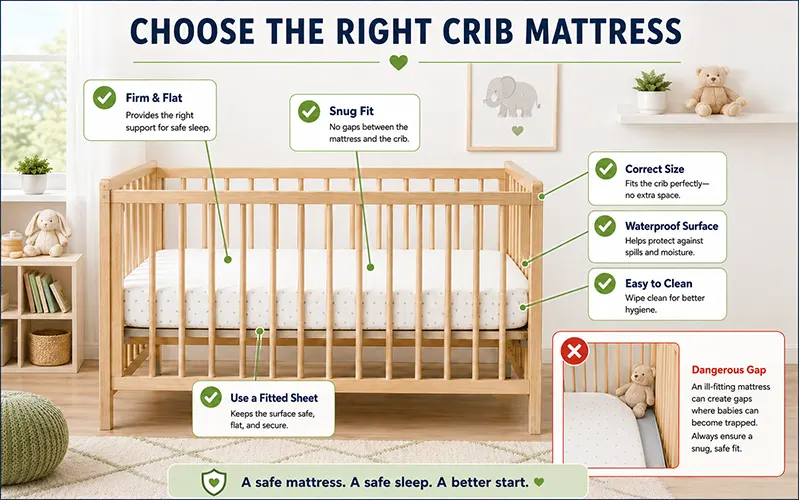
Keep the sleeping area tidy.
Regarding the infant’s sleep environment, it is recommended that the center keep the crib clean.
- No pillows
- No loose blankets
- No stuffed toys
- No crib bumpers
- Use a firm mattress and a fitted sheet
It is recommended that you use a firm mattress and a fitted sheet, and avoid placing soft bedding or toys in the bed.
Evaluate daily operations and maintenance.
Another important part of how to choose cribs for your childcare center is considering how they perform during everyday care, cleaning, moving, and inspection.Can Staff Members Easily Access the Children?
The height of the crib should allow teachers to safely lift and lower the infant, reducing the strain caused by repeated bending.
Standardize on cribs with a 26-inch rail height and 3-level mattress adjustment to eliminate staff back strain. This ergonomic setup allows teachers to safely lift infants 30+ times daily without excessive bending—use the highest setting for newborns and the lowest once they can pull up. To optimize operations, arrange cribs in a U-shape or staggered layout around your central care zone. This ensures 100% visibility for supervision while minimizing staff steps during transitions.

Is It Easy to Move and Lock?
For cribs with casters, check the following:
- Features a reliable locking mechanism
- Does not move on its own once locked
- Casters do not jam easily
- Remains stable on uneven floors
- Does not wobble noticeably when moving
How to Clean
Recommended choice:
- Structure with smooth surfaces and minimal seams
- Wipeable or waterproof surfaces
- Bed corners designed to prevent dirt accumulation
- Mattress that is easy to remove and clean
- Coating resistant to frequent disinfection
- Materials resistant to moisture and odor absorption
For wooden cribs, the finish and edge sealing require close inspection; for metal cribs, it is necessary to check the weld points, screws, and rust-proofing.
Periodic inspection process
Crib safety is an ongoing risk management process, not a one-time purchase check. train your staff to perform a quick visual sweep every morning and a detailed physical inspection monthly.
Inspect each slat for hairline cracks; in a high-traffic center, wood fatigue is a real structural risk. Test the locking mechanism of every caster to ensure the crib remains immobile, and perform the “two-finger gap test” between the mattress and frame to prevent entrapment. By documenting these checks in a signed facility log, you are building a verifiable culture of safety that parents and inspectors will trust.
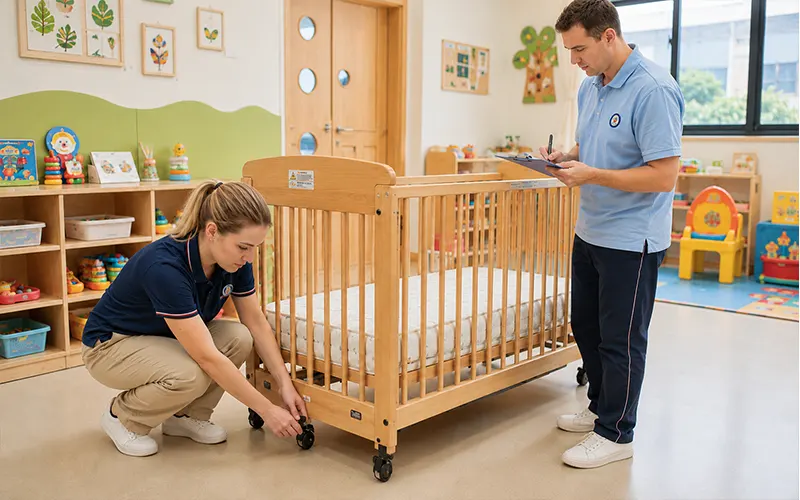
Compare long-term costs, not just the purchase price.
Durability-for-Commercial-Use
Be sure to select a frame that remains stable under lateral force and features a chemically resistant surface coating. In a high-traffic childcare center, equipment endures ten times the wear and tear found in a home environment.
The frame must not only support the weight of children and withstand vigorous play but also resist the constant lateral pressure exerted when teachers lean against the rails or toddlers shake the enclosure.
The quality of the surface coating is equally critical; it must be durable enough to withstand hundreds of cleanings with 70% alcohol or bleach solutions without softening or peeling.
Once the coating is compromised, the wood develops micropores that harbor bacteria and absorb odors. This not only negates any initial savings from purchasing a cheaper crib but also creates serious hygiene risks and necessitates a replacement purchase the following year, resulting in double the expense.
Replacement Parts and After-Sales Support
Buying a crib for your center is a long-term investment, not a one-time transaction. In a high-traffic commercial environment, small components like casters and connectors take a beating. You need to ensure your supplier stocks these as individual replacement parts; otherwise, a single broken wheel could force you to decommission a $400 piece of furniture.
Beyond hardware, you must prioritize model longevity. Ask your supplier how long they intend to keep a specific model in production. Nothing is more frustrating—or looks more unprofessional to prospective parents—than having a mismatched sleep room because your original model was discontinued when you were ready to expand. By choosing a manufacturer that guarantees batch consistency and part availability, you aren’t just buying beds—you’re protecting your facility’s Total Cost of Ownership and ensuring your equipment remains in service for its full expected lifespan.
A well-designed commercial crib may have a higher initial cost, but it entails lower expenses for maintenance, replacement, and staff handling over its service life. Choosing the right product means opting for a lower Total Cost of Ownership .
FAQ
What Type Of Crib Is Best Suited For a Childcare Center?
Full-sized wooden cribs are the most common choice. They offer exceptional structural stability for daily use and utilize standardized mattress sizes, which significantly reduces long-term maintenance and replacement costs.
What Ss The Difference Between a Standard-Size Crib and a Non-Standard-Size Crib?
Standard full-size cribs have internal dimensions of approximately 28 by 52⅜ inches, whereas non-standard cribs are smaller. The most critical practical difference is that it is difficult to find properly sized replacement mattresses for non-standard cribs, and a mismatched mattress poses a serious risk of entrapment.
Do Cribs In Childcare Centers Need To Have Wheels?
Not unless your local fire code or childcare licensing authority explicitly requires them. Wheels add a mechanical failure point — locks must be checked daily. If your center is single-story with ground-floor exits directly from the infant room, fixed-leg cribs are simpler and safer. Only add wheels when regulations demand them.
What Kind Of Mattresses Should Be Used For Cribs In Childcare Centers?
Firm, waterproof, and the exact dimensions specified by the crib manufacturer. A two-finger gap between mattress and frame is enough to trap a child. Use tight-fitting sheets only — no mattress pads, no additional layers. Replace any mattress that sags, tears, or loses its shape. In a commercial setting, budget for mattress replacement every 2-3 years.
Can Commercial Cribs Be Repurposed Once They Are No Longer Suitable For The Infant?
Once a child is able to climb out of the crib, it is no longer safe. You can pass it on for use by a younger baby—but only if the crib’s structure remains sturdy. Never modify it into a storage unit, playpen, or makeshift changing table.
Which Is More Suitable For a Childcare Center: a Wooden Crib Or a Metal Crib?
Wooden cribs evoke a sense of warmth, tranquility, and natural beauty, making them easier to integrate into Montessori, Reggio, or other thoughtfully designed childcare environments. Their structure is relatively stable, often giving them the feel of permanent classroom fixtures.
Metal cribs, on the other hand, reflect the practical style typical of commercial facilities. With smooth surfaces that are easy to wipe down and resistant to frequent cleaning and disinfection, they are well-suited for high-traffic infant care rooms. However, visually they can appear somewhat cold, and they tend to generate noise when bumped or moved.
Conclusion
Understanding how to choose cribs for your childcare center means balancing safety, durability, daily usability, and long-term value.At West Shore Groups, we design commercial-grade cribs for the everyday demands of childcare centers, with a focus on reliable construction, easy maintenance, and practical use. Choosing durable, well-designed cribs can help create a safer, more professional environment while reducing future replacement and maintenance costs.